Issued by the Catholic Center for Studies and Media - Jordan. Editor-in-chief Fr. Rif'at Bader - موقع أبونا abouna.org

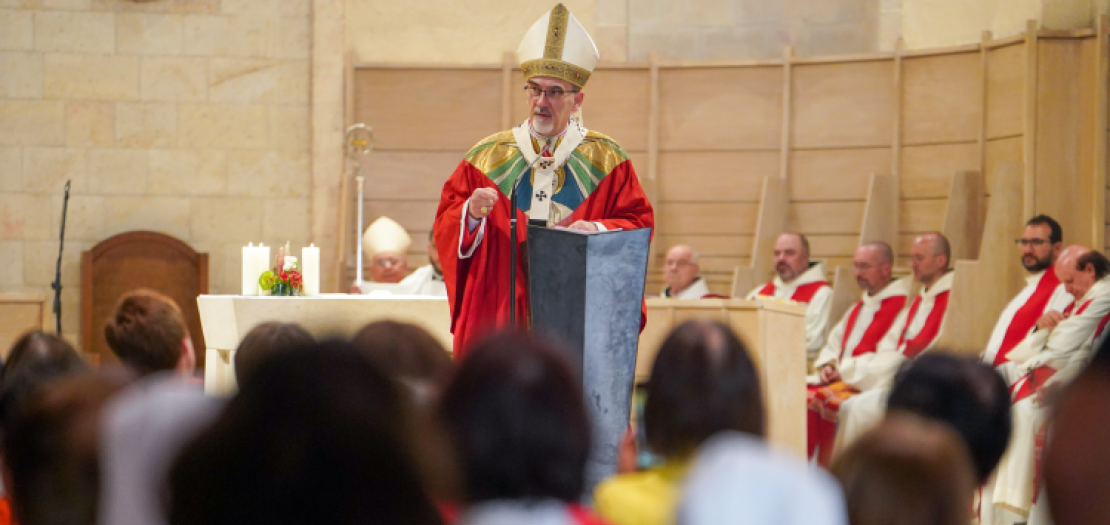
Following is the text of the homily solemnity of Pentecost by His Beatitude Cardinal Pierbattista Pizzaballa, Latin Patriarch of Jerusalem, dated May 24, 2026:
Dear brothers and sisters,
Dear Father Nikodemus,
The Lord give you peace!
The Gospel for this Pentecost takes us back to the evening of Easter. This is not a minor detail: to understand what takes place today, we must return there, to that Upper Toom, not far from here. John the Evangelist is the only evangelist to put the outpouring of the Spirit on the same day of the Resurrection — not to create confusion, but to reveal something essential: Easter and Pentecost are not two separate feasts. Each is the breath of the other. Easter contains the seed of Pentecost, because the Risen Christ cannot keep His new life for Himself; and Pentecost is Easter becoming living flesh in the Church.
For this reason, if we want to understand who the Spirit is, we must not look towards the extraordinary phenomena, but at what really takes place in the Upper Room. The Church does not begin as a strong community, or heroes of faith. They are a group of people who are afraid, marked by failure and flight, unable even to hope. The doors are locked not only because of fear, but also behind those doors are hearts that are closed off and disappointed. They had seen their Master, Jesus, die, and they felt lost. They had heard that He has risen, yet fear was stronger than the news.
And it is precisely into this reality that Jesus enters. He doesn’t wait for them to get their act together. He doesn’t ask them to be in better condition. He does not say, “When you have more faith, I will return.” He enters the situation as it is: marked by fear, closure, and failure. He stands among them — His usual place, the place where he wants to be — and says: “Peace be with you.” (John 20:21) It is not simply a greeting. It is the revelation of who He is. The peace He gives is His very own life: a life that is fearless, that passes through closed doors, that restores what has been broken.
Then He performs a gesture that Luke in the Acts of the Apostles, will describe with wind and fire. While John sums it up in a simpler gesture. Jesus “breathed on them and said: ‘Receive the Holy Spirit.’” (John 20:22) He breathed on them — as God did in the Garden of Eden, when He formed Man from the dust and breathed the breath of life into his nostrils. That breath turned clay into a living being. Here, in the Upper Room, Jesus is also making a new creation. He does not create out of nothing; He takes the fragility and fearfulness of the disciples and creates out of it. He breathes on them and transforms them — not into superhumans, but into people through whom the life of God flows.
This is why that gesture is so important. The Holy Spirit is not an inspiration, He is not a moment of enthusiasm, He is not a force that comes and goes. He is the very breath of the Risen Christ entering the lungs of the Church. Breath cannot be seen, yet without it there is no life. A person may possess all the strength in the world, but without breath, life comes to an end. Likewise, with the Church: she may have structures, projects, and strategies, but if she lacks the breath of the Spirit, she is only a body without life. And Jesus gives that breath right there, to scared individuals. He does not wait for them to become perfect. He takes them as they are and breathes on them.
It is the very life of the Risen One passing into their lives. Easter and Pentecost belong inseparably together: communicated life.
This place, Mount Zion, helps us not to lose our direction. Close to us there is a tangible memory: a room, a gathering of people, a story that began in fear. And even today, in Jerusalem, history continues to unfold amid a situation marked by tension, uncertainty, fear, and mistrust. The Spirit does not come to magically change external circumstances; rather He comes to generate new life within those very conditions. Just as He did back then.
The evangelist gives us three characteristics of this life, three criteria for recognizing where the Spirit is at work.
First of all, it is a reconciled life. “Whose sins you forgive…” (John 20:23) Sin here is not merely a moral stain: it is a realm of death, a place where relationships have been broken, where life no longer flows. Forgiveness is not simply a generous act; it is life returning back to where it has been suffocated. Here, in Jerusalem, the ruptures are not theoretical. They are historical, visible, and at times part of daily life. And the first concrete manifestation of the Spirit is often small: reopening space for relations, a word that does not fuel isolation. This is how the Spirit brings about reconciliation: by allowing life to begin anew right there, in those seemingly hopeless situations.
It is also a life sent forth. “As the Father has sent me, so I send you.” (John 20:21) The Spirit does not close in, retreat, or isolate. The Spirit opens, expands, and sets things in motion. The disciples are not just comforted; they are sent forth. Mission work is notan additional task added to an already busy life. A life that has been received, if it is real, tends to open up, to share itself, to enter into relationship. The Spirit does not ask us to do extraordinary things; He urges us to go through the door of our homes, our workplaces, our parishes, and to be where life asks to be lived — even amid the difficulties of our own circumstances.
Finally, it is a life that is inhabited. The Risen Lord does not remain outside. He enters, stands among us, and breathes on us. He is not an occasional help that appears from time to time. He is a lasting presence, like someone who comes to dwell within our humanity. This is not a matter of emotion. It is something deeper: Someone who dwells within, guiding, enlightening, and sustaining us from the inside. The Virgin Mary understood this: she did not restrict her Son, but made space for Him. And it is precisely there, in the space we make, that the Spirit comes to dwell. The Spirit asks only for a small space in which to abide.
Dear brothers and sisters,
the question we must ask ourselves today is this: where is the Spirit seeking to breathe new life? Not in a general sense, but in something specific.
It may be in a relationship that has grown cold. It may be an inner weariness that has become the norm. It may be fear — the kind that paralyzes you, that keeps you shut away. It could be despair, when meaning can no longer be found. It may be disappointment over wounded relationships. Or it may simply be the need to feel welcomed and accepted as you are.
The Spirit does not wait for all of this to be resolved. He enters precisely there, just as He entered the Upper Room. And right there He breathes. The only thing asked of us is not to create new life in our own strength, but to let it in. To make a small but real space for Him. It may seem little, yet it is exactly where the Gospel begin. For Pentecost does not transform people by making them strong; It makes them open to life passing through them. And this here and now, remains possible.
And so, as we ask that the fire of the Spirit continue to kindle our mission, we entrust our prayer and our journey to the Virgin Mary, living Temple of the Paraclete, confident that her maternal intercession will obtain for us the grace to be, like her, docile to the voice of the Bridegroom who comes. Through Christ, in the gift of the Holy Spirit.
Amen.