
Issued by the Catholic Center for Studies and Media - Jordan. Editor-in-chief Fr. Rif'at Bader - موقع أبونا abouna.org

The 40th anniversary in the spirit of Assisi
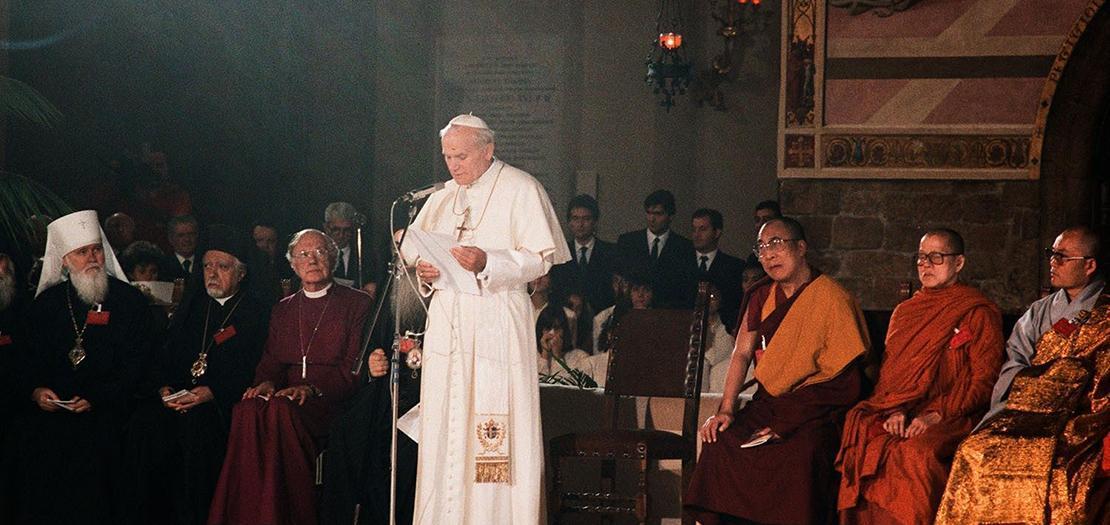
On 27 October 1986, Saint Pope John Paul II brought together religious leaders in the Italian city of Assisi, the birthplace of Saint Francis, to pray for peace. The gathering was not an attempt to unify religious doctrines, but rather a declaration stating that differences among religions do not prevent their followers from coming together in defence of human dignity and the sanctity of life.
The strength of the initiative lay in its simplicity as the participants neither gathered to eliminate the differences between their beliefs nor did they perform a single shared religious ritual, as everyone prayed according to one’s own faith and came together in silence that respected the conscience of the other. This is how the “Spirit of Assisi” was born, not being as a theological compromise, but rather as a shared human commitment.
On 24 January 2002, the same Pope returned to Assisi, reiterating his call for prayer amid mounting global tensions, in the hope of sparing humanity new wars. Yet March 2003 brought the war in Iraq, which was a painful discrepancy between calls for peace and decisions to wage war. Then Pope Benedict XVI continued this journey in 2011 on the 25th anniversary of the gathering, which was followed by Pope Francis in 2016, on its 30th anniversary while affirming that dialogue is not a luxury, but a moral duty.
Today, the 40th anniversary of the Assisi gathering is approaching, which coincides with the 800th anniversary of the death of Saint Francis--the man who made fraternity and peace a way of life, while Pope Leo XIV has announced his intention to take part in commemorating the occasion. We offer our prayers to Almighty God for his recovery from the health setback he has suffered from, hoping that it will not hinder his mission or his anticipated visits, either in Italy or abroad. Among the destinations proposed for his visits are Uruguay, Argentina and Peru, the country where he served as a missionary and bishop, in addition to having previously served as prior general of the Order of Saint Augustine.
Assisi also holds a special place in Jordanian memory. In 2019, His Majesty King Abdullah II received the “Lamp of Peace” in recognition of his efforts to promote interfaith dialogue and strengthen common living. This honor goes hand-in-hand with Jordan’s mission to protect Muslim and Christian holy sites in Jerusalem, and to defend a culture of mutual respect.
After four decades, has the world become more peaceful? Humanity has made technological advances, but it has not progressed morally at the same rate. Wars continue to uproot people from their homes, while some voices exploit religion to inflame disputes rather than heal wounds. In our Holy Land in particular, silencing the guns is not enough for peace without justice, without protected rights and respected dignity remains a fragile
Our region needs this lesson more than ever today for Christians and Muslims in the East are not guests in one another’s lands; they are rather partners in a shared history and future. When holy sites become sources of conflict, religious leaders bear an even greater responsibility to protect the sanctity of these places by obviating hate speech and advocating for human rights without allowing religion to be exploited for political purposes.
Thus, the “Spirit of Assisi” is not merely a commemorative photograph of leaders praying together, but rather an ongoing test of the sincerity of their mission. Can prayer turn into commitment, dialogue turn into partnership, and faith turn into service to humanity?
Forty years ago, a prayer was offered for peace from Assisi. Today, heaven still listens, but the earth is waiting. Peace is a blessing we ask of God, and a responsibility we must strive to fulfil.