
Issued by the Catholic Center for Studies and Media - Jordan. Editor-in-chief Fr. Rif'at Bader - موقع أبونا abouna.org

From the Castle Mountain (Jabal Al-Qal'a): Art and language highlight human values
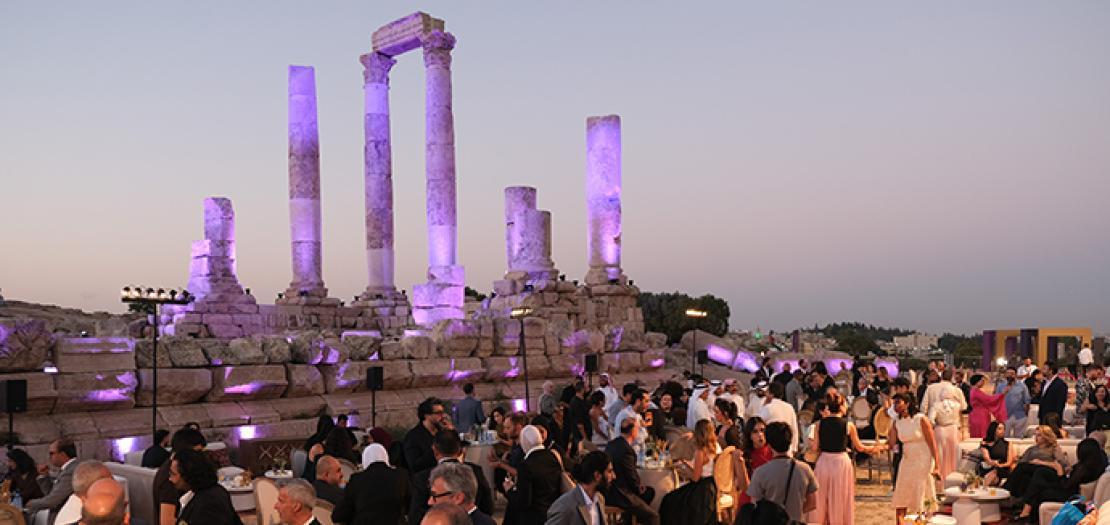
This week, I accepted an official invitation to attend the closing ceremony of the 7th edition of the Amman International Film Festival, held at the remarkable site of the Castle Mountain (Jabal al-Qal'a) which is one of the most prominent archaeological and historical landmarks in Jordan's capital, Amman. Anyone who visits this mountain realizes that Amman is not merely a city that has passed through history, but rather a city where civilizations meet, religions converge, and every stone tells the story of a nation deeply rooted in time while confidently looking toward the future.
Before the ceremony started, I paused at the Byzantine Church dating back to the 5th century which is one of the oldest churches in Amman. Then, I walked past the Umayyad Mosque, which dates to the 8th century. In the short distance between the church and the mosque lies the true message of Jordan, namely a message of common living, respect for diversity, and building the future upon a rich civilizational and human heritage.
At the top of this historic mountain, the closing ceremony was held which was the first I have attended. I found it to be impeccably organized, warmly welcoming, and professionally executed, which reflects the distinguished position the festival attains both regionally and internationally. The event was honored by the presence of His Royal Highness Prince Ali Ibn Al Hussein, Chairman of the Board of Commissioners of the Royal Film Commission in Jordan, and Her Royal Highness Princess Rym Ali, the festival's president, alongside their children Prince Abdullah and Princess Jalila. It was impressive that the addresses were brief and allowed art and cinema to speak for themselves.
This year's festival chose the theme "Beyond the Frame," a title rich with meaning. The film is not confined to what appears within the frame, but rather invites for reflecting on what lies beyond the image—the human being’s story and values, and message. This is exactly what our world needs today, namely to look beyond events and discover in art a space for dialogue, mutual understanding, and the expression of our shared human values.
The outcome of this festival is not confined to marking films and filmmakers. It rather calls for reflecting on the future of cinema and art in Jordan. This year's film coincided with the 40th Jerash Festival for Culture and Arts which underlines the growing maturity of Jordan's cultural movement and underlines that investment in culture and arts has become an integral part of our national vision in “the legacy that endures and generations that Meet," as this year's Jerash Festival slogan proclaims.
This is where the importance of what is increasingly being referred to as the Jordanian narrative. It is not simply about retelling historical events or documenting events but rather about presenting Jordan to the world as it truly is, namely a nation with an ancient civilization, a vibrant present filled with achievements under its wise Hashemite leadership, and looks for a future that is brighter and more open. Art, especially cinema, is one of the most powerful languages capable of conveying this narrative to peoples beyond the limitations of traditional speeches.
A special praise is due to Her Royal Highness Princess Rym Ali for her outstanding contributions, both in supporting media through the Jordan Media Institute and in her patronage of the Amman Film Festival, in cooperation with the Royal Film Commission. These efforts are worthy appreciation because they contribute to building people, enhancing Jordan's image as a center of creativity, a bridge for dialogue, and a civilizational message that extends from Amman to the world… beyond the frame.
Holding the festival's closing ceremony at Jabal Al-Qal'a also serves as an invitation to bolster Jordan's historic and religious tourism to our holy land.