
Issued by the Catholic Center for Studies and Media - Jordan. Editor-in-chief Fr. Rif'at Bader - موقع أبونا abouna.org

A spiritual reflection--Woman in the Bible: A gateway of transformation in the history of salvation
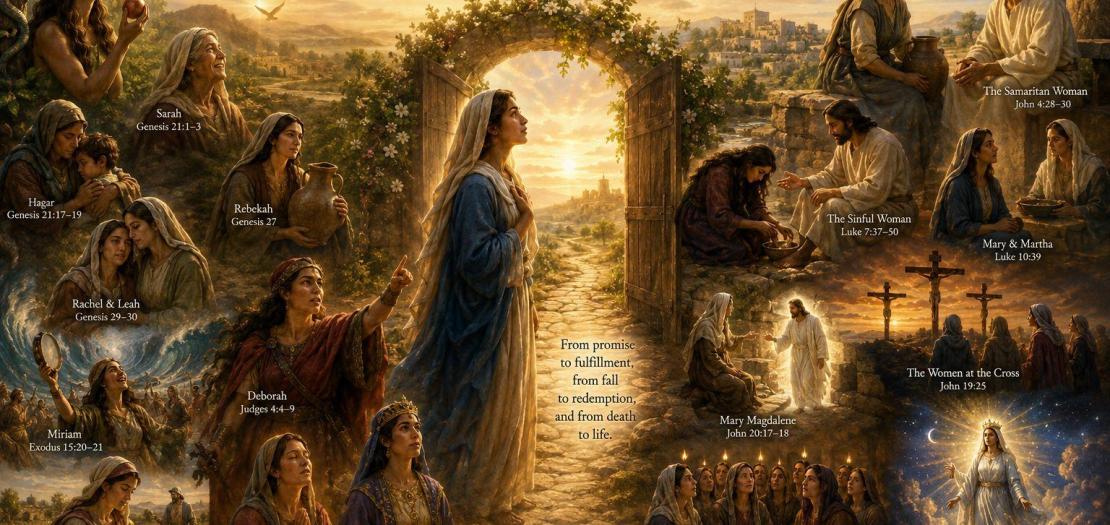
The contemplative reader of the Holy Gospel notices how the Lord Jesus Christ dealt with women with love, respect, and dignity, restoring to them their human and spiritual honor, and making them witnesses of faith and messengers of hope. Through this Gospel perspective, the reader discovers that woman was not a marginal figure in the history of salvation, but rather, at many of its decisive moments, an instrument chosen by God to mark the beginning of a new phase in His salvific plan. Whenever God intended to open a new page in His relationship with humanity, we find a woman standing at the beginning of the path, carrying in her heart the pain of humanity and in her faith the seeds of hope. Through her obedience and trust in God, she becomes a bridge through which His promises pass—from promise to fulfillment, from fall to redemption, and from death to life.
From the very first page of the Holy Scripture, God created the human being “male and female” in His image (Genesis 1:27), in a clear declaration that the image of God is not complete without communion, and that both man and woman equally carry the divine calling. Yet the first transformation in human history was associated with a woman, when sin entered the world through the disobedience of Eve (Genesis 3:6). However, what is striking is that at that very moment, God announced the first proclamation of salvation, linking the promise also to a woman: “He shall crush your head.” (Genesis 3:15) It is as though God declared from the beginning that the woman who witnessed the fall would also become a gateway to salvation.
Then comes Sarah, the woman beyond childbearing age, who becomes the womb of the divine promise, giving birth to Isaac as the fulfillment of God’s covenant with Abraham. (Genesis 21:1–3) What was naturally impossible became possible by grace, and an elderly woman became the beginning of an entire nation, affirming that the divine plan of salvation is not governed by the laws of the flesh but by the authority of the promise.
In the wilderness, Hagar, the rejected servant, weeps with her son Ishmael, and God hears the voice of the boy and sees the tears of the mother. (Genesis 21:17–19) Here, woman appears as an object of divine care even on the margins, because divine mercy does not distinguish between the son of the maidservant and the son of the free woman.
Rebekah then appears, shaping amid historical complexities the transfer of blessing to Jacob. (Genesis 27) Rachel and Leah become the mothers of the tribes from which God’s chosen people emerge. (Genesis 29–30) God does not make history in palaces, but in homes filled with exhaustion, waiting, and tears.
When the people come out of Egypt, Moses is not alone in the scene; Miriam the prophetess rises with timbrels, leading the first communal song of praise after the crossing, (Exodus 15:20–21) as if the first response to salvation was the voice of a woman praising God.
Then Deborah appears, a woman who combined prophecy, judgment, and leadership, (Judges 4:4–9) leading an entire people to victory at a time when men hesitated to confront the enemy. God thereby reveals that spiritual strength is not measured by gender but by faith.
Ruth the Moabite follows—an outsider and a poor woman—yet she becomes part of the genealogy of Christ Himself. (Ruth 4:13–17) This is a major turning point, where the foreigner becomes the grandmother of King David, affirming that the plan of salvation is universal and that faith transcends race and geography.
In Hannah, the mother of Samuel, we see weeping transformed into prayer, and prayer transformed into a prophet who leads Israel. (1 Samuel 1:10–20) From the womb of a broken woman emerges one of the greatest prophets of the Old Testament.
Esther then stands in the Persian palace, risking her life for her people, saying: “If I perish, I perish.” (Esther 4:16) One woman becomes a bridge of salvation for an entire nation, as faith overcomes fear.
But the greatest turning point in the entire history of humanity comes with a simple girl from Nazareth named Mary. When the angel said to her, “Hail, O favored one,” (Luke 1:28) he was not addressing a woman alone, but announcing the beginning of a new creation. When she responded, “Behold, I am the servant of the Lord; let it be to me according to your word,” (Luke 1:38) history opened to the Incarnation, and God became man. Here lies the greatest paradox of Scripture: Eve said “no” and humanity fell; Mary said “yes” and the Savior entered the world. Between these two words, the entire history of salvation unfolds.
The presence of women in the ministry of Christ was no less profound. The Samaritan woman (John 4:28–30) was transformed from an outcast into the first missionary in Samaria. The sinful woman who washed His feet with her tears (Luke 7:37–50) was transformed from a symbol of sin into an icon of repentance. Mary, the sister of Martha, sat at the feet of Jesus as a disciple receiving teaching, (Luke 10:39) breaking many cultural and religious barriers.
At the cross, while many fled, the women remained standing. (John 19:25) And at the Resurrection, Christ did not first appear to authorities, priests, or assembled disciples, but to Mary Magdalene, sending her to proclaim the Resurrection. (John 20:17–18) It is as though history, which began with a woman at the tree of knowledge, begins anew with a woman at the empty tomb.
In the early Church, women were present with the apostles in the upper room, persevering in prayer, (Acts 1:14) participating in the birth of the Church. And in the Book of Revelation, the image reaches its climax in the woman clothed with the sun, (Revelation 12:1) a symbol of the Church, grace, and victory, who gives birth amid labor yet remains preserved by God’s care.
Reflecting on the journey of woman in the Bible reveals that God did not place her on the margins of history but at the heart of the plan of salvation. At nearly every transitional moment, we find a woman carrying the promise, guarding it, witnessing it, or proclaiming it. From Eve to Mary, from Sarah to Mary Magdalene, from Deborah to Esther, and from Ruth to the woman clothed with the sun, the same message is repeated: whenever God prepares to begin a new chapter in salvation history, He often chooses the faithful heart of a woman as the gateway to that new stage.
This is perhaps the secret behind how Christ honored women throughout His life—by speaking with them, healing them, defending them, accepting their testimony, and entrusting them with the proclamation of the Resurrection. He did not merely change society’s view of women; He revealed the original divine intention from the beginning of creation: that woman is not a follower in the journey of salvation, but a partner in its making, a bearer of hope, a vessel of grace, and a continual sign that God accomplishes His greatest works through the humble heart that responds to His will.