
Issued by the Catholic Center for Studies and Media - Jordan. Editor-in-chief Fr. Rif'at Bader - موقع أبونا abouna.org

The Theology of Brokenness: How are the voices of the humble immortalized and their words become living liturgy?
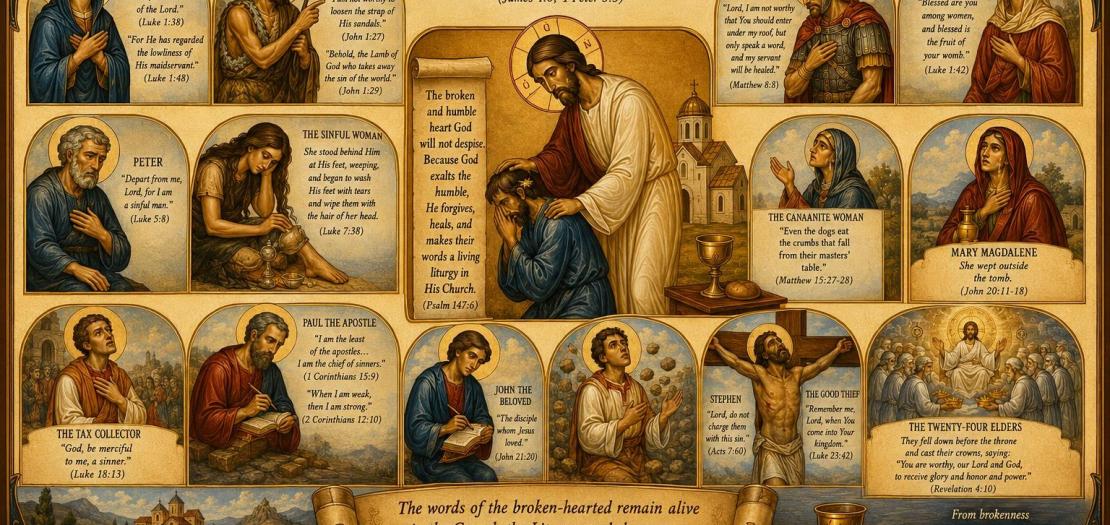
Many times, during the Divine Liturgy and liturgical prayers, I have found myself pausing before short phrases that we constantly repeat—phrases we may have become so accustomed to hearing that they pass by without reflection on their depth. Yet a question kept echoing within me: Why did the Church choose precisely these words to live for thousands of years within her prayers? And why did certain phrases spoken in fleeting moments by simple people remain alive in the conscience of believers more than the words of kings, philosophers, and great figures?
How did a sentence spoken by a Roman centurion—“Lord, I am not worthy that You should enter under my roof”—or the cry of John the Baptist—“Behold! The Lamb of God who takes away the sin of the world”—or Elizabeth’s words—“Blessed are you among women”—become liturgical texts and daily prayers repeated throughout the centuries in the Church? Was this merely a historical preservation of Gospel events, or was there a deeper spiritual mystery the Church desired to preserve for generations?
From here, this reflection began.
The more I reread the Gospel, the Acts of the Apostles, and the Epistles, the more I discovered that most of the words immortalized by the Church did not come from the mouths of the powerful, the proud, or the self-confident. Rather, they emerged from hearts broken before God. It is as though the Holy Spirit desired to leave humanity with a unique spiritual memory that preserves the words of those who knew their true standing before God, not those who glorified themselves.
What deeply drew me was this spiritual thread extending throughout the entire Holy Scripture: God exalts the humble and makes their words a living proclamation, while the voices of the proud fade away no matter how great they seemed in their own time. Remarkably, many of the figures immortalized in the liturgy were not seeking glory at all. Most confessed their unworthiness, wept, were broken, or stood afar off, not daring even to lift their eyes toward heaven. Yet the Church preserved not the speeches of kings nor the declarations of the mighty, but the sighs of the brokenhearted, because she recognized in them the echo of divine truth.
Thus, was born this reflection: an attempt to explore the “Theology of Brokenness” as it appears in the Gospel and liturgy, and to understand the mystery that transformed certain short phrases into living universal prayers repeated every day upon the lips of millions. Perhaps the matter was not simply linguistic beauty or eloquence of expression, but rather because these words came forth from hearts that truly encountered God. Therefore, the Holy Spirit carried them from the boundaries of a historical moment into the ongoing life of the Church throughout the ages.
From the very first pages of Scripture, God reveals a constant spiritual law governing humanity’s relationship with Him: “God resists the proud, but gives grace to the humble” (James 4:6; 1 Peter 5:5). This is not merely a passing moral teaching, but a divine pattern extending throughout all history, from the fall of Adam until today.
Pride lay at the core of the first fall. Adam and Eve did not fall merely because of the desire for food, but because of the temptation of self-exaltation and independence from God: “You will be like God” (Genesis 3:5). From that moment, pride became humanity’s deepest wound, while humility became the path of return into God’s presence.
Throughout the Old Testament, the same pattern appears repeatedly in astonishing ways. Cain’s heart was lifted up, leading to envy and murder, while Abel’s humble sacrifice was accepted. The Tower of Babel was an attempt to create earthly glory independent of God, and it ended in confusion and division. Abraham, however, when he obediently departed without knowing where he was going, became the father of believers.
Pharaoh, who arrogantly declared, “Who is the Lord, that I should obey His voice?” ended broken before the sea, while Moses—whom Scripture describes as “very meek, more than all people on the face of the earth”—became the leader of the Exodus and the friend of God.
Goliath the giant fell, while David the humble shepherd was exalted. Nebuchadnezzar, who gloried in his greatness, was humbled until he confessed that “the Most High rules in the kingdom of men” (Daniel 4:32). In contrast, Hannah, broken in prayer, sang: “The Lord raises the poor from the dust… to make them sit with princes” (1 Samuel 2:8).
Then the New Testament reveals the fullness of this proclamation—not merely in teaching, but in the very person of Christ Himself. The Son of God did not enter the world in royal palaces, but was born in a manger, lived simply, washed the feet of His disciples, and “emptied Himself” (Philippians 2:7). Thus, humility became not merely a virtue, but a revelation of the very heart of God.
From here we understand why the words of the brokenhearted were immortalized in the Gospel and the Church’s liturgy. Through the centuries, the Church preserved not the words of the powerful and proud, but the prayers of the broken who recognized their truth before God.
This path begins with the Roman centurion (Matthew 8:5–13; Luke 7:1–10), a man of authority and stature, who stood before Christ saying: “Lord, I am not worthy that You should enter under my roof, but only speak a word, and my servant shall be healed.”
Remarkably, this commander—accustomed to giving orders—recognized that Christ’s authority surpassed every human authority. He understood that one word from the Lord was sufficient for healing and salvation. Therefore, the Church did not leave his statement confined within the Gospel story, but brought it into the heart of the liturgy, so that before Communion the believer confesses his unworthiness for Christ to enter the “house of his heart,” while trusting in the power of the divine word.
Then appears John the Baptist (John 1:27–29; Matthew 3:11), the great prophet who shook all Judea with his voice yet declared: “I am not worthy to lose the strap of His sandal.” The closer John came to Christ, the smaller he became in his own eyes. This is the true secret of holiness: those who are near God do not feel greatness, but brokenness. From the depth of this humility came the greatest proclamation: “Behold! The Lamb of God who takes away the sin of the world.” It is as though humility opened his eyes to see what others could not. Therefore, these words became the heart of the Eucharistic liturgy in the Church.
Then we move to Elizabeth (Luke 1:41–45), the woman who knew the bitterness of barrenness and years of waiting. Yet when she was filled with the Holy Spirit, she cried out before the Virgin: “Blessed are you among women, and blessed is the fruit of your womb.” Elizabeth did not look at herself nor her suffering, but rejoiced in God’s work in another. Here appears another face of humility: the humble person does not envy the grace of others, but rejoices in it. Thus, her words entered into the prayer of “Hail Mary,” becoming a daily blessing within the Church.
As for the Virgin Mary, in Luke 1:38,48 she represents the spiritual summit of humility, saying: “Behold the maidservant of the Lord,” and later proclaiming in her hymn: “For He has regarded the lowliness of His maidservant.” Astonishingly, the greatest calling in history—to bear the Incarnate Word—was linked to the deepest humility. The Virgin spoke not of her worthiness, but of God’s grace. Therefore, “all generations shall call her blessed,” and her words became part of the Church’s daily hymns, because God exalts those who do not exalt themselves.
Then comes the Apostle Peter in Luke 5:8, who after the miraculous catch of fish fell before Christ saying: “Depart from me, Lord, for I am a sinful man.” Suddenly he discovered that divine holiness exposes human weakness. Yet Christ did not move away from him, but came even closer and called him to become a “fisher of men.”
Here an important mystery is revealed: God does not reject the broken because of their weakness, but begins His true work within them when they acknowledge it.
Then we encounter the sinful woman (Luke 7:36–50), who entered the Pharisee’s house and stood weeping at Christ’s feet. She has no name in the Gospel, yet her tears became more famous than many names. She washed His feet with her tears and wiped them with her hair, offering complete repentance without many words.
Meanwhile, the Pharisee was filled with self-righteousness. Thus, the woman departed justified, while the Pharisee remained imprisoned within his pride. The Church preserved this woman’s tears because they reveal that the road to forgiveness begins with a broken heart.
Then appears the Canaanite woman (Matthew 15:21–28), who first encountered Christ’s silence and then a difficult test, yet clung to His mercy saying: “Even the dogs eat the crumbs that fall from their masters’ table.” This was not humiliation of dignity, but a declaration that God’s mercy is greater than human pride. Therefore, Christ said to her: “O woman, great is your faith!”
In John 20:11–18, Mary Magdalene appears weeping at the empty tomb. Her tears prevented her from recognizing the risen Christ, yet at the same time they testified to her deep love. Thus, she became the first to hear the voice of the risen Lord and the first sent to proclaim the Resurrection to the Apostles. The Resurrection was first revealed to a broken heart before it was revealed to doubting minds.
In the Book of Acts (Acts 7:54–60), Stephen stands beneath a shower of stones saying: “Lord, do not charge them with this sin.”
Even in death he did not cling to personal rights, but resembled the forgiving Christ upon the Cross.
The humble person does not live in continual self-defense, because he entrusts his cause to God.
Then we arrive at Saul of Tarsus (Acts 9; 1 Corinthians 15:9; 2 Corinthians 12:10), who was once confident in his knowledge and righteousness, yet his encounter with Christ cast him to the ground. From that day his language completely changed: “I am the least of the Apostles… I am the chief of sinners.” Then he reaches the summit of spiritual maturity by saying: “When I am weak, then I am strong.” He discovered that grace does not dwell in the self-sufficient person, but in the one who knows his complete need for God.
The Apostle John, meanwhile, often did not mention his own name in his Gospel, but described himself as “the disciple whom Jesus loved” (John 21:20). It is as though his identity no longer rested in his personal name, but in Christ’s love for him.
Then appears the tax collector (Luke 18:13), who did not dare lift his eyes toward heaven, but beat his breast saying: “God, be merciful to me, a sinner.” This short prayer became one of the greatest prayers of the Church because it comes from a heart that knows its truth before God.
In the final moments upon the Cross, the repentant thief says in Luke 23:42: “Remember me, Lord, when You come into Your kingdom.” He offered neither deeds nor justifications, but only brokenness and hope. The divine answer came immediately: “Today you will be with Me in Paradise.”
Finally, in the Book of Revelation (Revelation 4:10), the twenty-four elders cast their crowns before the throne, as though all heaven proclaims that all glory belongs to God alone.
This entire biblical journey reveals an astonishing truth:
All whom God exalted were first those who bowed before Him. But the proud—from Pharaoh to the Pharisee to Herod—fell because they were filled with themselves.
Humility in Christianity is not psychological weakness nor self-hatred, but a true vision of God and of oneself.
It is the realization that without grace humanity is poor, yet with grace all things become possible. Therefore, the words of the brokenhearted remain alive in the Gospel, the liturgy, and the prayers, because God Himself transformed their voices into an eternal hymn echoing throughout the Church across the ages.