
Issued by the Catholic Center for Studies and Media - Jordan. Editor-in-chief Fr. Rif'at Bader - موقع أبونا abouna.org

The word between sowing hatred and making peace
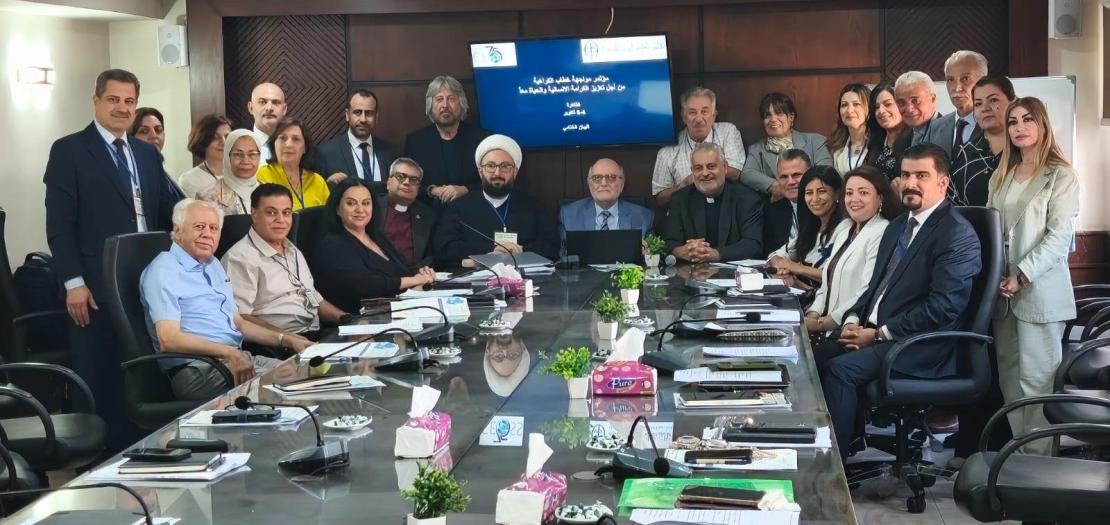
I have taken part in Cairo in the regional conference organized by the Middle East Council of Churches, the Coptic Evangelical Organization for Social Services, and the King Abdullah Ibn Abdulaziz International Centre for Interreligious and Intercultural Dialogue (KAICIID), on confronting hate speech and protecting human dignity. I presented a paper titled, "Mechanisms for Confronting Hate Speech within Socio-Political Frameworks."
I began my intervention with reference to a recent media incident that accompanied the visit of His Holiness Pope Leo XIV to Paris, when a short clip that went viral in some media outlets and social media platforms, with some people interpreting it as a racist stand by the Pope toward a black priest. But watching the clip in full reveals a completely different reality, namely the master of ceremonies informed the Pope that the French president and his wife were behind him, so he turned around to greet them. Even so, a few seconds were enough to concoct an accusation, to spread a verdict, and to set off a wave of comments.
Here lies one of the problems of our time, namely speed has outturned truth, emotional reaction has outturned verification, and some media outlets have become capable of turning a gesture, a word, or a clipped image into weapons. This is what I constantly reiterate that in recent years, humanity has advanced technologically, but it has regressed morally.
Weapons nowadays are not only those used in the battlefields. Words can become weapons, images can become weapons, and the media outlets themselves can turn from spaces of dialogue and acquaintance into arenas of mutual rejection, defamation, and the stripping away of the others’ humanity. When a human being is not viewed as a person with dignity but as an adversary, a number, or a stereotype, then the slide into hate speech becomes much easier.
That is why, we need "disarmed" media, as Pope Leo XIV calls for, and a gentle technology that serves humanity rather than manipulating it. We also need media and digital education that equips new generations the ability to verify information, to distinguish between news and opinion, between truth and disinformation, and between freedom of expression and offence against the dignity of others.
In 2019, the Catholic Center for Studies and Media launched a Media Code of Ethics, which calls for highlighting the bonds of closeness and affection among people, avoiding everything that stirs up factionalism, racism, and sectarianism, while promoting citizenship, as well as respecting privacy, human dignity, and human rights.
It is also important to refer to the conclusion of this regional conference--during which we listened to more than 30 intellectual and academic presentations from various Arab countries—which marked the launching of the Cairo Regional Charter for Confronting Hate Speech and Protecting Human Dignity.
Confronting hatred does not begin by silencing people, but by educating the word. When we disarm our discourse, we restore to the word its original mission, namely to be a bridge, not a wall; a means of encounter, not an instrument of conflict; in addition to a service to humanity and its dignity.