Issued by the Catholic Center for Studies and Media - Jordan. Editor-in-chief Fr. Rif'at Bader - موقع أبونا abouna.org

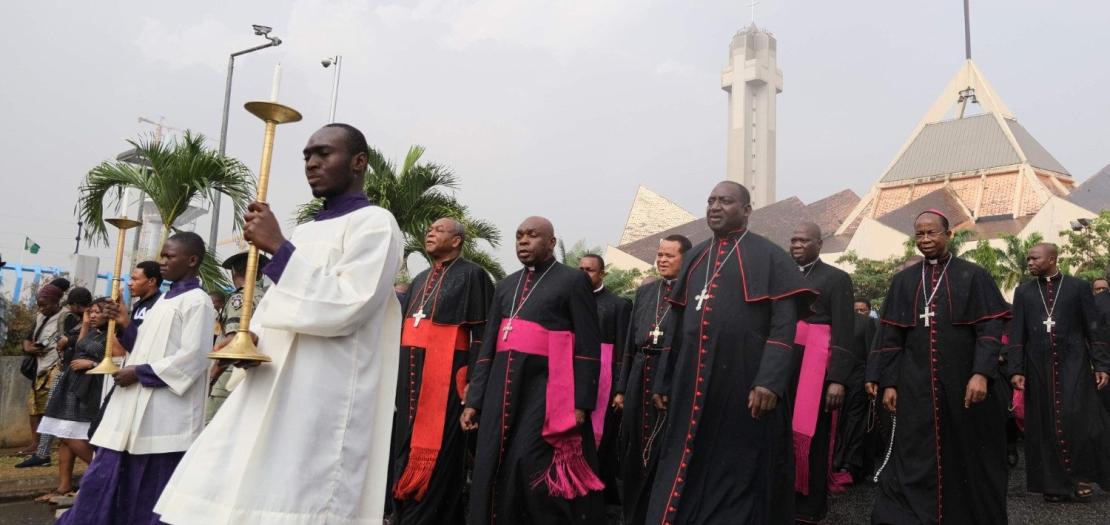
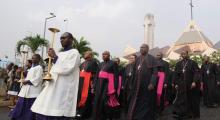
File photo of Catholic bishops in Nigeria gathered to pray for security and denounce the killings of Christians by Boko Haram terrorists
“They immediately asked us to convert, and when we refused, they began beating us. They whipped us, tied our legs and arms, and put chains around our ankles.”
Solomon Ako, a 33-year-old Christian from northern Nigeria, survived an ordeal that reflects the suffering endured by millions of believers around the world. He was abducted during an attack by extremist militants on his village near Zaria. In an account given to Aid to the Church in Need (ACN), he described being subjected to torture alongside other hostages. For hours, they were held immersed in cold water up to their necks and threatened with death if they refused to renounce their faith.
His experience is far from an isolated case. It is one example of the widespread violations of human rights and religious freedom documented in ACN’s latest report, Persecuted and Forgotten? A Report on Christians Oppressed for Their Faith 2024–2026, published on 27 October.
According to the pontifical foundation, persecution of Christians has intensified in more than half of the countries examined, or 55 per cent, compared with the previous reporting period. None of the countries reviewed showed an improvement. More than 220 million people worldwide are now directly exposed to the most severe forms of persecution.
“Behind these stark figures are faces, people and families,” says Marta Petrosillo, director of the ACN report. “I have often interviewed Christians who have experienced violence, discrimination and persecution. One of their first requests, particularly to us as brothers and sisters in the faith, has been not to forget them.”
“For the 20 years in which we have published this report, we have sought to denounce and analyze these situations, while ensuring that the suffering of these communities is known around the world and that persecution is not compounded by indifference.”
Africa remains epicenter of extremist violence
A comparison of ACN’s findings with those of the Global Terrorism Index 2026 points to sub-Saharan Africa as a major center of Islamist extremist violence worldwide. Six of the ten countries most affected by terrorism are in the region: Burkina Faso, Niger, Nigeria, Mali, Somalia and the Democratic Republic of the Congo.
The report documents severe violence against Christian communities, including killings and forced displacement.
In Nigeria, attacks by militants and radicalized Fulani herders in the Middle Belt have devastated villages and contributed to the displacement of more than 3.5 million people within the country. The report cites the massacre in Yelewata, where more than 200 Christians were reportedly killed in a single night, some hacked to death with machetes and others burned alive as they slept.
Further north, in Burkina Faso, jihadist groups linked to Al-Qaeda, including Jama'at Nusrat al-Islam wal-Muslimin (JNIM), are reported to control at least 40 per cent of the country's territory. Christians have been systematically targeted, including 26 men who were reportedly killed by having their throats cut in the Diocese of Nouna. Survivors have also faced restrictions on passing on their faith to their children.
In Mali, according to the report, some Christian communities have been forced to comply with Islamic requirements concerning dress and social conduct, while others have suffered killings and forced displacement.
In Mozambique, particularly in the northern province of Cabo Delgado, Islamic State-linked militants have pursued the establishment of a caliphate governed by Sharia law. The report records more than 1,000 Christians killed since 2017, alongside attacks involving beheadings and the systematic abduction of women and children.
Violence and restrictions on religious freedom in Asia
In Asia, the forms of persecution vary, ranging from repression by authoritarian regimes to the rise of religious nationalism.
In North Korea, the authorities regard Christianity as a harmful Western influence and a direct threat to the political system. Christians are forced to practise their faith in extreme secrecy, sometimes hiding their Bibles even from their spouses.
Those discovered may face torture, forced labor or execution. Christians are also believed to account for a significant proportion of the approximately 190,000 people held in political prison camps.
In China, the report describes a policy of forced “Sinicization” of religious life, under which religious communities are pressured to conform to the country's dominant culture and political ideology.
The Chinese Communist Party has tightened digital controls, including through the Code of Conduct for Online Behavior of Religious Personnel introduced in September 2025. The report says that unauthorized religious content and livestreaming have been prohibited. Members of so-called underground Churches who refuse to comply face mass arrests, detention and the demolition of places of worship.
In India and Pakistan, the main threats identified by the report stem from social hostility fueled by religious extremism and nationalism.
In India, radical Hindutva rhetoric has contributed to an environment in which violence against Christians has continued, with more than 700 incidents recorded in 2025 alone, according to the report. Strict state-level anti-conversion laws have also raised concerns. Extremists have disrupted liturgical celebrations, physically assaulted believers and denied Christian families the right to bury their dead, forcing some to exhume the bodies of relatives.
In Pakistan, the report highlights the abduction of underage girls from religious minorities, forced conversions and coerced marriages. Such cases are sometimes upheld by courts that, according to the report, give precedence to interpretations of Islamic law over civil protections.
The Middle East and the case of Nicaragua
In the Middle East, the historic homeland of Christianity, Christian communities continue to face serious threats to their future.
In Syria, following the fall of Bashar al-Assad's government in December 2024 and the rise to power of Ahmed Al-Shara’, formerly associated with the jihadist group Hayat Tahrir al-Sham, Christians already weakened by years of emigration have faced renewed insecurity.
Despite assurances from the transitional authorities, the report points to growing concerns over the increasing influence of Islam in public life. These tensions were brought into sharp focus by the suicide bombing at Mar Elias Greek Orthodox Church in Damascus on 22 June 2025. The attack, which Pope Leo XIV also condemned, struck the Christian community in the Dweil'a neighborhood on the outskirts of the capital, killing 25 people and injuring more than 60.
The report also draws attention to Latin America, particularly Nicaragua, where international commissions have described the repression of the Church as particularly severe.
The government of President Daniel Ortega has systematically targeted the Catholic Church through the confiscation of property, the closure of seminaries and other institutions, and the expulsion of hundreds of members of the clergy. Those affected include the president of the Nicaraguan Bishops' Conference, who was exiled in November 2024. The authorities have also gone so far as to prohibit people carrying Bibles from entering the country.
The danger of indifference
Beyond the scale and geographical reach of the violence, ACN's report raises concerns about the lack of attention these cases receive internationally.
Archbishop Ettore Balestrero, the Holy See's Permanent Observer to the United Nations, has also warned that “anti-Christian hostility is too often downplayed or ignored by the international media”.
When a church is attacked in Nigeria or Syria, the report argues, the violence is often presented primarily in terms of ethnic conflict, competition over land and water resources, or geopolitical instability following regime changes. In doing so, it says, the religious dimension of the attacks risks being overlooked, even when victims and perpetrators explicitly identify faith as a central factor.
This, the report warns, can obscure the circumstances of Christian communities in many parts of the world, where believers live as vulnerable minorities with limited rights and protections.
For those who suffer persecution, knowing that they have not been forgotten can be a vital source of strength. Solomon Ako, who remained faithful despite the chains and abuse he endured in captivity, recalls how prayer helped him and the other hostages persevere.
“Every night, when our captors were asleep, we prayed. We prayed knowing that we were not alone, that God was with us and that there were people who would never abandon us. That is what gave us the strength to endure then, and it is what continues to give us strength today.”