Issued by the Catholic Center for Studies and Media - Jordan. Editor-in-chief Fr. Rif'at Bader - موقع أبونا abouna.org

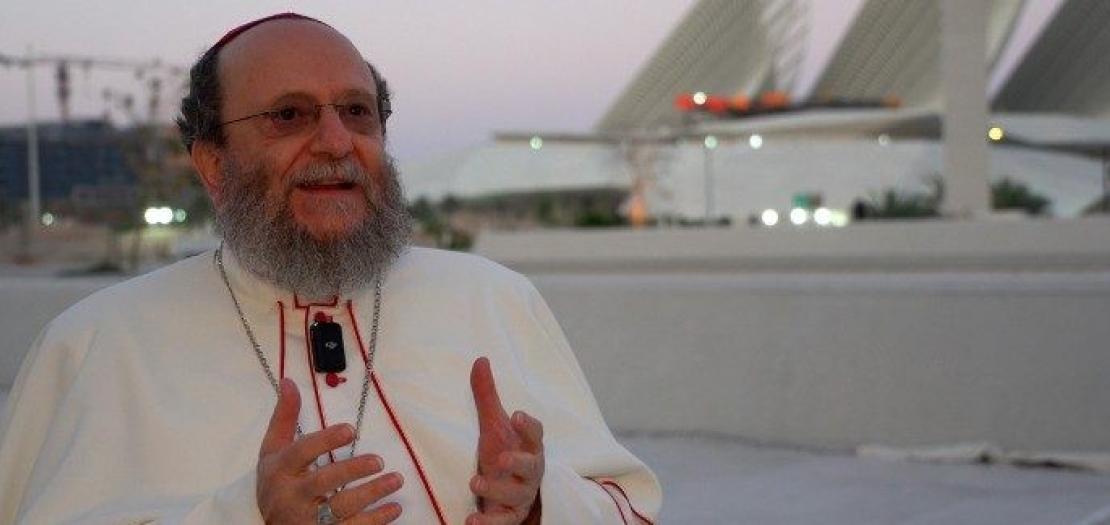
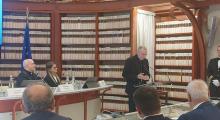
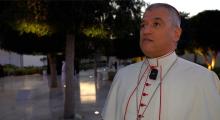
Bishop Paolo Martinelli, Apostolic Vicar of Southern Arabia, has taken part in the panel “A Hope in the Time of Conflicts” at the 2026 Meeting for Friendship Among Peoples in Rimini, Italy.
The meeting brought together Cardinal Claudio Gugerotti, Prefect of the Dicastery for the Eastern Churches; Bishop Paolo Martinelli, and Adriano Dell’Asta, Professor of Russian Literature and Culture at Università Cattolica del Sacro Cuore.
In his intervention, Bishop Paolo shared the experience of the Church in Southern Arabia, a migrant Church living in countries marked by great religious, cultural, and linguistic diversity. Speaking about the ongoing conflict affecting the Gulf region, he recalled the uncertainty, fear, and disruption experienced by families, young people, workers, and parish communities. Yet his reflection focused above all on the signs of hope that emerged from that difficult time.
A strong sign of hope, he said, was the faith of the people. Even when catechism had to move online, gatherings were limited, and some churches faced temporary closures or restrictions, the faithful continued to pray and support one another. “Certainly, a sign of hope was the way in which our faithful accepted the hardship and did not stop praying and praising God.”
He was especially moved by the many online Rosaries organized every day by groups of faithful and families and an online meeting with the teens, with their questions on faith, forgiveness, love of enemies, and how to believe in God’s love in a time of war. “We spent more than one hour together, dialoguing, praying, singing, and listening to the Pope’s messages on peace. An unforgettable and moving moment.”
Bishop Paolo also highlighted the importance of ecumenical relations in the Gulf. Through the Gulf Churches Fellowship, Christian leaders from different Churches have built a stable friendship over the years, meeting to reflect, pray, and deepen themes of common interest. During the war, this fellowship promoted public moments of ecumenical prayer for peace and supported a common document in favor of peace. “Praying publicly together for peace and reconciliation among peoples is not only a spiritual event but has social and civil relevance.”
The Bishop also pointed to moments of interreligious friendship and sharing, especially in the United Arab Emirates: during Ramadan, local authorities invited religious leaders to share in moments of encounter and to break the fast together. In those days, he said, while violence was often justified in religious language, Christians praying together for peace and believers of different religions experiencing friendship became a concrete sign of hope.
In the second part of his reflection, Bishop Paolo described the Church in Southern Arabia as a “joyful polyphony of faith,” quoting Pope Francis’ words in Abu Dhabi. With faithful from more than 100 nations, including many belonging to Eastern Catholic Churches, “we learn that the same faith can be expressed in different ways.” The motto of Pope Leo XIV, In Illo uno unum — in the one Christ we are one — becomes a key to understanding this experience.
In a time marked by fear, polarization, and violence, Bishop Paolo’s witness from Southern Arabia showed that hope is not an abstract idea. It is found in young people, in families gathering to pray the Rosary, in Christian leaders standing together for peace, and in believers of different religions choosing dialogue and friendship.
In this way, even in a time of conflicts, the Church is called to continue building fraternity, reconciliation, and hope.