Issued by the Catholic Center for Studies and Media - Jordan. Editor-in-chief Fr. Rif'at Bader - موقع أبونا abouna.org

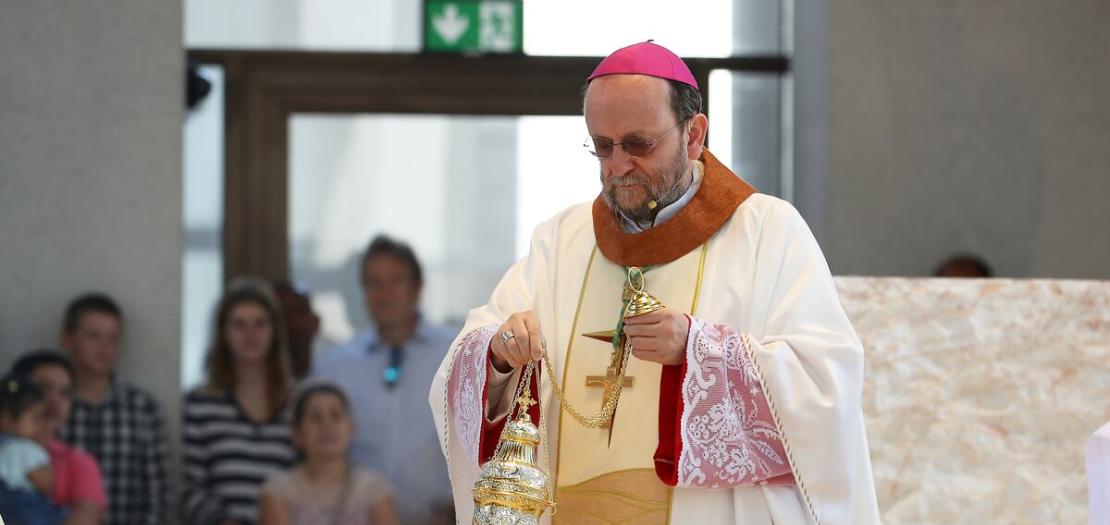
Bishop Paolo Martinelli, Apostolic Vicar of Southern Arabia, took part in the 18th Inter-Christian Symposium, held in Thessaloniki from September 22 to 24, 2026, on the theme “Christian faith in a multicultural context.”
Founded in 1992, the Inter-Christian Symposium is an academic and ecumenical gathering promoted by the Franciscan Institute of Spirituality of the Pontifical University Antonianum in Rome and the Faculty of Theology of the Aristotle University of Thessaloniki. It brings together Catholic and Orthodox theologians for a path of study and dialogue on important themes for the life of the Churches and for Christian witness in the contemporary world.
This year’s edition, with reference to the Franciscan Jubilee, addressed the question of Christian faith in a world marked by migration, cultural plurality, new technologies, social tensions, and the search for peaceful coexistence. The Symposium opened at the Metropolis of Thessaloniki, with greetings from Metropolitan Philotheos of Thessaloniki and Mons. Andrea Palmieri, Undersecretary of the Dicastery for Promoting Christian Unity. The programme included sessions on the dialogue between faith and culture, Christianity in the Middle East, new technologies, and the relevance of the Franciscan message today, together with liturgical moments, cultural visits, and a concluding round table.
In his introductory presentation titled, “Christian faith in a multicultural context: mapping the questions at stake,” Bishop Paolo offered a broad reflection on the challenges that the multicultural world poses today to society and to the Church.
The Bishop recalled that the mobility of peoples belongs to the history of humanity, to the history of salvation, and to the very history of the Church. Today, however, he noted, this phenomenon is taking place “in proportions that have never occurred before.” Migration, globalization, mobility, and the digital revolution are changing the perception of space and time and profoundly affecting the fundamental relationships of the human person.
Drawing from his experience in Southern Arabia, Bishop Paolo presented the Church in the Vicariate as a concrete example of a “laboratory of intercultural Church”: a community made up of migrants and expatriates from more than one hundred nations, called to live the same faith in different languages, rites, and cultures.
At the heart of his reflection, however, was a wider question. According to Bishop Paolo, the mixing of peoples cannot simply be denied or approached with fear. Referring to the concept of a “hybridization of cultures and civilizations,” elaborated by card. Angelo Scola, he underlined that this is now an irreversible process: “It is not a political choice, but a process that happens without asking our permission. This process needs to be governed with wisdom and foresight.”
For this reason, he explained, models such as assimilation, which erases differences, are not enough. Nor is multiculturalism understood as mere tolerance, which leaves differences separate, or a generic melting pot, which mixes them without real encounter. The true challenge is interculturality: not overcoming differences, but allowing them to interact, while respecting their human and spiritual depth.
Applying this reflection to the life of the Church, Bishop Paolo pointed to Pentecost as the original model. In the Church, he said, “we do not have the overcoming of languages, but unity manifested in the diversity of languages and cultures.” Christian faith does not eliminate cultures; it passes through them, purifies them, brings them into relationship, and opens them to communion.
From this perspective, he stressed the need to hold together the inculturation of the Gospel, the evangelization of cultures, and the interculturality of faith. If inculturation values local cultures, and evangelization calls them to conversion, interculturality shows how the same faith can bring different cultures into relationship around the one Gospel. “The Church does not live from the autonomy of the individual cultures in which she is present, but from the fruitful reciprocity of cultural differences,” he said.
In conclusion, Bishop Paolo indicated the task of the Churches today: to develop reflection and pastoral practice capable of fostering the interaction of cultural differences around the one Christian faith. In this way, the Church can also offer a precious contribution to the harmony of plural societies, against every form of polarization that threatens coexistence and peace.