Issued by the Catholic Center for Studies and Media - Jordan. Editor-in-chief Fr. Rif'at Bader - موقع أبونا abouna.org

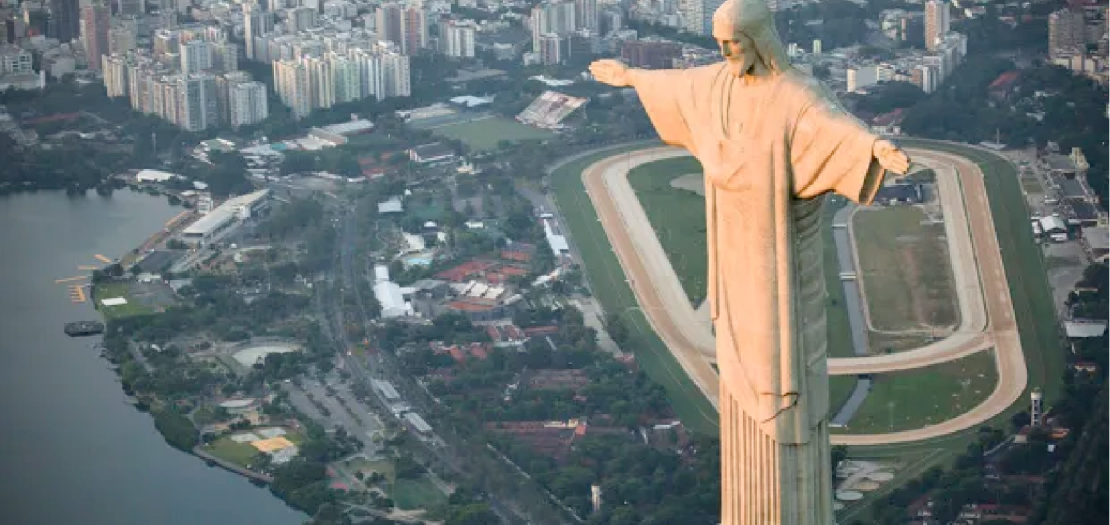
In 2025, the Sanctuary of Christ the Redeemer in Rio de Janeiro crossed an important threshold: it became not only one of the most visited religious landmarks in the world, but also one of the most active sacramental centers in Brazil’s urban Church. Behind the iconic silhouette that dominates the skyline of Rio, a dense rhythm of liturgical, pastoral, and devotional life is unfolding—measurable not in photographs, but in numbers, people, and rites.
Over the course of the year, the sanctuary recorded roughly 2,300 celebrations, a figure that includes baptisms, weddings, Masses, and organized pilgrimages. The data show a clear upward trend compared to 2024. Eucharistic celebrations rose from 860 to 1,036—an increase of just over 20 percent. Pilgrimages grew from 174 to 204, a 17.24 percent rise. Weddings climbed from 112 to 128, up 14.29 per cent. Baptisms remained stable at around 1,000, indicating not stagnation, but continuity at an already high pastoral level.
What these figures reveal is not simply growth, but transformation. The Christ the Redeemer site—long perceived primarily as a global tourist destination—has increasingly consolidated its identity as a functioning archdiocesan sanctuary. It is becoming a place not only to visit, but to belong to; not only to photograph, but to pray in, marry in, and initiate children into the Church through baptism.
Religious tourism also intensified in 2025, blurring the traditional boundary between pilgrimage and sightseeing. Visitors arrive for cultural reasons and leave having encountered a living faith community. This dual dynamic has reshaped the sanctuary’s pastoral structure. According to Father Omar, the rector of the shrine, the sanctuary expanded its pastoral staff, increasing the number of priests, religious sisters, and religious brothers assigned to welcoming and accompanying visitors.
This is not merely logistical reinforcement. It reflects a vision: the sanctuary understands itself as a space of evangelization, catechesis, and sanctification, not simply hospitality. In Catholic terms, the site is positioning itself as a locus of sacramental grace, not just symbolic heritage. The physical monument becomes a pastoral instrument.
The pastoral strategy is visible in how celebrations are distributed across the complex. Liturgies and sacraments take place not only at the foot of the statue itself, but also in the Chapel of Our Lady of Aparecida—Brazil’s national Marian shrine in microcosm—and in the Laudato Si’ Adoration Chapel, whose name references Pope Francis’ ecological encyclical and links worship with care for creation. The sanctuary thus integrates devotion, sacramental life, and contemporary Catholic social teaching into a single spiritual ecosystem.