Issued by the Catholic Center for Studies and Media - Jordan. Editor-in-chief Fr. Rif'at Bader - موقع أبونا abouna.org

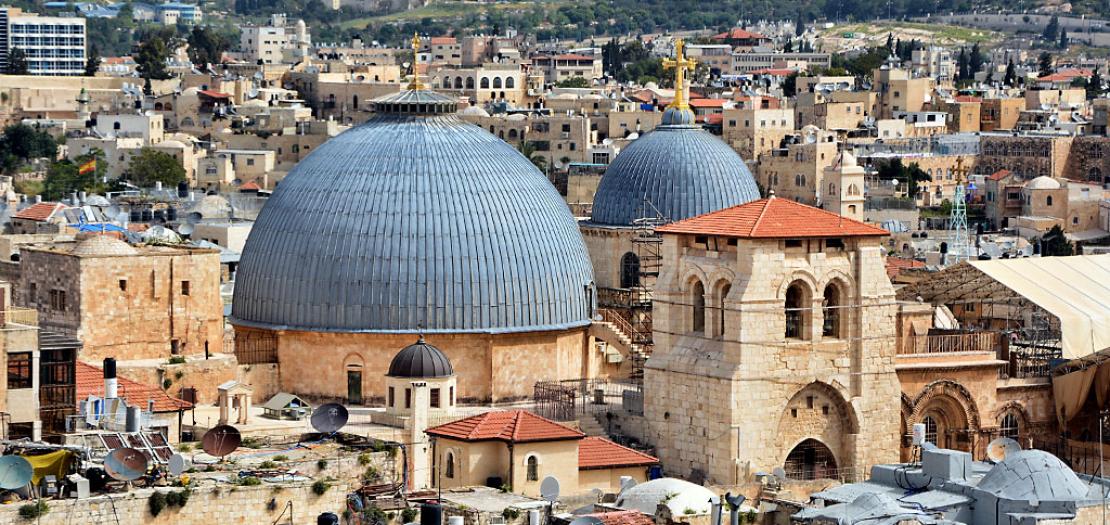
“In recent years, your faces have somehow become part of the status quo of the Basilica of the Holy Sepulcher”, says, with a touch of affectionate irony, the Custos of the Holy Land, Fr. Francesco Ielpo, addressing the researchers and young archaeologists of Sapienza Università di Roma who, from 2022 to the present, have taken turns working at the excavation site in the sanctuary dear to the entire Christian world. These words were spoken on the afternoon of September 17, 2026, during a brief video connection with a conference organized at the Faculty of Letters and Philosophy of the Roman university for the presentation of the volume Hagia Polis Project. Excavations at the Holy Sepulcher in Jerusalem. Vol. 1 Project and methodology. The text, entirely in English and edited by Professor Francesca Romana Stasolla, is published by TS Edizioni in the institutional series of the Studium Biblicum Franciscanum. Seven more volumes will follow in the coming years, the second is already in preparation.
Professor Stasolla, in her dual capacity as director of the Department of Ancient Sciences and head of the archaeological excavation site at the Holy Sepulcher, introduced the conference by speaking of “an extraordinary collective adventure” because, in addition to the archaeologists working in the field, many other colleagues from the University have participated and continue to participate in this “great university adventure, strongly supported by the magnificent rector”. For her, Professor Antonella Polimeni, it was not only a moment for thanks. In addition to mentioning the governor general of the Equestrian Order of the Holy Sepulcher, Ambassador Leonardo Visconti di Modrone, Monsignor Pasquale Iacobone, president of the Pontifical Commission for Sacred Archaeology of the Holy See, and the personalities connected from Jerusalem, Polimeni above all wished to underline her emotion at the volume presented. The reference was to the uniqueness of the place under investigation, with its daily coexistence of faiths, liturgies, and memories, which also imply a complex institutional balance. There are aspects that the pages of the book do not recount, says the rector. “The less simple moments when those working in the field strongly felt the sensation of being alone, sometimes on the margins, sometimes being questioned”, Polimeni said, recalling her two recent trips to Jerusalem. The first, in 2023, allowed her to enter the excavation site while it was still open. The second, a few weeks ago, during which she also spent time with the young researchers from Sapienza working in the field, invited one by one to the speakers’ table to receive the applause of the audience present. Students and researchers who, as the dean of the Faculty of Letters, Professor Arianna Punzi, said, showed courage in difficult moments and approached the religious communities of the basilica with respect, attentiveness, and humanity.
A project in which Italy has also made its contribution at the diplomatic level, as underlined by the consul general in Jerusalem, Domenico Bellato, and the local head of Italian Development Cooperation, Mirko Tricoli. The Italian approach, the consul said, is characterized by research, expertise, and innovative approaches to the conservation of sites. Bellato also recalled Italy’s commitment in Bethlehem, at the Basilica of the Nativity, at Tell es Sultan in Jericho, included among the UNESCO World Heritage Sites, and in the protection of the natural landscape of Battir, also in the West Bank, in the surroundings of Bethlehem. A role that has also been built through training programs for local operators. In this regard, Professor Stasolla mentioned the summer training courses carried out in collaboration with the Mosaic Center of Jericho and in partnership with Bethlehem Catholic University and Al Quds University in Abu Dis.
A difficult context in which Fr. Ielpo wished to thank everyone “for the scientific rigor, for the passion, and for the very human way in which you have conducted this work”. “For us Franciscans”, he said, “your work is an undertaking of extraordinary importance, because safeguarding these places also means knowing them, studying them, and passing them on to future generations”. The wars and divisions afflicting the Holy Land, the Custos continued, “have also had repercussions on the work of this project, which nevertheless represents a reason for hope and demonstrates how collaboration, research, and culture can continue to build bridges and prepare the future”.
A bridge made of expertise and rigor, but above all of work that is unique from the point of view of research. This was said by Professor Arnaldo Marcone, formerly full professor of Roman History at Roma Tre University. It was emphasized by Professor Shimon Gibson, British archaeologist and professor at the University of North Carolina (USA), who praised the work of Stasolla and her team, recalling how Sapienza conducted investigations using a modern and multidisciplinary method. And with this “it rendered a service to the whole world”. Professor Vincenzo Fiocchi Nicolai, full professor of Christian Archaeology at the University of Roma Tor Vergata and professor of Archaeology of Ancient Christian Cemeteries at the Pontifical Institute of Christian Archaeology, instead focused on some studies included in the Stasolla volume and on some interesting aspects of the work carried out by the Italian team.
Meanwhile, Professor Basema Hamarneh, professor of Late Antique and Early Christian Archaeology at the University of Vienna, proposed some learned considerations on the relationship between sacred architecture and liturgical action in the first centuries of Christianity, with particular reference precisely to the Holy Sepulcher. Among the audience present in the room, around one hundred people of all ages, were also three Franciscans of the Custody of the Holy Land: the delegate of the Holy Land in Rome, Fr. Antonino Milazzo, Fr. Stanisław Narcyz Klimas, Church historian, and Fr. Gianfranco Pinto Ostuni, for several months Commissary of the Holy Land in Naples, but involved in the excavation site at the Holy Sepulcher in previous years as a photographer. A sign of the profound bond that unites the Custody and the excavations at the place that commemorates where Christ died and rose again.