Issued by the Catholic Center for Studies and Media - Jordan. Editor-in-chief Fr. Rif'at Bader - موقع أبونا abouna.org

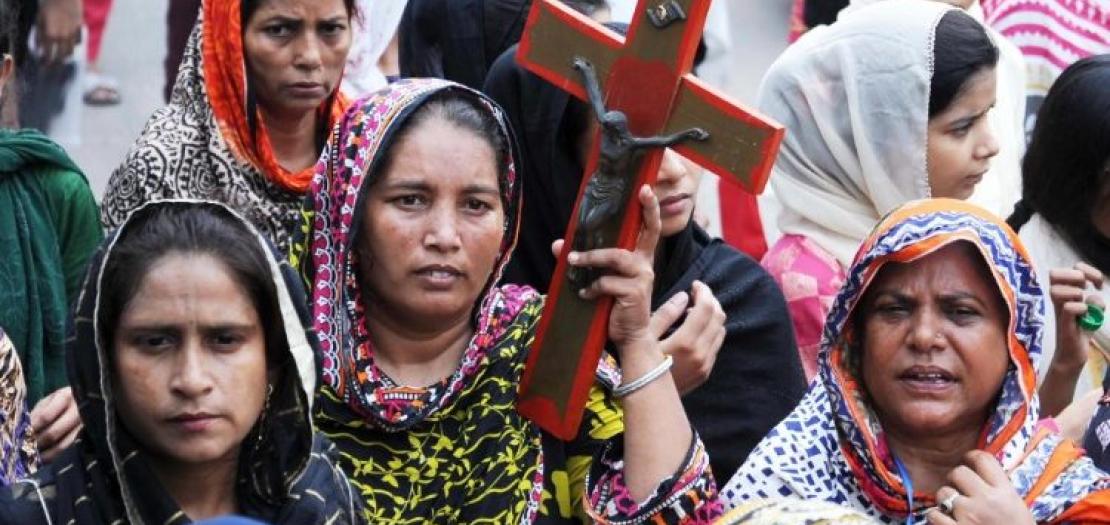
The number of Christians exposed to persecution and at risk of suffering violence worldwide rose by eight million people compared to last year—reaching a record 388 million.
“Unfortunately, this is once again a record year,” noted Cristian Nani, Director of Open Doors, which on Wednesday published the World Watch List 2026, its latest report on persecuted Christians around the world. “Of these 388 million, 201 million are women or girls; while 110 million are minors under the age of 15.”
Violence and discrimination
According to the World Watch List, the number of countries with a level of anti-Christian persecution that can be described as “extreme” has risen from 13 to 15.
North Korea remains the country where it is most dangerous to be Christian. The list of countries with an alarming level of persecution also includes Somalia, Eritrea, Libya, Afghanistan, Yemen, Sudan, Mali, Nigeria, Pakistan, Iran, India, Saudi Arabia, Myanmar, and Syria.
Syria has moved from a “high” to an “extreme” level, according to the Watch List.
Speaking to Vatican News, Mr. Nani said Christians in Syria are in danger because the new political power is still partly “fragmented,” as also shown by the clashes in recent days in Aleppo.
“Based on our data, only 300,000 Christians remain in Syria—that is, hundreds of thousands fewer than ten years ago,” he noted.
Focus on sub-Saharan Africa
After a decline, the number of killings of Christians has risen again, increasing from 4,476 to 4,849—13 a day.
Nigeria is confirmed as the epicenter of the violence, with 3,490 victims, about 70 percent of the global total of people killed.
The number of Christians arrested for their faith remains almost unchanged (4,712 compared to 4,744 in 2024), while the number of Christians kidnapped is down (3,302 versus 3,775 in 2024).
Attacks against churches also decreased (from 7,679 to 3,632), as did attacks against homes or shops (from 28,368 to 25,794), while the number of victims of abuse, rape, and forced marriages increased (from 3,944 to 5,202).
The director of Open Doors pointed to sub-Saharan Africa as the “special observation” area of the Watch List 2026, due in particular to the presence of “fragile governments” that leave Christians exposed to violence.
“The center of gravity of Christianity has shifted to Africa, but it is there that it is primarily under attack,” said Mr. Nani, speaking of the continent where about one-eighth of the world’s Christian population lives.
Sudan is among the particularly critical countries, he added, due to the civil war, but also Nigeria, Mali, Niger, Burkina Faso, the Democratic Republic of the Congo, and Mozambique.
Attacks against Christians, in these fragile contexts, have a range of causes in which economic factors combine with a religious dimension.
Attacks in Nigeria
The Watch List 2026 was presented on Wednesday in the “Fallen of Nassiriya” hall of the Italian Senate in Rome, accompanied by the account of a witness from Nigeria, one of the countries most affected by growing insecurity.
In recent days, Open Doors collected several remarks from Christians worried about possible reprisals by terrorist groups after the US Christmas raid, reporting also the latest episodes of violence in northern Nigeria.
These included 14 victims of attacks by the Islamic State West Africa Province (ISWAP) in Adamawa State on December 29, as well as dozens of victims at the hands of unidentified armed men who assaulted a marketplace in Dema, in Niger State, on January 4.