Issued by the Catholic Center for Studies and Media - Jordan. Editor-in-chief Fr. Rif'at Bader - موقع أبونا abouna.org

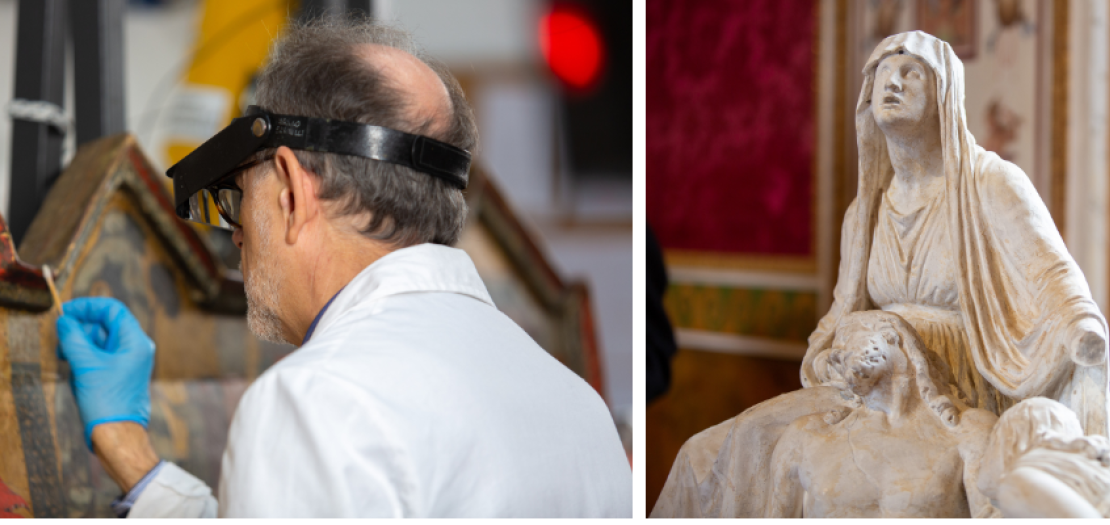
Ten thousand hours. This is how long it takes to digitally analyze, map and conserve a marble statue, which could well be 2,000 years old. The work is not about restoring the statue to its original beauty. The team of experts in the stone materials restoration laboratories of the Vatican Museums are working on preserving such pieces in their current state for generations to come.
It is a meticulous work. First, the restorers need to identify the problem. They pay particular attention to the color of the artifact and how it may have lost pigment over time. Then, stains need to be removed; small fractures should be mended. To clean the marble, a special kind of algae is applied. It removes any potential contaminants.
“Every piece here has its own history,” explained Msgr. Terence Hogan. A priest of the Archdiocese of Miami, Msgr. Hogan serves as the coordinator of the Office of Relations with the Patrons of the Arts in the Vatican Museums (ORPAVM). He appreciates the time he is able to spend inside the laboratories. After all, it is his job to ensure the operations keep running. Renovating millennia-old artwork is not only time intensive but also costly.
There are more than 100 professional restorers working in various laboratories, focusing on diverse fields such as tapestry, paintings and woodwork. They are tasked with maintaining pieces on regular display in one of the most important collections in the world.
Up to 35,000 visitors come every day to find inspiration by the collections of the Church. Only few are aware that even more treasures are stowed away beneath the Vatican Museums in vast vaults. To bring these works of art back to light is a huge undertaking. Despite new records in ticket sales, the museums are impossible to sustain with entrance fees alone. That is why Msgr. Hogan and his team are making sure that people with a heart for art know about the needs of the Vatican Museums.
During a tour, the monsignor pointed out monkey statues.
“Look at these baboons,” he said while walking through the stone materials laboratories, pointing at two statues of the monkeys, which are around 3,000 years old. They were found in Egypt and presumably adorned in an ancient palace.
“We have to first map the surface and document the damage,” the monsignor explained, looking over the shoulder of one of the restoration experts sitting with a tablet and a digital pen next to the statue. On the screen was an image of the baboon in front of her. With her pen, she selected certain parts of the surface and marked them. She made sure that she would later be able to apply the biochemical solution in the right places. “It is a fine line we are walking here, between preserving and distorting,” Msgr. Hogan said, referring to the fact that the museums’ restoration efforts are not aimed at reinventing the ancient art but bringing their original beauty to light.
To promote, restore and preserve, this summarizes the mission of Msgr. Hogan’s Vatican foundation tasked with inspiring benefactors to support the magnificent museums of the world’s smallest state. In the first week of November, the “Patrons of the Arts in the Vatican Museums” celebrated their 40th anniversary. More than 300 patrons from across the globe followed the invitation of the governorate of Vatican City State to participate in the weeklong festivities.
Barbara Jatta, director of the Vatican Museums, welcomed the benefactors in the courtyard of the museums, reminding the patrons that without them and their generous support, many works of art would have never seen the light of day. Msgr. Hogan had already brought many of those present into the laboratories, as, for patrons, the Vatican Museums offer special-access tours. “We try to provide them with an extraordinary experience. For us, they are more than just visitors; we want them to become part of the family,” said Msgr. Hogan.