Issued by the Catholic Center for Studies and Media - Jordan. Editor-in-chief Fr. Rif'at Bader - موقع أبونا abouna.org

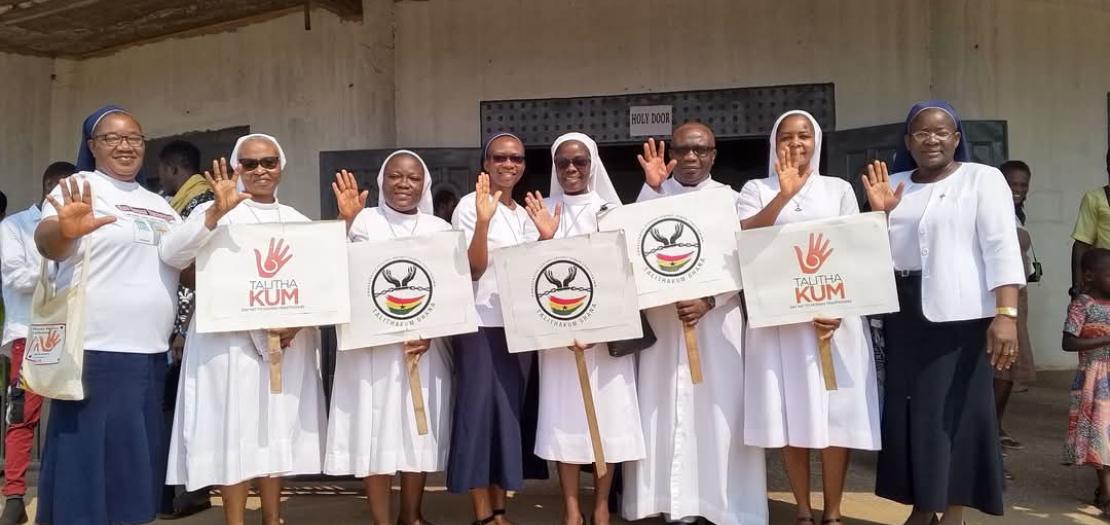
Human trafficking is evolving in increasingly complex ways and the rapid expansion of online scam operations has become “one of the most urgent and alarming forms of exploitation”, the anti-trafficking network Talitha Kum has warned.
Releasing its annual report for 2025, the network – led by women religious around the world – said an estimated 50 million people worldwide experience modern-day slavery, generating more than US$236 billion in criminal profits annually.
The report highlights how thousands of young people have been deceived by false promises of employment, trafficked across borders, and forced into cyber-enabled criminal activities through violence and coercion.
At the same time, wars and conflicts in the Middle East and in countries like Burkina Faso, South Sudan, Nigeria and the Democratic Republic of Congo, together with forced displacement, climate-related crises and growing inequalities, expose millions of people to trafficking as criminal networks exploit fear, vulnerability and desperation.
A bishop echoed this point with a warning that false reports of prosperity in South Africa are luring thousands of foreign nationals into modern-day slavery.
Speaking to mark the World Day Against Trafficking in Persons on 30 July, Bishop Joseph Mary Kizito of Aliwal said traffickers exploit a gap between the perceived and actual socio-economic conditions in South Africa, trapping vulnerable migrants in a nightmare of abuse and exploitation.
“A lot of people have been fooled for a long time that South Africa has got a lot of jobs and easy good life,” he told The Tablet.
“The social-economic conditions are very bad in South Africa but a lot of people do not know and do not see it. It is only once they have been trafficked and they have arrived in the country that their reality comes out.
“We have no jobs in South Africa. Out of 10 young people only four can get jobs. We have a lot of challenges of accommodation.”
Kizito, who serves as the liaison bishop for the Migrants and Refugees department of the Southern African Catholic Bishops’ Conference (SACBC), said that the primary trafficking route is from North and East Africa, funneling victims through Zimbabwe and Mozambique before dispersing them into South Africa’s major urban hubs: Johannesburg, Pretoria, Durban and Cape Town. He said movement is driven by a deeply ingrained myth.
“A lot of people have been fooled for a long time that South Africa has got a lot of jobs and an easy, good life,” Bishop Kizito said. “The socio-economic conditions are very bad in South Africa, but a lot of people do not know and do not see it. It is only once they have been trafficked and they have arrived in the country that their reality comes out.”
He explained that he has interviewed numerous young trafficking victims, predominantly young women, who have travelled to South Africa expecting opportunity but found themselves entirely at the mercy of their traffickers once they realized the reality.
“The stories, the narrative they give me, are of regret,” he said. “They can see that they made wrong choices. They were fooled. They have been abused, raped, and they have lost a lot of their human dignity.”
Last year, Talitha Kum reached over 1.2 million people through prevention, protection, survivor accompaniment, advocacy, formation and capacity-building initiatives, according to its report.
“Behind every number is a real person: a survivor regaining freedom, a young person leading change, a family finding hope, and a community choosing solidarity over indifference,” said Sr Abby Avelino MM, international coordinator of Talitha Kum.
In 2025, women and girls continued to make up the majority of victims and survivors. The majority of girl victims (60 per cent) are trafficked for sexual exploitation.
The report reveals that 45 per cent of children are trafficked for forced labor while 47 per cent are exploited for other purposes such as forced crime.
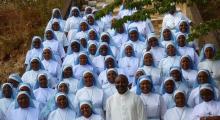
Last year the anti-trafficking network expanded into Malawi, Botswana, Lesotho and Eswatini, making it present in 113 countries. Its mission was undertaken by 6,387 sisters and partners including 882 women religious congregations and 100 male congregations.
These figures demonstrate the strengthened commitment of consecrated life to the global mission of ending human trafficking, the report says.
During 2025, members of the network had a meeting with Queen Camilla which “offered meaningful international recognition of the invaluable contribution of Catholic Sisters and affirmed the essential role of faith-based leadership in confronting one of the greatest human rights challenges of our time”.