Issued by the Catholic Center for Studies and Media - Jordan. Editor-in-chief Fr. Rif'at Bader - موقع أبونا abouna.org

Following is the text of the meditation by His Beatitude Cardinal Pierbattista Pizzaballa, Latin Patriarch of Jerusalem, marking the 13th Sunday of ordinary time, dated July 5, 2026:
In several passages of the Gospel of Matthew, as in the other Synoptic Gospels, we are given the privilege of hearing the voice of the Father speaking to the Son, revealing what is dear to Him and in whom He delights.
The Father holds the Son close to His heart—the beloved Son who freely chose to take on human nature and to share in all its limitations. And so, whenever the Father looks upon the Son and takes delight in Him, He also sees all of humanity: He looks upon it with the same love with which He looks upon the Son.
Today, however, in the Gospel passage for this 14th Sunday of Ordinary Time, (Mt 11:25–30) we hear the voice of the Son speaking to the Father. And He too reveals what is dear to His heart, what fills Him with delight.
The Son delights in the way the Father chooses to reveal Himself to the world: not to the great or the powerful, but to the little ones. (Mt 11:25–26)
The Father reveals himself to the humble, to the poor, to those who have done nothing to deserve such a gift and have nothing to offer in return, so that the Father’s gift of himself may shine forth in all its mercy and generosity.
Throughout the Gospel, we can observe this perspective of Jesus and see it confirmed time and time again: the little ones, in fact, are always the first to understand, the last to take offence, the freest in receiving, and the most capable of allowing themselves to be loved.
Yet, even as Jesus rejoices in the Father's way of revealing Himself, He is, in fact, revealing something about Himself. In what sense?
In this passage, we contemplate the capacity of the Lord’s heart to rejoice at a gift that the Father bestows not upon him, but upon others.
It is the joy of the Son, who delights in seeing the Father pour out His love.
This ability to rejoice in the good of others reveals the quality of the relationship between Jesus and the Father: The Son is not jealous of the revelation given to the little ones; He is not troubled that others receive what He Himself already possesses; nor does he fear losing anything. Quite the contrary!
His identity is so deeply rooted in the Father that He can celebrate whenever the Father pours Himself out elsewhere.
This is the freedom of the children of God: a freedom that does not cling to grace, but rejoices wherever grace blossoms.
Jesus not only accepts that the Father reveals Himself to the little ones; He praises the Father for it.
At this point, the second part of today's Gospel opens. (Mt 11:28–30)
In the first part, we have seen the Son addressing the Father in a spirit of pure gratuity, expressing His perfect communion with the Father's heart.
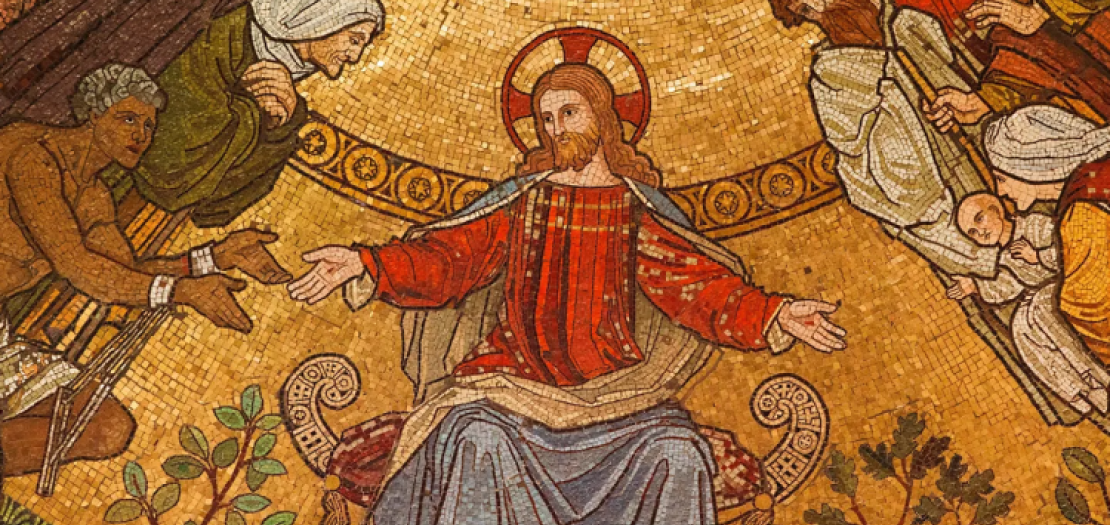
Now, without delay, Jesus turns to His disciples with an invitation: "Come to me... learn from me... and you will find rest."
This transition is natural because whatever Jesus receives from the Father, he immediately passes on; what He contemplates in the Father, He transforms into an invitation; and what He experiences in the Trinitarian relationship, he opens up as a space of communion.
His movement toward His brothers and sisters is simply the fruit of what the Son lives in His relationship with the Father. It is born not of obligation, but of the overflow of love.
These are not, then, two separate prayers placed side by side. They are one continuous stream flowing from the Father to His children through the heart of the Son. Jesus receives from the Father the revelation granted to the little ones, and immediately offers that same gift back to the little ones as rest. The movement is immediate: from praise of the Father to an invitation extended to His disciples.
Three verbs mark this journey: come, take, learn.
"Come to me." This is the disciple's first step: to turn one's heart toward the Lord and come to Him to receive life.
“Take my yoke upon you” – not in the sense of taking on an additional burden. The yoke is not a burden, but the relationship that unites two people.
And finally, "Learn from me." Allow yourselves to be formed by My filial heart. Enter into My own relationship of love with the Father, for only this can free the heart from every hardness.
These three movements are not commands but the offer of a relationship that promises rest —the rest of those who receive the life that the Father gives to the Son, and that the Son, in turn, gives to us.
+Pierbattista