Issued by the Catholic Center for Studies and Media - Jordan. Editor-in-chief Fr. Rif'at Bader - موقع أبونا abouna.org

Do not be afraid because you are few in number!
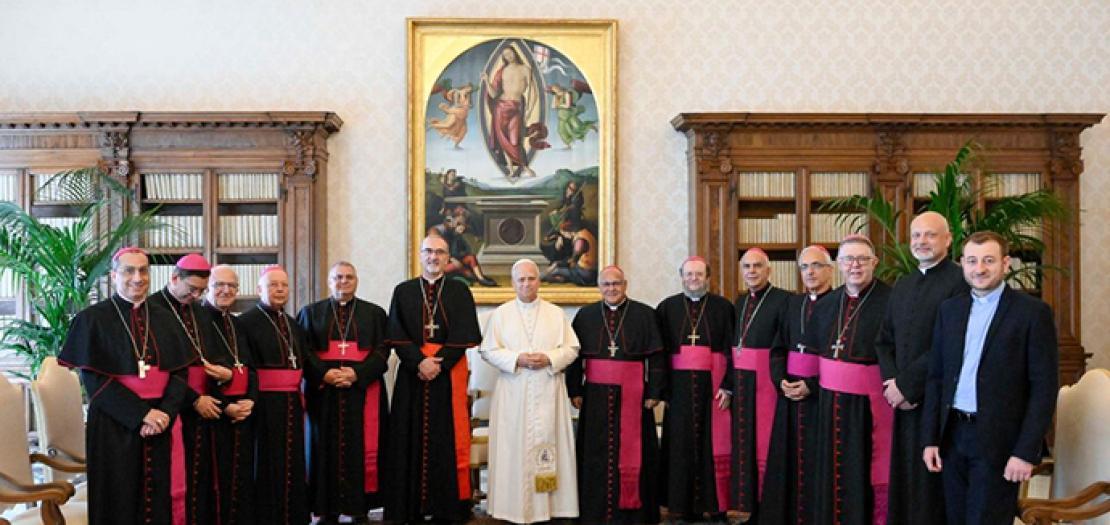
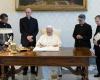
On September 3, 2026, His Holiness Pope Leo XIV met with the president and members of the Conference of Latin Bishops in the Arab Regions (CELRA), which brings together the pastors of the Latin Church across a vast area of land encompassing the Levant, Egypt, the Horn of Africa, and the Gulf countries.
The papal address conveyed a clear message from the Holy See to the Christians in these countries, namely do not be afraid and do not despair, but rather continue your procession of presence, service, and witness despite the difficulties, emigration, and declining numbers in some regions.
His prominent statement stated, “Do not be afraid because you are few in number. The contribution of the Church is not measured by numbers, structures, or resources, but by fidelity to the Gospel.”
This is an extremely important message of encouragement for Christians who constitute an integral part of the history of this region as well as of its civilizational and human fabric. Christian faith in this regard is neither imported nor something recent, yet it is deeply rooted in the history of these Holy Lands, which witnessed the emergence of Christianity and from where the Apostles conveyed the good news to the world.
From this premise, numerical smallness should not become a source of fear or retraction, but rather a motivation for a greater positive presence in addition to serving people and society. The Pope’s words expressed this clearly: A small community can have a precious presence, “not because it seeks power, but because it serves; not because it imposes itself, but because it bears witness; not because it responds to violence with another form of violence, but because it confronts power with love.”
The address also reflected on the martyrs of faith and service in the region, from Iraq and Syria to Yemen, affirming that their sacrifices remain a light, as well as a call not to surrender to fear and despair.
At the same time, the Pope accentuated the importance of families, young people, and Christian upbringing, as well as schools, hospitals, and deeds reflecting cordiality, in their capacity as an essential part of the Church’s mission and service to all members of society without discrimination.
Christian-Muslim dialogue and unity among the Churches were not absent from this vision. Dialogue, as the address stated, “does not mean renouncing one’s identity, but living it without fear of encounter .” This is an extremely important principle for our region, which needs further encounter, cooperation, and peacebuilding.
The concluding message was one of hope: “Do not be afraid to sow without seeing the fruits immediately. You are called to sow and God is the one who gives the growth.” It is an invitation to the Christians of the East in our region to continue their journey with confidence, remaining rooted in their faith and in their homelands, faithful to their history, open to their fellow citizens, especially their Muslim brethren, as well as working for justice, reconciliation, and peace. What matters is not their number, but what they contribute to their homelands and how faithful they remain to their faith as well as to their humanitarian, dialogical, and spiritual mission.
Consequently, the meeting was not merely an occasion for listening; but rather a dialogue with His Holiness the Pope. The discussion was opened by His Beatitude Cardinal Pierbattista Pizzaballa, Latin Patriarch of Jerusalem and President of the Council of Latin Bishops. Then, the bishops who came from the Arab countries were then given the opportunity to exchange views on the coming years and on the possibility of a papal visit to the region during this important upcoming period.
This takes place at time when Jordan is preparing to mark, in 2030, the 2,000th anniversary of the Baptism of the Lord in 2030, while Jerusalem is preparing to commemorate, in 2033, the 2,000tha anniversary of the Resurrection of the Lord in 2023. This requires, first and foremost, stability in the region and granting the Palestinian people their right to freedom and independence, so that the Holy Land would hold celebrations with hearts filled with joy and happiness, and be ready to welcome millions of pilgrims in an atmosphere of security and peace.