Issued by the Catholic Center for Studies and Media - Jordan. Editor-in-chief Fr. Rif'at Bader - موقع أبونا abouna.org

A journey of hope: A new document
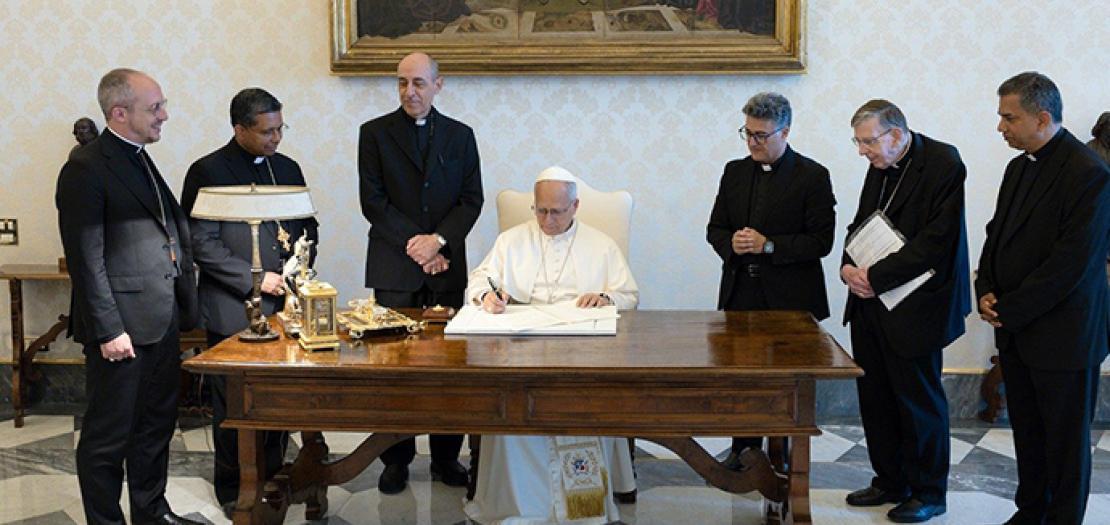
Sixty years ago, the Second Vatican Council’s document Nostra Aetate marked a historic turning point in the Catholic Church’s relationship with followers of other religions, as It clearly declared that the Church “rejects nothing that is true and holy” in these religions as well as called for respect, appreciation, and dialogue. Today, the new Vatican document “A Journey of Hope: Sixty Years of Interreligious Dialogue and Fraternity Among religions” looks back on the achievements of this journey while also asking: Where should dialogue go in today’s world? The document was approved by Pope Leo XIV after being signed by the heads of three Vatican dicasteries, namely the Dicastery for the Doctrine of the Faith, the Dicastery for Promoting Christian Unity, and the Dicastery for Interreligious Dialogue.
In our Arab world, the Muslim-Christian dialogue has a particular importance because Muslims and Christians do not meet only at conferences and through official committees, but rather they live together every day in the neighborhoods, at school, at university, in the workplace, and in the same homeland. Over the past decades, friendships have developed among religious leaders, as councils and platforms for dialogue have been established, and pioneering initiatives have been launched, including the Amman Message, the “A Common Word” Initiative, the World Interfaith Harmony Week, papal visits to Arab countries and mosques, and most of which is the Document on Human Fraternity for World Peace and Living Together that was signed by Pope Francis and the Grand Imam of Al-Azhar Ahmed el-Tayeb, in Abu Dhabi in 2019. Among these notable initiatives was the establishment of the King Abdullah ibn Abdulaziz International Centre for Interreligious and Intercultural Dialogue in 2012, from which the Interreligious Platform for Dialogue and Cooperation in the Arab World emerged in 2017.
The document states that dialogue is no longer an intellectual luxury or a diplomatic courtesy. This is why the words of Pope Benedict XVI remain particularly significant when he said that dialogue between Christians and Muslims “cannot be reduced to an optional issue, yet it is rather a vital necessity on which our future depends to a great extent.” Yet, the new stage requires moving from dialogue in conference rooms to dialogue in everyday life and dialogue of action. The question is not only: What do we believe in? It is also: What can we do together for humanity? How can Muslims and Christians support the poor, the sick, the refugees, and those who are suffering? How can they support young people, protect the family, as well as confront hate speech and extremism? The suffering persons do not first ask about the identity of the hand reaching out to them, as they need only a compassionate hand.
The new document accentuates the rejection of using religion to justify terrorism, war, or violence. It also addresses clearly the phenomenon of Islamophobia, or fear of Islam, rejecting the conflation of Islam with extremism and affirming that the life of the vast majority of Muslims are peaceful that contributes to building their societies. At the same time, it affirms the need to respect religious freedom, the dignity of all believers, and the rejection of persecution of any person based on one’s faith.
Pope Leo XIV, meanwhile, places dialogue within a clear framework of peace, justice, and truth. He stresses that whoever uses the name of God to justify terrorism, violence, or war “betrays his true nature,” and that fighting in the name of religion is an assault on religion itself.
A new challenge emerging today, namely the age of artificial intelligence. In this regard, Muslim-Christian dialogue is called upon to contribute to building an “ethics of technology,” confronting fake news and religious incitement, protecting human dignity and privacy, in addition to using digital tools to promote peace and rapprochement rather than hatred and division. This is the age of “disarming modern technologies”—a phrase that will be the title of next year’s 2027 Message for the World Day of Peace.
Sixty years after Nostra Aetate, and now with “A Journey of Hope”, the goal is no longer simply to say that Muslims and Christians are capable of living together; but they rather move from coexistence to cooperation, from getting to know one another to solidarity, and from dialogue about humanity to serving humanity together.