Issued by the Catholic Center for Studies and Media - Jordan. Editor-in-chief Fr. Rif'at Bader - موقع أبونا abouna.org

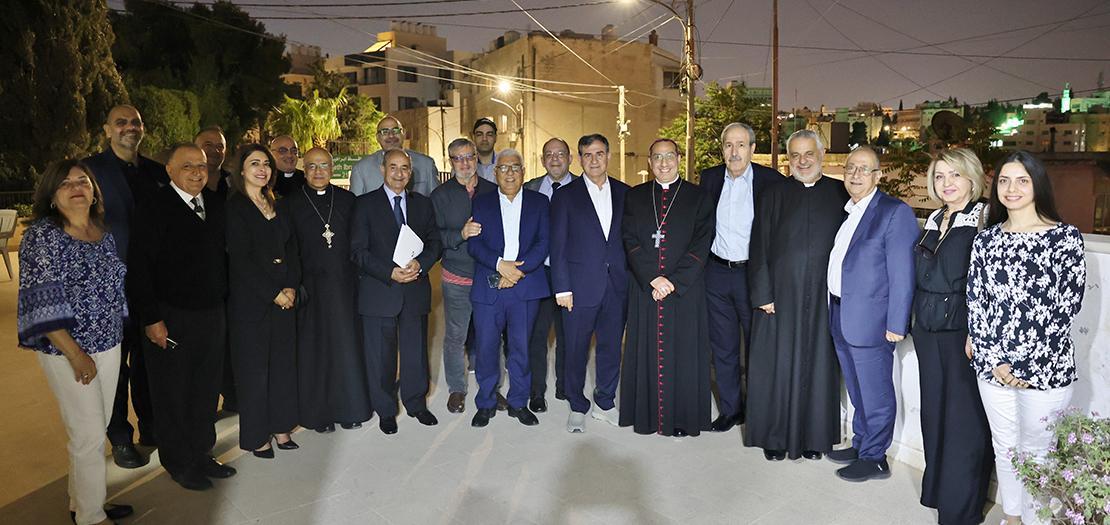
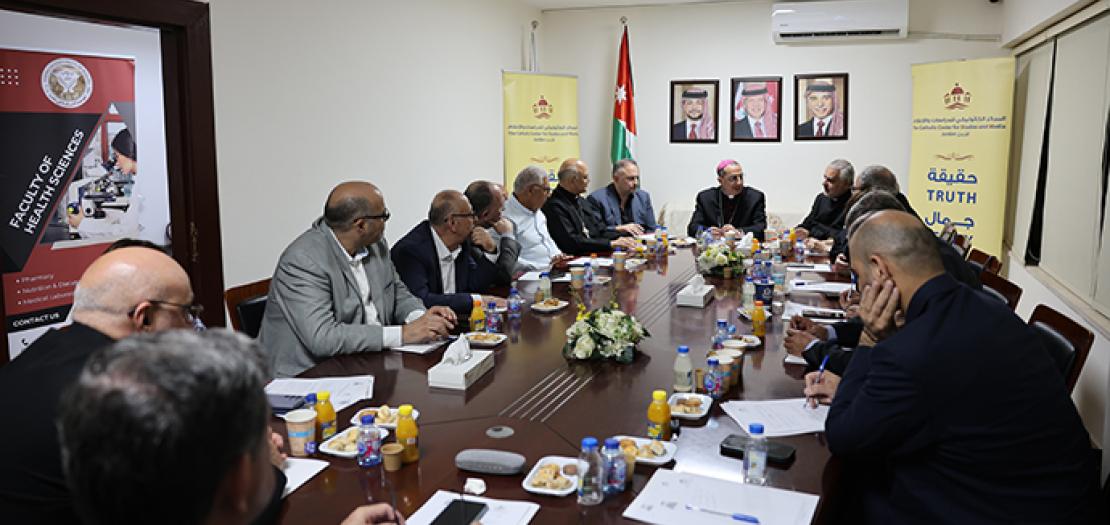
On Saturday, May 9, 2026, Latin Patriarchal Vicar for Jordan Bishop Iyad Twal held a meeting with the Catholic Center for Studies and Media (CCSM) Consultation Council in the presence of the CCSM members of staff. The meeting was dedicated to exchanging views on the strategic media plan of the Latin Vicariate in Jordan, within the framework of enhancing church media performance and presence.
At the outset of the meeting, following the recitation of the Christian prayer presented by Pope Francis in his message for the 2018 World Communications Day, Bishop Twal expressed pleasure at meeting once again with the CCSM members of staff and its Consultation Council. He noted the importance of regular encounter and the opportunities it provides for developing a shared media vision in addition to strengthening the Church’s identity and presence in society.
Bishop Twal stressed the importance of partnership and shared work in order to achieve “a unified church media voice.” He added that this meeting represents a step in an ongoing process of dialogue, cooperation, and exchange of expertise among the various concerned parties, which contributes to the formulation of a clear and written media vision capable of strengthening the Church’s presence in the modern media sphere as well as in reinforcing its spiritual and humanitarian mission in society.
For his part, CCSM Director Fr. Dr. Rif’at Bader presented the CCSM’s media vision, which had been discussed in recent weeks by the CCSM and its Consultation Council, while stressing its philosophical and reference framework which is based on the transition from a spiritual mission to a media witness.
He pointed out that the vision is based on deep-rooted academic principles that build upon previous achievements, while emphasizing that digital media has become a primary space for religious practice and for building a spiritual community which requires a professional media system deeply rooted in evangelical identity, as well as reflective of the Christian and national presence in Jordan.
Fr. Bader added that the media mission aims at organizing a responsible discourse that reflects the Church’s identity, consolidates pastoral affiliation, as well as supports the values of citizenship, ecumenical dialogue, and interfaith dialogue, while using the language of the modern age in the service of the public good. He also referred to guiding principles based on Church teachings, which include credibility, mutual respect, professionalism, responsibility, and openness.
For his part, Head of the Consultation Council Mr. Omar Naber pointed out that the vision is not considered merely a technical or administrative framework, but rather an expression of the Church’s living mission. He continued that the contemporary media have become a space for witness, service, and reaching people wherever they may be, while conveying a message of hope, love, and peace. He added that the strategy seeks to combine authenticity with renovation, as well as the sacredness of the message with professional media practice, while giving special attention to young people in their capacity as the Church’s renewed energy and partners in creating a meaningful content.
The meeting concluded with an open discussion in which members of the Consultation Council presented general recommendations as part of the ongoing process of developing the media plan.