Issued by the Catholic Center for Studies and Media - Jordan. Editor-in-chief Fr. Rif'at Bader - موقع أبونا abouna.org

“I felt with certainty that the Lord loved me with a predilection. It was a long time during which the Lord showed me the love he has for me, his faithfulness... It felt like a cushion was wrapped around me and saved me from disintegrating.”
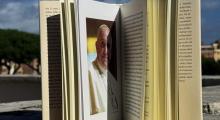
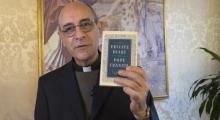
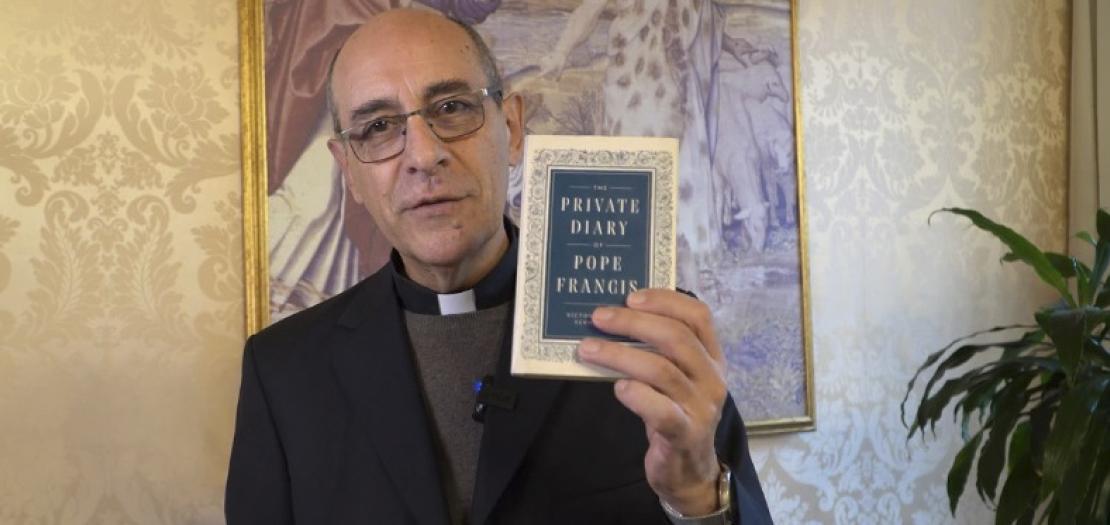
This is one of the passages from Pope Francis’ writings that most struck his collaborator and friend, Cardinal Victor Manuel Fernández, author of the book “The Private Diary of Pope Francis,” published in English by Penguin Random House in the US and the UK.
In this interview with Vatican News, the Prefect of the Dicastery for the Doctrine of the Faith recounts how the book came about and comments on its most significant passages.
Q: How did you learn of the Diary’s existence? Why did you decide to publish it?
One afternoon I was at Santa Marta with Pope Francis, over by his personal desk. One of his secretaries was in the next room. We were speaking privately about the possibility of preparing a document that would establish what to do if the Pope were to lose consciousness irreversibly. That did not go ahead.
In that context, he pointed out a place where he kept three documents and an appointment book. I saw that he had underlined passages in the documents. When I opened the appointment book, I saw that he was using it as a sort of diary, but I did not manage to read anything. That was when he said to me: Your others will see about this. I do not remember his other words exactly. I remember only the expression “whatever is for edification.” That is, he asked me, when the time came, to see what might be of use to people for their edification.
When Pope Leo was elected, I did not want to bother him with this matter, but after a few months I began to worry: who knew where that material might end up, whose hands it might fall into, if it did not disappear altogether... So, I went to tell Pope Leo about that conversation and to tell him that I felt obliged to carry out what Francis had asked of me. He showed an interest, and two days later he found the box containing all the texts Francis had shown me. And Pope Leo sent me the box immediately so that I could do that work.
Q: In the opening pages you explain that the purpose of the book The Diary of Pope Francis is “the spiritual edification of the reader.” What does that mean?
The purpose of this book is “the spiritual edification of the reader,” because that was the very word Francis had used: “edification.” That is, things that will do the reader good. In fact, some details about minor, practical matters, about the times of various meetings or things he had to remember, like going to the dentist, offer the reader no useful message, nor do they help us understand Pope Francis. But most of the Diary contains phrases and accounts that reveal Francis’ heart and give us powerful food for thought.
I myself, when I opened the box and read the Diary, was surprised, I was shocked, because it contained things I had never heard before, not gossip, but facts essential to a firsthand understanding of Francis as a person and of his soul. At first I was unsure whether to include certain things because they were too intimate. But I decided to do so.
I saw that, surprising as these new things might be, they nevertheless led us to ask ourselves great questions, and I remembered that the only thing he had asked for was people’s edification.
Q: Why did you not publish Francis’ Diary in full? Was Pope Leo XIV informed about this publication and about that choice?
In reality, the book contains everything worthwhile, even some very provocative and unsettling things, without hiding anything. You will find everything arranged by subject because that really helps you get the most out of the contents. All that is missing are a few phrases that add nothing or are repetitive. Or paragraphs about private matters concerning living people that he would not have wanted to make public in any case.
Finally, there are many parts written in strange signs, like hieroglyphics. Obviously, these are things he did not want anyone to read in the future, and we must respect that intention. But my decision was to include as much as possible. There is no shortage of interesting details, as when he recounts a conversation with Merkel or complains about some Argentines or about people who have already died. Those details are certainly there.
Pope Leo agreed with everything. He also believes that publishing the texts alone could confuse readers who did not know Francis well, and so he considered it important that my comments explain the context.
Q: Pope Francis emerges from the Diary as a Pope with mystical traits. He writes of spiritual visions and of looks that Mary gave him. What do they mean? Had Francis ever spoken to you about them?
Francis recounts simple and beautiful things about his spiritual experiences of personal contact with Jesus or with Mary. He says things like “smiled at me,” “spoke to me through a look,” “I fell asleep in that loving presence.” He never spoke about these intimate things we find in the Diary.
He could talk to you about very personal and controversial convictions on social, political, and pastoral questions, without holding anything back, but not about his own spiritual experience. That was very personal, something he kept very much to himself. And this confirms why it was essential to publish it.
But bear in mind that these things are not always pleasant. For he also recounts how on some occasions he encountered the devil. He describes his inviting eyes, the rattle in his voice. And there are other stories like these, all included in the book, of which he never spoke.
Q: As you have just said, Francis had distinct visions of the devil. Can you explain the scope and meaning of these visions mentioned in the Diary?
What is interesting about his visions of the devil and other chilling things is that he recalls them several times and recounts the circumstances in which they took place, as we see in the book. The demon even appears in the last paragraph of the Diary as Francis looks back over his life.
One could take these things as products of his own imagination, or simply as frightening details. But their meaning is very profound. They mark moments that God permitted, when Francis felt called to leave superficiality behind, to enter into the depths of life, to recover the most important and decisive meaning of his existence.
Outwardly, we could see that none of this robbed him of his joy and good humor. He joked and laughed. But deep down these experiences were telling him: you must be watchful, remember what you must live for, take your mission very seriously, do not lose sight of the true direction of your life.
Q: The Diary reveals a spiritual crisis that Francis dates to 2021–2022. He speaks of “dryness, desolation, a dark time.” Is this the first time we have learned of a Pope’s spiritual crisis? What does it mean?
Francis went through a serious spiritual crisis in 2021 and 2022, which is surprising because one would never have imagined it. He himself always interpreted crises, difficult moments, temptations, as preparation for something very important. God prepares you, purifies you, guides you in this way for something great, so that you may rise higher.
But in fact, this interior crisis he had lived through had not prepared him for a particularly unusual mission or for anything outwardly striking. It prepared him to attain true inner peace, the highest meaning of his life, to arrive at the most beautiful synthesis of his spirituality: namely, total abandonment into the arms of the Lord, which leads one to respect the dignity of others.
It is not that Francis was not a spiritual man before the crisis he went through, but thanks to that crisis his spirituality reached its fullest synthesis. In the book I share some things that help us understand that great crisis.
Q: Francis overcame his spiritual crisis through total trust in the Lord. In the book you cite Francis’ last two documents, C’est la confiance and Dilexit nos. What do they mean, and how are they connected to the pages of the Diary?
Francis’ last documents are the result of his overcoming his great crisis. They are, as it were, the expression of that final stage of his life in which God had purified and transformed him. That is why the earlier documents must be interpreted in the light of these two, which are texts by Francis at his most mature.
Perhaps this is the first time that important documents have arisen from a significant spiritual situation experienced by a Pope. I am referring to the exhortation on Saint Thérèse, a document that went through several drafts that did not convince him, until the final text was reached, which emphasizes total trust in God’s love. The other document is his last encyclical, Dilexit nos.
In both, it is important to note that the experience of complete trust in divine love is intimately linked to concern for one’s brothers and sisters.
Q: The Diary reveals Francis’ great esteem for popular piety, which he himself practiced. What does the Diary reveal about Bergoglio as a man of devotion?
Pope Francis did not merely love popular piety. He lived it and practiced it as one of the simplest of Christians. In this way, he united himself wholeheartedly with the simplest people.
At the same time, he helps us understand the value and the deeper meaning of popular piety. For example, his habit of placing a little slip of paper with a petition on it under the image of Saint Joseph was a way of keeping himself from placing his trust in his own strength and of acknowledging his own need for help. He called it “passive contemplation.”
The same can be said of the times when he would stay a long while in the presence of the Salus populi Romani, letting himself be embraced.
Q: Among Francis’ private papers, you found Church documents that were fundamental to Bergoglio, with passages he himself had underlined. Can you tell us which documents they were and which of the passages he underlined struck you most?
Besides the Diary, there are the books he kept, with passages he himself had underlined. Among the things he underlined, I would single out two.
One important theme is found in a line from Virgil that appeared in a painting he had at Santa Marta: “There are tears of things.” For him that line was a profound invitation to compassion in the face of other people’s tragedies. But it expressed an unshakable conviction of Bergoglio’s: the immense dignity of every human being, the infinite dignity of the poor, of people with disabilities, of migrants, of prisoners.
Each person has immense dignity, and I want to take their pain seriously. This conviction shaped his whole life and his heart, and this explains why, in the Puebla Document, he marked in red a phrase that expresses the Church’s fundamental commitment. It reads: “a bold Christian profession and an effective promotion of human dignity.” I want to emphasize the union of the two: profession of faith and human dignity. For those who want to portray him as a politician without faith, I insist that he underlined the need for an experience of faith alongside the struggle for human dignity.
And here is the second underlined phrase that seems important to me. In the Aparecida Document he marked these words: “religious experience. We must offer all our faithful a personal encounter with Jesus Christ, a profound and intense religious experience.” Together with the Diary, these books with his underlining are extremely important for understanding his mind.
Q: With what feelings do you offer this book of yours to readers throughout the world?
A feeling of standing before Francis, as if to say: “Here it is. I did it.” It was hard for me to decide to do it, because for a long time I did not speak about Francis. Since his death, many journalists have asked me for personal recollections, and I did not want to write anything about my relationship with him.On the one hand, it was cowardice, because there were violent people who took deep delight in being able to bury him. On the other hand, it was because I could not find the right words. In fact, this book allows me to let him speak about himself, to let a voice of his be heard that we had never heard before and that surprises us anew.
At the same time, making these things known is a way of vindicating him in the face of very unjust criticism.
Q: Is there one page that touched you most personally?
Many things in the Diary struck me, but two paragraphs come back to mind that complement each other. The first is this: “Last night I saw the entrance to hell. Pagan seduction in full force... it terrified me... Pagan seduction is strong… there's no room for hope in it.” (June 7, 2018)
The second is this: “I felt with certainty that the Lord loved me with a predilection. It was a long time during which the Lord showed me the love he has for me, his faithfulness... It felt like a cushion was wrapped around me and saved me from disintegrating.” (May 1, 2019)