Issued by the Catholic Center for Studies and Media - Jordan. Editor-in-chief Fr. Rif'at Bader - موقع أبونا abouna.org

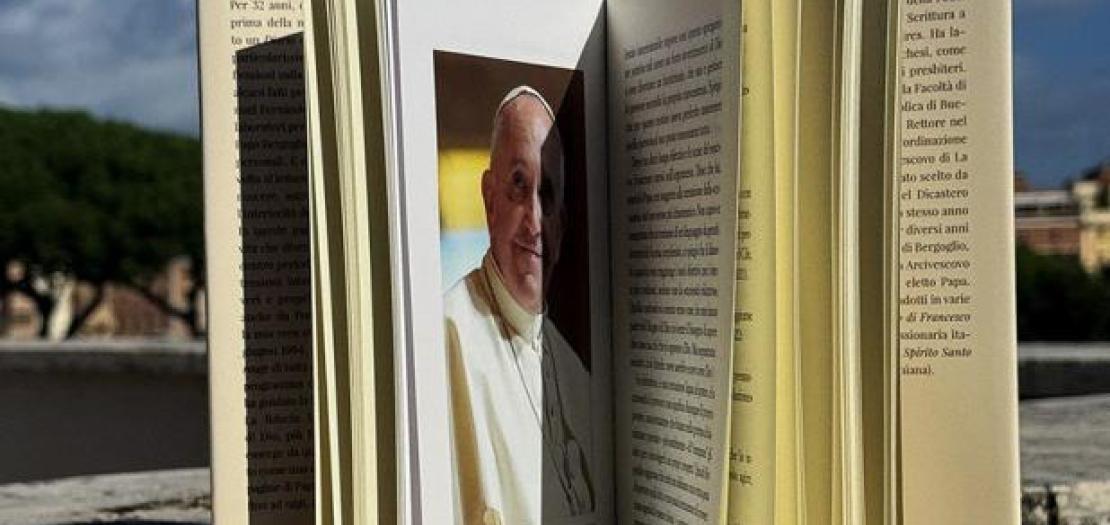
The reader feels a quiet sense of wonder, and is even moved, as the “heart” of Pope Francis gradually opens up.
In “The Private Diary of Pope Francis”, the reader comes to know his fears, his reflections, some of his most hidden thoughts, his unchecked feelings, and his judgments about himself and his actions.
It contains spiritual “visions,” such as that of the Lord smiling at him with mercy, or the threatening vision of the devil. It also reveals crises, including a spiritual crisis like the “dark night” described by Saint John of the Cross: a stripping of the soul, without separation from God, for a more radical union with Him.
Jorge Mario Bergoglio gave expression to the breadth of this inner life by jotting down brief notes in small, slanted handwriting in a planner with a black plastic cover. It dated from his years in Buenos Aires and was later kept at Casa Santa Marta.
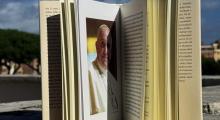
The Private Diary of Pope Francis opens this treasure chest, allowing the world to discover the most intimate side of a Pope who always shared a great deal about himself.
The book is now being released in five languages, with distribution in 94 countries and published in English by Penguin Random House in the US and the UK.
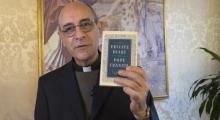
The Diary was edited by Cardinal Victor Manuel Fernández, a longtime friend of Francis, whom he called from Argentina to Rome in 2023 to serve as Prefect of the Dicastery for the Doctrine of the Faith.
It is precisely the trust between the two men that has brought these private writings to light today.
Cardinal Fernández explains this in the prologue, recalling an “old agenda book” he saw one afternoon at the Casa Santa Marta, where Pope Francis resided. Francis told the Cardinal: Others will see about this.
Cardinal Fernández later spoke to Pope Leo XIV about the matter and received his approval for publication. After a year, Cardinal Fernández completed the work, selecting the texts that can “bring some edification to readers.”
Reading the book’s 160 pages without sensationalism or spiritual or psychological voyeurism proves edifying, because what stands out above all is God’s work in the life of a believer, in this case the Vicar of Christ.
This Pope’s humanity, always celebrated but most often reduced to social initiatives or unconventional gestures, lay precisely in seeing himself as human. He was a man who listened, with his wounds and his thirst for grace.
He wrote a terse “I am afraid,” referring to his fear that he was unequal to his role or might cause "harm” to others. He went so far as to ask the Lord to take him “away” instead.
He was also a man of prayer and devotion, who entrusted himself to his beloved “Little Thérèse” (Saint Thérèse of Lisieux), to Saint Joseph, and to Our Lady, whom he asked “to protect and help me” less than a year before his death.
Bergoglio was a man of sacrifice, physical sacrifice in particular. He had experienced a great deal of “fatigue” and health problems since the 1990s, but he set them aside for the sake of a “dedication” to his pastoral work that he considered essential.
These writings also reveal that the Pope of the streets, with his frank speech and sharp wit, had a mystical side.
His “spiritual visions” attest to this, beginning with those of the devil. “I clearly heard the voice of the devil,” he wrote tersely in the planner. He had seen him once “from the car” and another time “in the choir loft” during Mass.
He could not forget his "menacing" eyes and sensed his presence lying in wait, intruding on his journeys, such as his 2018 visit to Chile amid the abuse scandal, and on his governance of the Curia. The devil tempted him with a “pagan seduction.”
Bergoglio “fought.” He “fought” with the Rosary. “The Virgin saved me,” he wrote.
In this vein, one of the most intense passages in the Diary concerns the “spiritual crisis” that the Pope reveals he experienced for about two years of his pontificate, from the beginning of 2021 until 2022, as his illness worsened and he also faced “decisive assaults by the forces of evil.”
“If the devil is attacking so blatantly, it's because there's not much time left and he wants his prey,” he said in 2016.
His own strength depleted, Francis entrusted himself entirely to God’s mercy. And from God he received “signs” and “promptings” that strengthened his “trust in the midst of trials.” He said he had spoken with the Lord in the chapel: “He smiled… I felt the merciful gaze of Jesus.”
This crisis bore fruit in a “spiritual renewal” that crystallized in two documents, one of the most interesting aspects of the story. The two drew less attention in the media but are extraordinary in light of what the Pope experienced inwardly: C’est la confiance, the 2023 Apostolic Exhortation marking the 150th anniversary of the birth of Thérèse of Lisieux, and Dilexit nos, his final Encyclical, issued in 2024, on the Heart of Jesus Christ.
Cardinal Fernández says these “two documents are a synthesis of the latter Francis.” They bring together an “intense and consoling trust in a God of love” and “commitment to others,” both of which sprang from that “spiritual experience.”
There is another significant episode: his journey to Lisbon for World Youth Day 2023.
Pope Francis visited Fatima on that occasion. He did not utter a word before the Virgin, and everyone wondered why. The answer is in a note from October: “I gazed and prayed.” He said nothing to the others because he was speaking to Our Lady. And she answered him.