Issued by the Catholic Center for Studies and Media - Jordan. Editor-in-chief Fr. Rif'at Bader - موقع أبونا abouna.org

By Massimiliano Menichetti/ vaticannews.va
The journey Pope Leo XIV is preparing to undertake on November 6-17 in Uruguay, Argentina, and Peru will be full of encounters and rich in memories.
Pope Leo’s sixth international Apostolic Journey brings together the proclamation of the Gospel and concern for young people, the poor, and Amazonian peoples, in a spirit of unity and reconciliation.
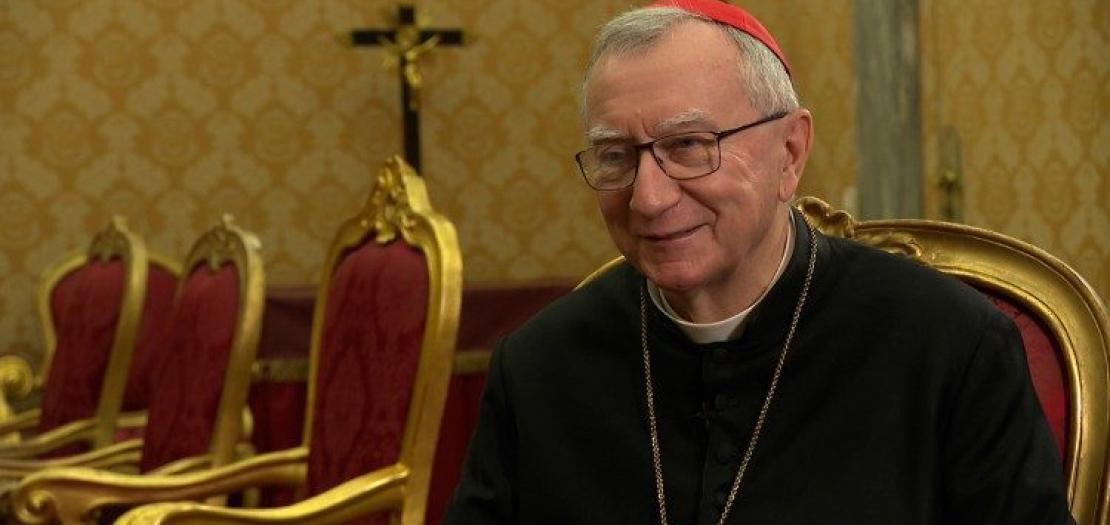
In the following interview with Vatican News, Cardinal Secretary of State Pietro Parolin emphasized that “in Latin America too, there is a greater need than ever to overcome deep social polarization, and the Church’s first mission is to bear witness to unity, becoming a leaven of peace, dialogue, and harmony.”
Q: Your Eminence, the Pope has expressed his joy at being able to return to Latin America, a continent where he experienced intense moments in his mission. How important is this personal bond for the journey ahead?
In returning to Latin America, Pope Leo XIV is returning to places that have shaped his life, especially in Peru. His encounter with local communities will therefore be filled with memories, affection, and gratitude. I think that, on a personal level, it will be a very intense and deeply engaging experience.
The institutional dimension of the Apostolic Journey is also enriched, because the Holy Father’s cultural and spiritual familiarity with that setting supports dialogue with civil society.
The joy surrounding the forthcoming journey thus arises from the opportunity to renew ecclesial communion through the very same mission of service to the Gospel that he carried out as Bishop of Chiclayo and now continues throughout the world as Bishop of Rome.
Q: The journey will begin in Uruguay, one of Latin America’s most secularized countries. The motto chosen for this stage points us toward its missionary dimension, “I bring you news of great joy.” What message does the Pope wish to bring to a society where the Christian faith no longer occupies the place it once held?
The secularization of our societies, including Uruguayan society, is unfortunately a fact. This, however, does not change the Church’s mission. Proclaiming the Gospel, in season and out of season, remains her task, today as in the past.
What may change is the way she does so, and this is precisely the meaning of the motto of the Apostolic Journey to Uruguay, “I bring you news of great joy.”
Pope Leo XIV is not going to reclaim lost ground, but to propose good news that is offered freely, never imposed. This good news has a face and a name. It is Jesus Christ, the Son of God made man, the Savior, the one who gives meaning to our individual and collective histories.
I would note that this proclamation may find a particularly warm reception in a country born of the encounter between people of different origins and united in a single identity, yet also marked, especially today, by hardships and wounds affecting many families and young people. It is precisely there that proclaiming Christ means offering hope to broaden life’s horizons.
To the Church in Uruguay, small in numbers but vibrant, preserving the faith in a setting that is not always easy, the Holy Father wants to say that its members are not alone and that their humble, joyful daily witness is the way through which the Gospel can once again speak to the heart of the country.
Q: The second stage will be Argentina, where Pope Leo XIV will be welcomed in a country that preserves a particularly strong memory of his predecessor. How will the Pope speak to this country, which is also marked by economic difficulties and social tensions?
Pope Leo XIV will arrive in a country that preserves a particularly vivid memory of Pope Francis, remembered with gratitude in his own country, throughout the Church, and in the hearts of so many men and women around the world.
I believe he will wish to pay tribute to him and, in some way, respond to a hope Argentinians have long carried in their hearts, that of welcoming the Successor of Peter, since Pope Francis was unfortunately unable to make a visit during his pontificate.
He will address Argentinians as a father addresses his children, using the language of closeness, certainly not to bring technical solutions, but with a desire to stand alongside those going through a difficult time.
He will acknowledge the commitment of those who, at various levels and with different responsibilities, are seeking concrete ways to build a future of justice and prosperity for everyone, pointing to sincere dialogue and unity as the surest path to lasting solutions.
At the same time, he will wish to embrace individuals, families, and communities who strive each day, with dignity and sacrifice, to carry on, so that no one feels excluded. This is what the visit’s motto emphasizes, “Welcome everyone. Go and proclaim.” It is a welcome that leaves no one out and a sending forth that makes each person a bearer of hope!
The example of the nation’s founding fathers, such as San Martín, still reminds us today that a people’s strength comes from listening to one another, respecting everyone, caring for those facing the greatest difficulties, and sharing a spirit of generosity.
Q: Peru represents a stage we might describe as personal for Pope Leo XIV. It is the country where he carried out his pastoral mission, served as Bishop of Chiclayo, and developed a deep bond with the people. What does this return mean, now as Bishop of Rome, beyond his role as pastor of a local Church?
A few months ago, when the Holy Father met the bishops of Peru during their ad limina Apostolorum visit on January 30, 2026, he shared a thought that may help us answer this clearly very personal question.
The Pope spoke to them about the special place Peru holds in his heart, because he shared its joys and hardships, learned so much from the faith of ordinary people, and experienced the strength of a Church that knows how to persevere through trials.
In light of those words, I think one of the feelings accompanying his return is, in Pope Leo XIV’s own style, a humble and joyful gratitude for what he received during the years of his ministry in Peru, from everyone, especially the humblest members of the People of God.
The Pope, however, returns to Peru as Bishop of Rome, Successor of Peter, and Pastor of the universal Church. This is a great gift for the many people who have known and loved him.
It brings an even deeper and stronger bond of communion with the whole great Family of God, as the love experienced between the flock and the pastor of a particular Church, whose faith is vibrant and firm, blossoms into a love that embraces all humanity in the Lord.
Q: One of the most significant stages will be Pucallpa, in the Peruvian Amazon, where the Pope will meet men and women missionaries and representatives of Amazonian peoples. Following the Synod for the Amazon and Pope Francis’ appeals to protect our common home, what are today’s priorities?
In continuity with Pope Francis’ appeals, Pope Leo XIV also renewed the invitation to promote a more responsible relationship with creation on the occasion of the World Day of Prayer for the Care of Creation, on September 1.
In light of the Synod for the Amazon and the teachings contained in Laudato si’ and Querida Amazonia, protecting the dignity of the human person remains central, with particular attention to the most vulnerable.
Protecting the environment is closely connected to defending the lives, rights, and living conditions of the populations most exposed to environmental degradation and the exploitation of resources.
It is also necessary to rethink models of development and production, moving beyond an understanding of growth focused exclusively on profit and consumption. We must promote an economy that pays greater attention to the human person, social justice, and future generations, valuing the cultures, rights, and knowledge of Indigenous peoples.
In this sense, the Amazonian experience provides an important example of how protecting creation is linked to respecting the communities that inhabit it. For the Church, this responsibility requires a pastoral, educational, and social commitment grounded in listening and closeness to these communities.
Q: In all three countries, the program alternates between meetings with the authorities, liturgical celebrations, encounters with young people, and visits to the most vulnerable. In your view, what are the deepest hopes Latin American communities are placing in this journey?
Argentina, Uruguay, and Peru share a historical, linguistic, and cultural heritage rooted in their common past.
Beyond each nation’s geographical, ethnic, and economic differences, the fundamental pillars linking the three countries include their shared language, which allows direct communication and a rich cultural exchange, and the Catholic faith. This faith has shaped a culture imbued with fundamental values such as family, openness to life, and community bonds of fraternity, solidarity, and hospitality.
Given these shared characteristics, the visit of the Holy Father Leo XIV inspires a mixture of joy and hope in these communities, together with great pastoral and social expectations.
Faced with complex socioeconomic, political, and historical circumstances, local crises, and everyday difficulties, the communities await words of encouragement in the search for reconciliation and peace, and on the importance of social justice in the lives of their peoples, with particular attention to restoring the social and environmental well-being of Indigenous peoples.
These expectations are accompanied by enthusiasm and joy because, for many bishops, priests, religious, and faithful in the region, the Apostolic Journey represents a sign of the Pope’s special affection for a part of the world where the shortage of priests, great geographical distances, and enormous challenges call for his fatherly, close, and caring presence.
Q: In many Latin American settings, priests, men and women religious, and laypeople continue to devote their lives to serving alongside the poor, sometimes in situations of grave risk. How important is it to support this witness?
I believe this aspect of evangelization is not only important but decisive. The witness of these brothers and sisters helps reveal the face of a Church that speaks about the poor, lives with them, shares their hardships, and stands by their side.
The work of so many Christians who, out of faith in Christ, devote their lives to the poor bears witness that the Church does not resign herself to injustice, violence, and what Pope Francis called the “throwaway culture.” I truly believe it is possible to build a different and better world.
We need these generous people. Their lives are a prophetic sign calling the entire People of God to remain faithful to the mission to the least among us, entrusted to it by the Lord Jesus.
Q: There is great anticipation, especially among young people who also face job uncertainty, insecurity, fear of the future, and sometimes poverty and deprivation. How can the Church help them regain confidence and feel that they can be agents of change?
Young people are experiencing difficult times. They know it is possible to live in peace, seek justice, find work that gives them dignity, and build a family. Yet they live in a world marked by war and injustice, with precarious employment and increasingly fragile families.
At this time of such contradictions for younger generations, the Church offers the witness of the Gospel and an encounter with Jesus. This encounter changes lives by offering a way to live them to the full, amid problems and tensions, without feeling alone.
“In the world you will have trouble, but take courage! I have overcome the world,” Jesus says in the Gospel of John.
It does not seem coincidental to me that this verse is the theme of the next World Youth Day in Seoul. I believe this is the message the Pope will bring to the many young people he will meet during his journey, inviting them to follow Christ in order to live fully the time they have been given.
Q: The Church is called to engage in dialogue with civil institutions while preserving her freedom and prophetic strength. How important is this balance for the good of every person?
I consider it an essential balance. The Second Vatican Council expressed it clearly. The political community and the Church are independent and autonomous, each in its own sphere, but both, in different ways, serve the personal and social vocation of the same people (cf. Gaudium et spes, 76).
Their meeting point is therefore the good of the individual person. The three countries the Holy Father will visit show how this principle can take shape in different settings, from Uruguay’s long tradition of secular government to the agreements with the Holy See in force in Argentina and Peru.
The Church is called to cooperate and does so willingly. At the same time, she continues to point out whatever wounds human dignity. Fidelity to the Gospel calls her to be particularly close to the weakest. Ultimately, institutions exist for people.
Addressing parliamentarians on June 21, 2025, during the Jubilee of Governments, Pope Leo XIV recalled their duty to promote and protect the common good, beyond particular interests and with special attention to the weakest and most marginalized.
It is on this ground that cooperation between the Church and civil institutions can bear fruit, with their respective responsibilities clearly distinguished and for the benefit of all.
Q: Your Eminence, you too have a special bond with Latin America. What do you personally hope this journey will leave in the Pope’s heart?
Drawing also on my personal experience, I hope the Holy Father will find Christian communities committed to being a sign of communion in their respective countries.
By her very nature, the Church is a sign and instrument of unity for all people, and in Latin America too, there is a greater need than ever to overcome deep social polarization. The Church’s first mission is to bear witness to unity, becoming a leaven of peace, dialogue, and harmony in society.
The Pope, who is the visible sign of the Church’s unity, is also, wherever he goes, the foremost witness to the need to overcome divisions and work together for the common good.
I hope the heart of the Successor of Peter may be consoled by encountering Churches committed to growing in unity and serving social harmony.