Issued by the Catholic Center for Studies and Media - Jordan. Editor-in-chief Fr. Rif'at Bader - موقع أبونا abouna.org

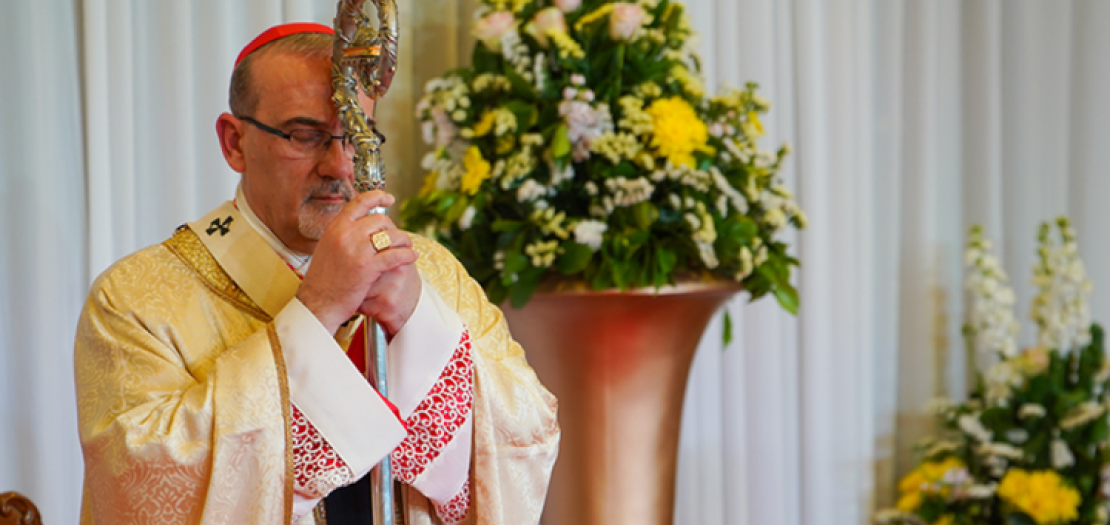
Following is the text of the meditation by His Beatitude Cardinal Pizzaballa, Latin Patriarch of Jerusalem, marking the Feast of the Conversion of Saint Paul in Nicosia dated January 24, 2026:
Brothers and sisters,
the conversion of the Apostle Paul, which we celebrate solemnly today, is not primarily a story of sin and forgiveness. It is not simply the account of a man who makes a mistake and then retraces his steps. Above all, it is a story of encounter.
An encounter that does not arise from a search, but from surprise. It does not emerge from doubt, but from conviction. It does not take place in failure, but in the fullness of religious certainty.
Paul was not searching for God. He was not experiencing a spiritual crisis, nor had he lost his faith or felt distant from the Lord. On the contrary, he was convinced he was right - persuaded that he was serving God faithfully, zealously, coherently, passionately. And it is precisely there, within this deep and apparently irreproachable certainty, that the Lord reaches him.
This is already a decisive message for all of us gathered here today, coming from different Churches, traditions, and spiritual paths: God meets the human person not only when they are lost, but also when they are self-assured. God enters not only our obvious fragilities, but also our religious certainties, our well-constructed frameworks, our spiritual securities.
On the road to Damascus, Paul falls to the ground - but before that, his inner certainty falls. The light that surrounds him is not merely dazzling; it is revelatory, unmasking. It does not simply illuminate the outward path, but lays bare the heart, the intentions, the deepest motivations.
And the voice he hears does not accuse or explain. It does not offer a lesson. It asks a single, simple, devastating question: “Why are you persecuting me?” Jesus does not say, “Why are you persecuting my disciples?” He does not say, “Why are you persecuting my community?” He says, “Why are you persecuting me?”
Contained in this word is one of the most profound revelations of the Christian mystery: Christ identifies himself with his Body. Christ makes himself present in the Church - in its fragility, in its wounds, in the concrete flesh of brothers and sisters.
Whenever communion is broken, whenever a brother or sister is excluded or humiliated, whenever a community is wounded by pride, harshness, indifference, or violence, Christ himself is touched.
This word resonates with particular force as we celebrate together today, even while belonging to different ecclesial traditions. It reminds us that unity is not an ornament of faith, but an essential dimension of the mystery of Christ. The wounds between Christians are not merely historical or institutional wounds; they are wounds in the Body of the Lord, who continues to suffer in the division of his disciples.
Here, then, is Paul’s first true conversion: a transformation in his understanding of God.
Paul discovers that God is not an idea to be defended, but a Person who calls. Not a doctrine to be imposed, but a relationship to be received. Not a human project to be protected, but a gift that precedes all our efforts, initiatives, and strategies.
Immediately after the encounter, Paul is struck blind. This blindness is not a punishment; it is a time of grace. It is the necessary silence in which the Word of God can take root. It is the fertile darkness in which a person learns no longer to see alone, no longer to rely solely on their own capacities.
Paul, once a leader, must now accept to be led. The teacher becomes a student; the guide learns to trust the guidance of others.
This blindness also speaks to us - ancient Churches, rich in tradition, liturgy, theology, and memory. At times the Lord allows our lights to dim, our certainties to falter, our structures to reveal their fragility and limits - not to impoverish us, but to lead us back to what is essential: to rely solely on His grace, which is not possessed, but received.
Conversion is never a solitary act. Paul needs Ananias. He needs someone who, overcoming fear, welcomes him as a brother. He needs a community that believes God’s grace can be at work even where human history breeds mistrust and suspicion.
This is a particularly powerful message for a Church living in a land of borders, crossings, and coexistence such as Cyprus. Here, at the crossroads of peoples, cultures, and religions, Christian witness always passes through the capacity to welcome, to trust, and to recognize God’s work even beyond our established patterns. At this point, the Word of God also opens onto the life of peoples, nations, and institutions.
We extend a respectful greeting to the religious, civil and diplomatic authorities present today. Your participation in this celebration is a sign of attentiveness to the spiritual dimension of the human person and to the role religious traditions continue to play in shaping human coexistence.
Paul’s conversion reminds us that authentic change does not arise from force, but from encounter; not from violence, but from recognizing the other; not from imposition, but from patient listening.
In a world marked by conflict, geopolitical tensions, forced migrations, and still-open wounds (how not to think now to our beloved Holy Land conflict?), this Word of God takes on a deeply human and universal significance. It affirms that no peace is possible without a change of perspective, and that no reconciliation endures unless it passes through recognition of the other’s dignity, history, and suffering.
Paul believed he was serving God by fighting. Instead, he discovers that we serve God by converting the human heart. This also applies to life in all its different contexts: laws, institutions, diplomacy, and every community is called not only to manage balances of power, but also to safeguard what is human, to protect the person, and to promote justice and peace.
Cyprus, situated at the crossroads of continents and cultures, is an eloquent symbol of this vocation. It is a land that knows the value of encounter, but also the weight of division - a place where history teaches how fragile peace is, and how necessary it is to protect it with patience, dialogue, and shared responsibility.
The figure of Paul - crossing seas and borders without weapons or power, but with the sole strength of the word and of witness - remains a reference point for our own time. He reminds us that the future of peoples is not built against someone, but together, and that true authority is born of service.
When Paul regains his sight, he does not receive a reward, but a mission: “I have chosen you so that you may know me and bear witness to me.”
Christian conversion never closes in on itself. Whoever encounters Christ is always sent. Faith is not something to be possessed, but a gift meant to be shared.
The mandate of the Risen Lord - “Go into all the world and proclaim the Gospel” is not entrusted to one Church alone, but to all disciples.
Paul will not proclaim himself. He will not display his experience as a trophy. He will proclaim Christ crucified and risen - and he will do so with passion, intelligence, struggle, suffering, until his life is spent.
And so today, this solemn celebration becomes for each of us an open and personal question: From what is the Lord calling us to be converted, as individuals and as Churches? Which certainties is he asking us to relinquish in order to be more faithful to the Gospel? Which steps toward communion, reconciliation, and shared witness are we still postponing?
Conversion does not belong only to the beginning of the Christian journey. It is a way of life. It is allowing ourselves to be continually surprised by God, who meets us precisely when we think we already know him.
Let us therefore ask today for the grace of Paul: not a comfortable faith, but a converted one; not Churches folded in on themselves, but communities on the move; not to “see more,” but to see better - with the eyes of Christ - so that together we may be witnesses of the Gospel, to the very edges of the sea and of history.