Issued by the Catholic Center for Studies and Media - Jordan. Editor-in-chief Fr. Rif'at Bader - موقع أبونا abouna.org

We have seen, in Jesus’ encounter with the Samaritan woman, (John 4:5–42) that Jesus is sitting by the well at Sychar, weary from the journey. And we said that this is not simply a physical weariness, but rather a weariness linked to his mission: Jesus is weary not only from the journey taking him from Judea to Galilee, but from another journey, the one that began in the bosom of the Father and led Him to seek out lost humanity, to lead it back home.
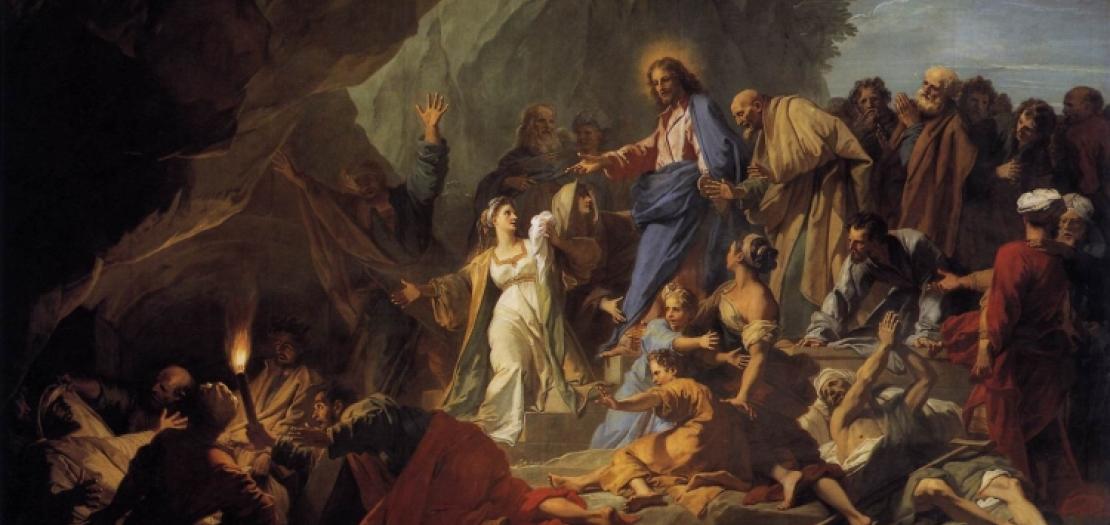
In today’s passage, (John 11:1–45) we see how far Jesus’s long journey reaches.
The journey leads him to confront death, which is one of the two main protagonists of chapter 11 of John. Because of this confrontation, this fight, Jesus today is not merely weary: he is also troubled and deeply moved. (John 11:33)
This confrontation with death is necessary and inevitable: if Jesus has come to fulfill God’s covenant with His creation, everything must be saved; and this salvation would not serve the purpose if death were left out. For if death was not overcome, it would mean that there is a place in our lives where communion with God ends, where the path between Him and us is cut off.
It will therefore be this confrontation—with death—that truly reveals to us who Jesus is, whether He is truly the One sent by the Father to bring us the good news of salvation.
In addition to death, as we have said, there is another central figure in this passage, and that is love.
We encounter this term right away, in verse 3, when Lazarus’s sisters send word to Jesus: “The one you love is ill.” Shortly after, it is said that Jesus loved Martha and her sister and Lazarus. (John 11:5) And then, in verse 36, when Jesus bursts into tears, those present exclaim: “See how he loved him.”
We thus have these two elements, death and love. And they would seem incompatible with one another; it would seem that where death arrives, love must inevitably yield, must cease to be.
Let us see, then, how this clash between love and death unfolds.
The story does not begin at the tomb, but far away, when Jesus receives the news of his sick friend.
Jesus does not rush immediately: he does not go to heal him, as he had done many times before with other sick people. He had healed many, in fact, and many were strangers. But faced with his sick friend, Jesus delays, and allows death to present itself in all its power.
When this has already happened, when there seems to be nothing left to do, Jesus sets out for Bethany; and when he arrives, Lazarus has already been dead for four days. (John 11:17) Death seems to have won, and love seems to have proved itself a useless love, incapable of saving from death.
This is what the sisters think as they go out to meet Jesus. Both, in fact, repeat the same phrase to him: “Lord, if you had been here, my brother would not have died.” (John 11:21, 32). Which means: if you had been there, where death appeared, where death came to take Lazarus, he would not have died; love would have triumphed, not death.
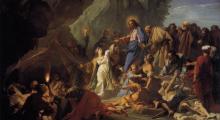
But Jesus does not limit himself to consoling the sisters for the loss of their brother: he wants to show that his love is capable of reaching him even in death. John’s account dwells at length on the journey Jesus makes to reach Lazarus’s tomb (Jn 11:34–38): he does not go to Lazarus’s bedside to heal him, but goes to Lazarus’s tomb to raise him from the dead.
He enters into death, descends into the darkest abyss where humanity has lost its way, and pulls it out from there.
It is not a spectacular miracle, a marvelous display: it is God’s final and most important revelation, showing that there is no place within humanity where God cannot enter.
Death releases its prey because the word of Jesus is the source of life. It does not only speak about life, as we often hear in the Gospel of John. But it generates life: when God speaks, what is dead becomes capable of hearing.
This, then, is what love does: it conquers death not through an act of power, but by entering into it, allowing itself to be moved, uttering a word that calls by name, signifying a relationship that is never broken, not even within a tomb.
+Pierbattista