Issued by the Catholic Center for Studies and Media - Jordan. Editor-in-chief Fr. Rif'at Bader - موقع أبونا abouna.org

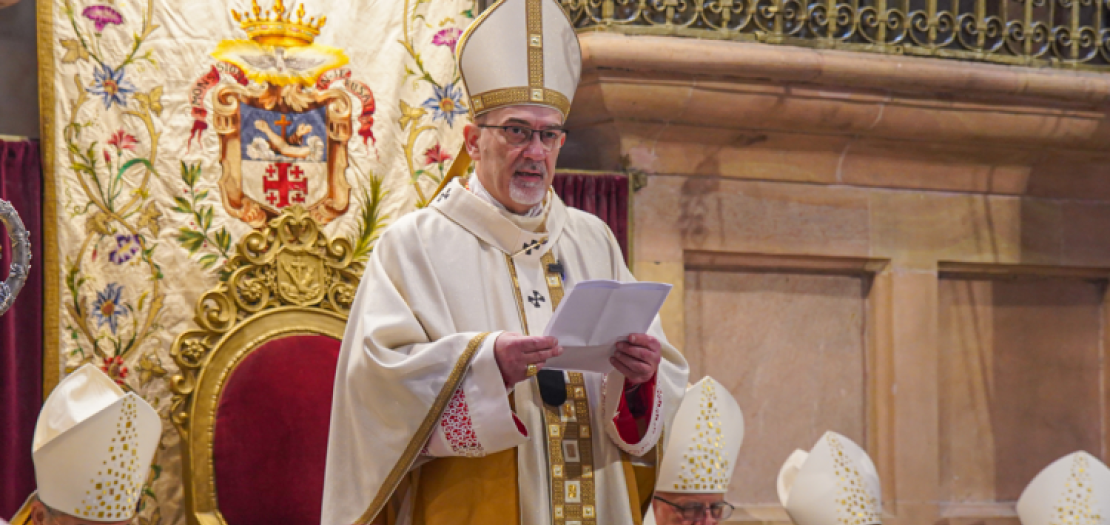
Following is the text of the Paschal Vigil Homily by Cardinal Pierbattista Pizzaballa, Latin Patriarch of Jerusalem, dated March 4, 2026:
Dear brothers and sisters,
This Holy Vigil takes us on a journey of expectation and hope, from darkness to light. Not abruptly but through a long and patient pilgrimage marked by the Word of God, by silence, by fire, and water. Easter does not begin with a proclamation of victory, but with listening to a story: a story that confronts death to reach life.
The doors are still closed. The silence is almost absolute, broken perhaps by the distant sound of what war continues to sow in this holy and torn land. Yet, right here, in this place where death has been inhabited by God, the Word of God resounds louder than any silence. And I say plainly that: we too, today, celebrate with a fragile faith that has been tested, perhaps weary… yet still standing. Not because we are strong, but because Someone sustains us here.
Here, death was neither avoided nor attenuated but faced fully to the very end. God did not choose an escape route but decided to enter the human condition in its most profound reality, taking upon Himself all the dimensions of human existence, including that which we unfortunately experience often today in a violent way: pain and death. He did this not to “explain” them from afar, but to inhabit them from within.
The lengthy Liturgy of the Word we have just heard has guided us through decisive moments in history. Creation emerging from chaos: “God said, ‘Let there be light,’ and there was light.” (Gen 1:3) The testing of Abraham on Mount Moriah, where a father is stopped from raising his knife and beholds a ram caught in the thicket, a prefiguration of the true Lamb. Then we hear of the crossing of the Red Sea: the open sea as a way of liberation, not of escape. The words of consolation from the prophet Isaiah: “For a brief moment I hid my face from you, but with enduring love I have compassion on you, says the LORD, your redeemer” (Isaiah 54:8). The universal invitation: “All you who are thirsty, come to the water” (Is 55:1). Then the voice of Baruch pointing to Wisdom as the way of life. Finally, the promise of Ezekiel: “I will give you a new heart and place a new spirit within you.” (Ezek 36:26) Every passage has led us to this point, where the Gospel of Matthew recounts: “There was a great earthquake; for an angel of the Lord descended from heaven, approached, rolled back the stone, and sat upon it.” (Matthew 28:2)
This scene is not a simple narrative detail. It is the heart of a passage that shakes the whole world: a stone removed not by human strength, but by divine power. At this moment, it seems there is no one who can roll away the stones from the tombs of suffering continuously dug up by war. But precisely for this reason, we listen with greater urgency to the question the women carried in their hearts: “Who will roll back the stone for us?” (Mark 16:3) It is not only a practical question. It is the question at the heart of every search for hope when it seems there is nothing left to do. It is the quest of those who love without seeking immediate answers, of those who approach the mystery with trust, even when the path appears obscured. Today, this question is raised throughout the Holy Land, and from every place in the world marked by violence. And the answer is not an empty proclamation, but an actual occurrence: the stone has been rolled away. Not by our own strength, but by the power of God’s love, which is stronger than death.
Brothers and sisters, that question – “Who will roll back the stone for us?” – here, today, is not a distant echo of the Gospel. It is the cry rising from our homes, because around us stones have been put back in place. And yet, today we are here: in a tomb that has been opened once and for all. Not because we were able to remove the stone by our own strength – we know well how weak we are, how afraid we are – but because Someone has rolled it away before, without waiting for us to be up to the task, without asking whether we had enough faith. The stone was rolled away while it was still dark, when no one yet believed it possible. And this is the first Easter proclamation, here and now: God does not wait for our wars to end before beginning to restore life. He begins in the darkness. He begins in the silence. He begins in the tomb that is still sealed.
On this Vigil we are being confronted: are we still trying to roll away the stones that oppress us on our own? Or do we allow Him, the Living One, to go before us? Because Easter is not the result of our efforts to achieve peace, however necessary they may be. It is the foundation that makes every effort possible. If the tomb is empty, then nothing is truly said and done. No land is forever in dispute, no wound is forever incurable, no memory is forever captive to hatred. Not because it is easy – we know how difficult it is – but because the direction of history has changed. We no longer walk towards death: from this tomb, death is behind us. And even when war seems to tell us otherwise, we are the ones who have seen the stone removed.
And together with that stone, the Gospel seems to roll away another stone: fear. For the first Easter message, here is simple and disarming: “Do not be afraid” (cf. Mt 28:5). Entering this empty tomb—even without fellow pilgrims, alone, despite the war—means coming face to face with the mystery of life that is renewed. The empty tomb is not a void that erases history. It does not tell us that suffering does not exist or that it will cease. The risen body of Christ, as the Gospels remind us, is not free of the marks of the Passion. But those wounds are not signs of defeat: they are the seal of a life that has conquered death, by bearing it within Himself. This is the heart of Easter: God does not erase our history; he transfigures it, by bringing it into the light.
Today’s liturgy reminds us that the Resurrection does not tell us to overlook evil. It tells us that reality itself can be transformed by the power of God. He has made a way where there stood a wall. Where there was an immovable stone, now there is a threshold.
Jerusalem, a city marked by the memory of death, and today by so many divisions, becomes the place where life is proclaimed. Not an ideal, distant, spiritualized life. But in real life—the life of people, at homes, in relationships, in communities. The question pondered by the prophet Ezekiel —“Can these bones come back to life?” (Ezek 37:3)—is a question we too ask ourselves today, looking at the ruins around us and within us. The answer of faith in Paschal Mystery is clear: yes, they can come alive again. Not because God performs magical miracles, but because God is faithful to life in its most authentic expression. Not a life without contradictions, but a life that can pass through contradiction and emerge transformed. And this is already a Paschal judgment on history: death with its sting (cf. 1 Cor 15:55) is not the master, is not sovereign.
The Gospel of Matthew announces to us that: “He is going before you to Galilee.” (Matthew 28:7) The Risen One does not invite us to remain at the tomb. He does not call us to look back. He goes before us on the path of our daily lives. To celebrate Easter does not mean merely remembering a past event, nor hiding in a sacred place—not even in this most holy place. Faith is a journey undertaken in real life, where we are called to bear witness to Easter every day. Galilee is one’s home, one’s neighborhood, one’s work, one’s shared suffering. In our Holy Land, Galilee is the courage to start believing once more that another path is possible. And if the Risen One ‘goes before us’, then hope is not a feeling: it is a step to be taken. It is a going forth.
Dear brothers and sisters, we are not called to leave behind a monument, but to carry with us the sign of an empty tomb: a sign that does not deny history, but opens it to hope. And allow me to say this: if here, today, there is a “stone” that we can truly roll away, it is the one that weighs our hearts—the stone of resignation, of resentment, of mistrust. The Gospel does not ask us to perform extraordinary feats, but to guard life, even in small ways. We are called not to deny the cross, but to transfigure it, making it part of the path of salvation that unites us to the life of God.
And this is the Easter message, here from the Holy Sepulcher: do not stand still before the stones of the world, but let us become— as much as we are able —“living stones,” signs of reconciliation, artisans of hope, witnesses to a life that death can no longer extinguish.
Christ is Risen. He is truly risen. Alleluia!
+Pierbattista Pizzaballa
Latin Patriarch of Jerusalem