Issued by the Catholic Center for Studies and Media - Jordan. Editor-in-chief Fr. Rif'at Bader - موقع أبونا abouna.org

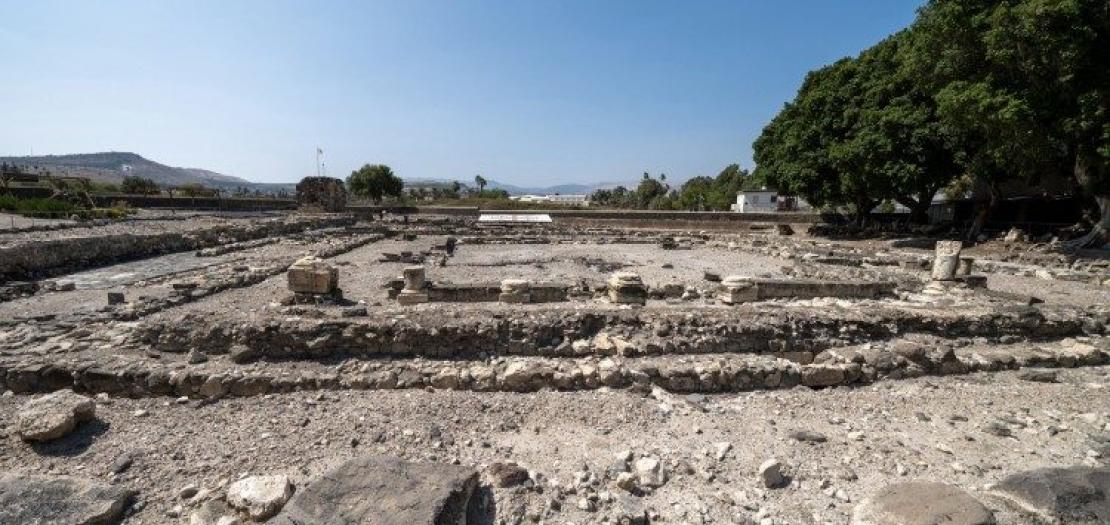
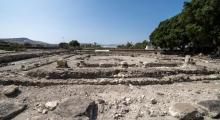
Archaeological site of ancient Magdala
In his first piece in a series of features dedicated to Bible characters published in the daily L’Osservatore Romano (and later collected in a book), Fr Frédéric Manns describes Magdala in the following way: “Dawn illuminated the fortified city of Magdala as it appeared in all its splendor to the weary eyes of the disciples. The Sea of Galilee glistened like a large mirror in the rising sun. The hills of Gaulanitis stood out on the other side of the lake. Jesus suggested making a brief stop to visit a new synagogue that had just been inaugurated. He wanted to proclaim the Good News of the Kingdom of God there. To avoid upsetting his disciples, he had deliberately avoided passing through Tiberias, a Roman city that had been recently built on a cemetery” (cf. Frédéric Manns, Raccontando la Bibbia, 2022, p. 148). Fr Manns’ first piece was dedicated to a fascinating woman who was born and lived in that city in Jesus’ time: Mary Magdalene.
According to Fr Manns, the encounter between the Teacher and Mary Magdalene may have taken place on the pier of the port, when the luxurious boat of this wealthy and tormented woman crossed paths with the decidedly more ordinary and humble boat of the Apostles, during the time of preaching known as the “Galilean Spring”. Luke the Evangelist wrote: “Soon afterward [Jesus] went on through cities and villages, preaching and bringing the good news of the kingdom of God. And the twelve were with him, and also some women who had been healed of evil spirits and infirmities: Mary, called Magdalene, from whom seven demons had gone out” (Lk 8:1-2). At the end of his Gospel, Mark (16:9) wrote that Jesus had cast away seven demons from Mary Magdalene, healing her from a very serious illness that affected her whole person and the most important aspects of her life. Seven demons indicated an “illness” that was very serious, affecting body, mind, soul, conscience, relationships, life choices and behaviors. It is no coincidence that Christian tradition identifies seven capital sins. In the New Testament, Mary Magdalene is by far the most important woman after the Virgin Mary.
A site with great archaeological value
Pilgrims who visit Magdala, which is located a few kilometers from Capernaum, Tabga and Tiberias, can have the extraordinary experience of walking among the remains of a city where Jesus and his first disciples very likely docked their boat. Jesus probably prayed and maybe preached in the synagogues in Magdala, walked along the magnificent road and stopped to speak in the forum. Excavations carried out by archaeologist friars of the Studium Biblicum Franciscanum (SBF) of Jerusalem and other teams have brought to light a city which, if not reaching a population of 40,000 as reported by Flavius Josephus (Vita 126-129; 142; Bellum Iudaicum II,608-21,4), was nevertheless the most important city on the western shore of the lake before Tiberias was founded, as well as the richest from a commercial, cultural and strategic standpoint (Flavius Josephus, Bellum Iudaicum II,21,4; III,10,1).
An important city on the banks of the river
Magdala-Tarichea was located on the northwestern bank of Lake Tiberias (Kinneret), in Galilee, some 210 meters below sea level, 6.6 kilometers north of Tiberias and about 10.3 kilometers south of Capernaum. It was in a strategic location along the Via Maris that connected Egypt to Syria, and its ruins cover an area of roughly 6-10 hectares (cf. De Luca — U. Leibner, A monastery in Magdala (Taricheae)?, in: “Journal of Roman Archaeology” 32, 2019, pp. 390-414). The city’s original Semitic name was Migdal, or, Magdala, which means “tower” in Hebrew and in Aramaic. Rabbinical sources call it Migdal Nunayya, which means “Tower of the fish”.
Magdala’s economy was based mainly on fishing and the processing and salting of fish (hence the Greek name Tarichea). It had an imposing port structure with docks, cranes and a fleet of about 230 boats. Transit trade and businesses for dyeing fabric rounded out the city’s economy. The workshops where the fish was processed also had baths for purification to guarantee that the products were legally pure. Excavations have also documented a social stratification which can be seen in the construction of homes: noble houses with courtyards with columns and mosaics coexisted with more modest dwellings, such as one that probably belonged to a family of fishers who rounded off their income with a small bakery. Thermal baths, public baths, a gymnasium (marked with a rich advertising sign made with mosaics), and the quadriportico bear witness to the Greek inculturation of the urban elite (cf. R. Bauckham — S. De Luca, Magdala As We Now Know It, in: “Early Christianity”, vol. 6/2015, pp. 91-118).
Mary of Magdala
As I mentioned above, Mary’s connection with Magdala is present in all of the Gospels, which describe her as “Mary Magdalene” (Mt 27:56, 61; 28:1; Mk 15:40, 47; 16:1, 9; Jn 19:25; 20:1, 18), as “Mary, called the Magdalene” (Lk 8:2) or as “the Magdalene Mary” (Lk 24:10 - YLT). Whereas traditional interpretations believe this epithet points to her birthplace, some scholars suggest the term may have a deeper meaning. Joan E. Taylor studied the origin of the name of Mary Magdalene and its link with the town of Magdala on the Sea of Galilee. According to her, the name “Magdalene” is not derived from a particular geographical location, but rather is an Aramaic nickname (“Tower Woman”), like the ones Jesus chose for his closest disciples, indicating her authority as a disciple (J.E. Taylor, Missing Magdala and the Name of Mary ‘Magdalene’, in: “Palestine Exploration Quarterly”, 166/3, 2014, pp. 205-223). Mary of Magdala was part of a circle of women who followed Jesus and who provided for him with their resources (Lk 8:3). She witnessed the crucifixion, Jesus’ burial (Mt 27:55-56, 61), and the empty sepulcher (Mt 28:1-8). According to the Gospel of John, the Risen One appeared to her first and entrusted her with announcing the message of the Resurrection to the Apostles (Jn 20:11-18).
The fourth Gospel’s account of Mary recognizing Jesus is moving: “she turned around and saw Jesus standing there, but she did not know that it was Jesus. Jesus said to her, ‘Woman, why are you weeping? Whom are you looking for?’ Supposing him to be the gardener, she said to him, ‘Sir, if you have carried him away, tell me where you have laid him, and I will take him away.’ Jesus said to her, ‘Mary!’ She turned and said to him in Hebrew, ‘Rabbouni!’ (which means Teacher)” (Jn 20:14-16). Countless artists have depicted this encounter, and the Easter sequence Victimae Paschali Laudes ‘sings’ it with one of the most evocative Gregorian melodies: “Dic nobis, Maria, quid vidisti in via?” (“Tell us, Mary: say what you saw on the way”).
Respected Franciscan archaeologists (Corbo, Loffreda) believed the current site of Magdala to be the birthplace of the woman the Church calls the “Apostle to the Apostles”. It is important to remember that it is in the nature of religious anthropology and popular devotion, which includes the experience of pilgrimages, to link names, people and events to concrete places, nurturing a “tradition” which in most cases represents a solid bond with history.
The discovery of the first-century synagogue
Found in 2009 by Dina Avshalom-Gorni and Arfan Najjar, the Magdala Synagogue is located in Galilee and dates back to before 70 AD. It consists in a large vestibule, a main room with a raised corridor lined with stone benches along the perimeter of the walls, and a small lateral room that very likely was where Torah scrolls were kept. The walls and columns were decorated with brightly colored frescoes, and there were remains of mosaics on the floor.
It is believed that the synagogue was constructed in three phases and that it was probably abandoned and damaged around the time of the Roman conquest in 67 AD, perhaps within the context of the First Jewish Revolt. The main room is some 120 square meters and could have housed 120 people. The most extraordinary finding is a sculpted stone found in the middle of the room, decorated on all sides with motifs referring to the Temple of Jerusalem, including the seven-branch Menorah, whose depiction dates back to a time when the Temple was still standing (cf. R. Bauckham — S. De Luca, op. cit., pp. 106-111).
From Jewish city to Arab village
Magdala’s decline began with the Roman destruction of 67 AD and continued after an earthquake in 363 AD (V.C. Corbo, “Scavi archeologici a Magdala (1971-1973)”, in: Liber Annuus 24, 1974, pp. 5-37). The city shrank in size and importance, but the memory of its link to Mary Magdalene endured.
In fact, starting from the second half of the fourth century AD, Magdala became a destination of Christian pilgrimages for devotees of Mary Magdalene. It was later organized around a fortified monastery built using pre-existing structures in the southern part of the city, an area that had previously been part of the port. Pilgrims headed to the shrine commemorating her birth or her home, entered directly from the place where they docked, into the monastery walls. The church and monastery, and the areas set aside for welcoming pilgrims, remained in use until the first Islamic period. Crusader pilgrims recall the basilica up to 1294, when Ricoldo da Montecroce described it as having been “turned into a stable”. The Byzantine port structures found between the ’70s and ’90s are no longer visible. They included a dock, a closed basin and a paved road leading towards the monastery entrance, similar to the one in the Kursi complex (cf. S. De Luca — A. Lena, “The Harbor of the City of Magdala/Taricheae…”, in: S. Ladstätter, F. Pirson, T. Schmidts cur., Häfen und Hafenstädte im östlichen Mittelmeerraum von der Antike bis in byzantinische Zeit…, 2014, pp. 113-163).
Up until 1948, the Palestinian village of al-Majdal, which, like the Greek name, Magdala, means “tower” in Arabic, covered the site of the ancient city of Magdala. Like many other villages, its inhabitants were driven away by the Israeli army during the Arab Israeli War (W. Khalidi edit., All That Remains…, 1992, pp. 529-530).
Archaeological excavations
Magdala’s archaeological history began in 1971 when the Custody of the Holy Land, which had already owned land in the area since 1889, entrusted Fr Virgilio Corbo and Fr Stanislao Loffreda with the task of conducting systematic excavations (cf. S. Loffreda, “Alcune osservazioni sulla ceramica di Magdala”, in: Studia Hierosolymitana I, 1976, pp. 338-354). During the course of eight campaigns between 1971 and 1977, the two Franciscan priests uncovered a Byzantine monastery, a paved road (cardo), a public square surrounded by four porticos (forum), an urban villa with mosaics, a water tower and a building which at the time they described as a “mini synagogue” (cf. V.C. Corbo, “Piazza e villa urbana a Magdala”, in: Liber Annuus 28, 1978, pp. 232-240). Their work became the basis for the archaeological understanding of the city.
In 2007, after a long hiatus, the SBF launched the “Magdala Project”, led by Fr Stefano De Luca and Lena, with the objective of furthering investigations in the area that belonged to the Franciscans (S. De Luca, “La città ellenistico-romana di Magdala/Taricheae”, in: Liber Annuus 59, 2009, pp. 343-562). These excavations uncovered a thermal complex, a water canalization system and a large residential neighborhood. Moreover, the excavations conducted by the Magdala Project uncovered three distinct phases of use of the port (Hasmonian, Roman and Byzantine), as well as the port’s towers, mooring stones and basin (cf. S. De Luca — A. Lena, op. cit., pp. 113-163).
In 2009, construction of the Magdala Centre, a spiritual center established by the Legionnaires of Christ north of the Franciscan property, led to necessary large-scale archaeological investigations conducted by the Israel Antiquities Authority (IAA) and Universidad Anáhuac México Sur (cf. M. Zapata-Meza — A.G. Diaz Barriga — R. Sanz-Rincón, “The Magdala Archaeological Project 2010-2012”, in: ‘Atiqot 90, 2018, pp. 83-126). In addition to the first-century synagogue, the investigations uncovered four residential areas, a network of roads, the remains of a market and containers used for fish salting. Results from the excavations were published as a collective effort by archaeologist Marcela Zapata-Meza (cf. M. Zapata-Meza et al., Ancient Magdala: Archaeological Excavations 2010-2017: Volume I: Daily life, First interpretations, 2025). In 2021, excavations in the same area, led by Dina Avshalom-Gorni, brought to light another synagogue dating back to the Second Temple Period.
The return of pilgrims
Pilgrims who visit Magdala today seeking a connection with the city of Mary Magdalene, the place where the Saint’s gaze first encountered Jesus’, can immerse themselves in the scene and be guided by the above-mentioned account by Fr Frédéric Manns, who pictured the moment when Mary was healed by the Teacher on the pier of Magdala: “Jesus prayed and ordered the demons to leave the woman. Seven demons came out. A violent cry as quick as lightening marked their exit. Jesus said to her ‘Woman, now that you have been freed, your vocation is to open the world to the era of heart and compassion. The door of the Kingdom of Heaven shall open for you when you find the key” (F. Manns, op. cit., pp. 150-151). And truly, this became Mary’s mission, as was clear on Easter morning when, after being the first to see the Risen One, she earned the honor of being called “Apostle to the Apostles”.