Issued by the Catholic Center for Studies and Media - Jordan. Editor-in-chief Fr. Rif'at Bader - موقع أبونا abouna.org

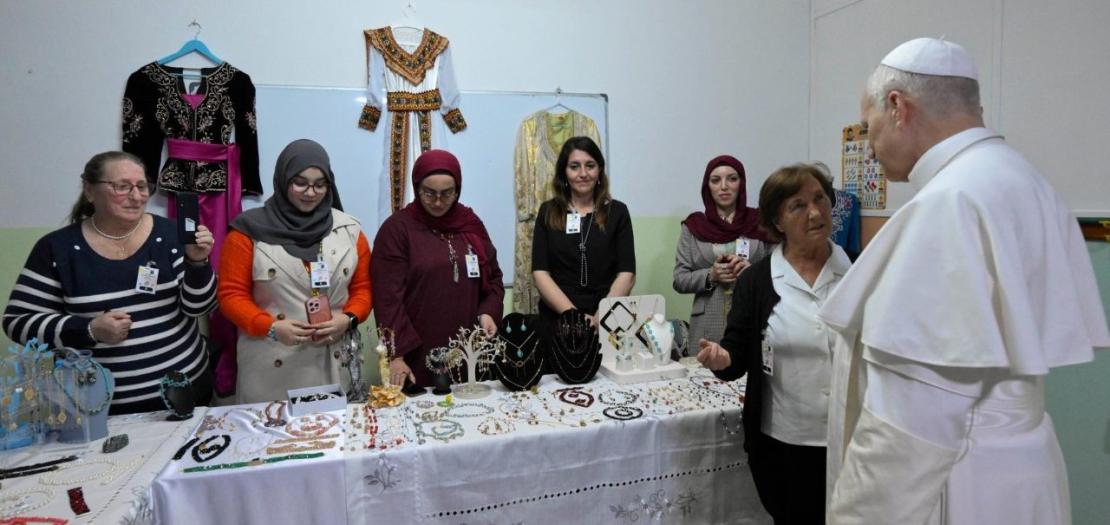
Pope Leo visits Centre for Welcome and Friendship in Algiers run by Augustinian Missionary Sisters
Pope Leo XIV met with members of the community in Algeria on Monday, April 13, at the Basilica of Our Lady of Africa in Algiers, the last event of his first day in the country.
Greeting those gathered, the Pope expressed "profound joy and fatherly affection" at being with a community whose presence he described as "discreet and precious," marked by "an ancient heritage and by luminous witnesses of the faith."
He recalled in particular the nineteen religious men and women killed in Algeria in the 1990s, noting that they chose "to stand alongside this people in its joys and sorrows."
Their witness, he said, remains alive today and "their blood is a living seed that never ceases to bear fruit."
The Holy Father pointed to the deeper historical roots of Christianity in the region, recalling that in this land "resounded the fervent voice of Augustine of Hippo," together with the example of St. Monica and other saints.
Reflecting on the life of the Church in Algeria, Pope Leo XIV focused first on prayer, describing it as essential. "We all need to pray," he said, recalling the words of Pope St. John Paul II that "man cannot live without prayer, any more than he can live without breathing."
He referred to the experience shared by a member of the local community, noting that many come to the Basilica seeking silence, to "express their concerns, to pray for their loved ones," and to find someone willing to listen.
"Prayer unites, humanises, strengthens, and purifies the heart," the Pope said, adding that through prayer "the Church in Algeria sows humanity, unity, strength and purity, reaching places known only to the Lord."
Turning to charity, the Pope highlighted the work of those serving vulnerable people, especially children with disabilities and their families. He stressed that such service goes beyond meeting material needs.
"Mercy and service are about more than just providing material help," he said. Rather, they become "an opportunity for grace, enabling everyone involved to grow and be enriched."
He noted how simple acts, such as visiting the sick, can develop into broader forms of support and community life. In this context, he again pointed to the witness of the martyrs, who remained faithful “in the face of hatred and violence.”
Recalling the words of Brother Luc of Tibhirine, who chose not to leave despite the risks, the Pope said his response was simple: "I want to stay with them."
The Pope went on to speak of unity and peace, recalling that the motto of his visit is drawn from the Gospel: "Peace be with you!"
He also quoted an early Christian inscription from Tipasa that says, "In God, may peace and harmony reign in our life together." From the earliest days of the Church, he noted, peace and concord have been central to Christian community life.
Describing the Basilica as a sign of this calling, Pope Leo XIV said it represents "a Church of living stones, where communion between Christians and Muslims takes shape under the mantle of Our Lady of Africa."
He highlighted that faith should foster openness and fraternity: "Faith does not isolate, but opens us up; it unites us, but does not create confusion; it brings us closer, without homogenising."
In a world marked by division and conflict, he said, the experience of coexistence in Algeria offers a meaningful witness of unity and peace, calling it "a compelling sign."
Bringing his address to a close, the Pope turned to an image drawn from the country’s landscape, noting that much of Algeria is desert.
"In the desert, no one can survive alone," he said, adding that such an environment reminds people of their need for one another and for God.
"When we acknowledge our fragility, our hearts become open to supporting one another," he said, as well as to seeking "the profound reconciliation of hearts and, with it, true peace."
Encouraging the faithful to continue their mission, Pope Leo XIV called them to remain "a cohesive and open community of faith" and thanked them for their witness.
"I assure you of a remembrance in my own prayers", he said, entrusting them to Mary, Our Lady of Africa, before imparting his blessing.
Pope visits Grand Mosque of Algiers and calls for mutual respect and peacebuilding
Pope Leo XIV marked the beginning of his apostolic journey to Africa with a visit to the Grand Mosque of Algiers, where he highlighted the site’s spiritual significance and paused in silent meditation.
Welcomed by the Rector of the Mosque, Mohamed Mamoun al Qasim who offered words of fraternity, the Pope said “I thank you for these reflections and for these important words during this visit, from a place that represents the space that belongs to God, a divine and sacred space, where many people come to pray and to seek the presence of the Most High in their lives.”
He went on to recall his personal link to the country through Augustine of Hippo, describing Algeria as “the land of my spiritual father,” and highlighted themes central to his address: the search for truth, the recognition of the dignity of every human being, and the shared responsibility to build peace. “To seek God,” he said, “also means recognising the image of God in every man and woman,” and he said that such recognition calls for mutual respect and coexistence.
The Pope also pointed to the dual religious and intellectual vocation of the mosque complex, noting the importance of developing human knowledge to better understand creation and the dignity of the human person.
He concluded by assuring prayers for the people of Algeria and for all nations, expressing hope that peace, justice, reconciliation and forgiveness would grow among peoples.
During his visit, the Pope was accompanied by Cardinals George Jacob Koovakad, Prefect of the Dicastery for Interreligious Dialogue and Jean-Paul Vesco, Archbishop of Algiers. The programme included a guided visit to the mosque, an official photograph and the signing of the Book of Honour in which the Pope wrote:
“May the mercy of the Most High keep the noble Algerian people and the entire human family in peace and freedom.”
The Grand Mosque of Algiers was commissioned by former Algerian President, Abdelaziz Bouteflika, as part of his vision of moderate religiosity. It is the third-largest mosque in the world, capable of accommodating up to 120,000 worshippers.
The Mosque’s minaret reaches a height of 267 meters, making it the tallest in the world, while the main prayer hall is surmounted by a large dome, 50 meters in diameter and 70 meters high, whose exterior combines stone decorative elements with golden aluminium panels that create a visual effect that reflects traditional Arab artistic motifs while maintaining a sense of lightness.
Beyond its role as a place of worship, the mosque complex integrates a wide range of cultural and academic functions. It includes a library, research centre, museums, administrative offices, gardens, panoramic terraces, restaurants and parking facilities, positioning it as both a religious and civic landmark.
Pope visits Augustinian Sisters, recalls enduring witness of martyrdom
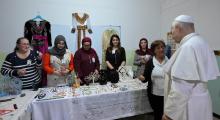
Following his visit to the Mosque of Algiers on Monday afternoon, Pope Leo XIV paid a private visit to the Centre for Welcome and Friendship of the Missionary Augustinian Sisters to render homage to the memory of religious sisters who were killed during the Algerian civil war and to thank the Sisters for their charitable work.
The Pope was welcomed by the community that is located in the district of Bab El Oued, some 16 kilometres from the city of Algiers.
During his visit, he paused in prayer with the sisters and met those who continue to carry forward their mission of hospitality, education, and friendship in a context marked by memory and reconciliation.
Pope Leo’s visit was especially dedicated to the remembrance of two religious sisters of the community who were among the 19 martyrs of Algeria killed between 1994 and 1996 during the civil war.
Sr. Esther Paniagua Alonso and Sr. Caridad Álvarez Martín were assassinated on 23 October 1994 during the “Black Decade," as the Algerian Civil War is known, as they were on their way to Mass.
According to a statement by the Holy See Press Office, the Pope reflected on their testimony within the wider witness of the Algerian martyrs, explaining that their lives express a dimension deeply inscribed in Augustinian spirituality: that of witness, even to the point of martyrdom.
“Your presence here means a great deal,” he said, recalling a previous visit, and he spoke of the gift that St. Augustine represents in this part of the world, which promotes "respect for the dignity of each person," noting that "it is possible to live in peace, valuing differences.”
Until the early 1990s, this was the community where the Missionary Augustinian Sisters lived, and from which the two martyred sisters departed for their daily mission. Their memory, the Pope recalled, remains a living presence that continues to illuminate the meaning of Christian witness.
At the conclusion of the encounter, Pope Leo XIV thanked the sisters for their service and encouraged them to persevere in their mission. He also recalled that the commemoration of the 19 martyrs of Algeria is celebrated on 8 May, the same day as his election, linking their memory to a shared spiritual horizon of witness and hope.
The structure is currently run by two of the three religious sisters who live in a house at Notre-Dame d’Afrique in Algiers. It serves as a place of encounter open to the local population, offering daily activities carried out with the support of professional teachers of various nationalities.
These activities include after-school support for children and French and Spanish language courses for young people and adults, as well as workshops for women, who learn sewing, crochet, painting, and jewelry-making.