Issued by the Catholic Center for Studies and Media - Jordan. Editor-in-chief Fr. Rif'at Bader - موقع أبونا abouna.org

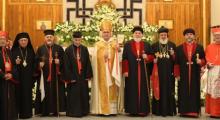
The Executive Committee of the Middle East Council of Churches held its regular meeting in Beirut, Lebanon, on Wednesday and Thursday, 10 and 11 December 2025, under the presidency of His Eminence Anba Antonios, Metropolitan of Jerusalem and the Near East for the Coptic Orthodox Church and President of the Council for the Oriental Orthodox family, represented by His Eminence Anba Hermina, General Bishop of the Churches of East Alexandria; and His Beatitude Patriarch John X, Patriarch of Antioch and All the East for the Greek Orthodox Church and President of the Council for the Orthodox family, represented by His Eminence Metropolitan Antonios Al-Soury, Metropolitan of Zahle, Baalbek, and their dependencies; and His Eminence Rev. Dr. Paul Haidostian, President of the Union of Armenian Evangelical Churches in the Near East and President of the Council representing the Evangelical family; and His Beatitude Patriarch Raphael Bedros XXI Minassian, Catholicos-Patriarch of the House of Cilicia for the Armenian Catholic Church and President of the Council for the Catholic family.
The meeting was attended by members of the Executive Committee from Lebanon, Syria, Iraq, Egypt, Jordan, Cyprus, and Palestine, representing the Middle East churches that are members of the Council, as well as the Secretary General, Professor Michel Abs, the Associate Secretary Generals, and the staff of the Council’s General Secretariat.
The meeting opened with an opening prayer and a biblical reflection inspired by the sacred season of Christmas. The participants then observed a minute of silence for the repose of the souls of the martyrs and victims of violence in the Middle East and the world.
Members of the Executive Committee paid a visit to His Excellency the President of the Lebanese Republic, General Joseph Aoun, during which they discussed a number of issues, most notably the Christian presence in the region and the role of the Middle East Council of Churches in strengthening this presence both ecclesially and socially, consolidating the foundations of dialogue, and safeguarding human dignity in this suffering and afflicted East. They expressed appreciation for the pioneering role undertaken by His Excellency at the head of the Lebanese state, and praised the historic visit of His Holiness Pope Leo XIV to Lebanon, with its various stops and the important meanings it carried, affirming the deep-rooted presence of Christians in Lebanon and the region, the concept of living together, and the strengthening of stability. They also commended the joint efforts of the state and the Church in preparing for this visit, which took place at the highest levels and highlighted Lebanon’s exemplary image.
During the meeting, participants discussed the items on the agenda, most notably the report of the Secretary General and the various departments. They praised the service and relief efforts carried out by the Council in extending assistance to all those in need amid the difficult circumstances facing the Middle East.
The participants emphasized the necessity of serious work to establish comprehensive peace across all Lebanese territories, and expressed their hope that parliamentary elections would be held on their constitutional date, with guarantees for the participation of all citizens on the basis of justice and equality.
They also discussed the situation in Syria and stressed the importance of building a new Syria founded on citizenship, the participation of all components, and the guarantee of their rights, elevating the voice of tolerance and love above all interests or considerations. They emphasized that the Christian component is original and foundational in Syria.
The participants affirmed the need to stop all forms of violence in Palestine, and in Gaza in particular, to facilitate the delivery of humanitarian aid, and to establish a final and comprehensive peace that guarantees the right to life for every human being. They appealed to churches around the world, the international community, and all people of good will to intensify efforts to silence weapons and establish peace.
They expressed appreciation for the role played by the Arab Republic of Egypt in consolidating the Gaza agreement as a basis for a ceasefire and the preservation of peace in the region.
They praised the leading role of the Hashemite Kingdom of Jordan in safeguarding the holy sites and the Christian heritage in the Holy Land.
The participants expressed the hope that a government would be formed in Iraq that meets the aspirations of the Iraqi people, following the parliamentary elections held last month.
They renewed their call to put an end to the civil war in Sudan.
They reiterated the appeal to strengthen efforts aimed at reunifying the island of Cyprus, more than fifty years after its division.
They reaffirmed the importance of the issue of releasing the abducted Metropolitans Yohanna Ibrahim and Boulos Yazigi, as well as all abducted clergy and laypersons, and the need to expedite the clarification of their fate.
At the conclusion of their meeting, as the feast of the Nativity of the Lord Jesus in the flesh approaches, the participants raised thanksgiving to the Lord, the incarnate God, praying that He may dwell in the hearts of all and unite them as one, comfort the sorrowful and afflicted, heal the sick, support orphans and widows, and strengthen His people in the land where He chose to become incarnate, so that they may bear witness with one heart and one love to the joy of His saving birth, proclaiming: “Glory to God in the highest, and on earth peace and good hope to humankind.” (Luke 2:14)