Issued by the Catholic Center for Studies and Media - Jordan. Editor-in-chief Fr. Rif'at Bader - موقع أبونا abouna.org

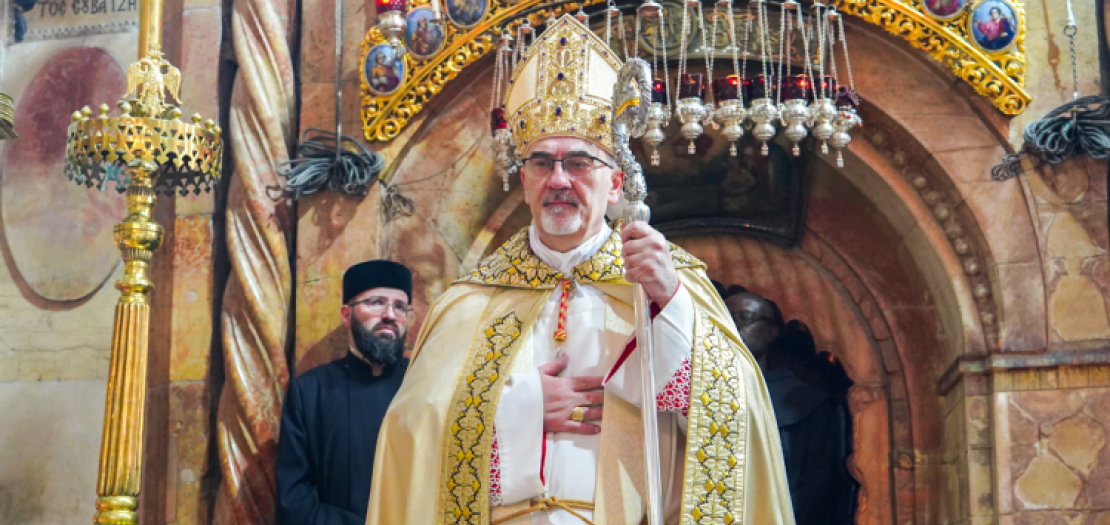
Following is the text of the homily by His Beatitude Cardinal Pizzaballa, Latin Patriarch of Jerusalem, marking Easter Sunday, dated April 5, 2026:
Dear brothers and sisters,
Here, inside this Sepulchre, we are not facing a symbol: we are facing a real emptiness. An emptiness that is not an absence, but a proclamation. An emptiness that unsettles us, because it takes from our hands what we would like to hold on to. Easter begins this way: not with an explanation, but with a rupture. Not with emotion, but with a disorienting question.
Today’s Gospel immediately sets us in motion. Mary Magdalene arrives “early in the morning,” when it is still dark. She goes to the place where she thinks she will find Jesus. It is a gesture full of love, but also full of habit: she looks where she had left him, where death had placed him. And she finds the stone rolled away, the tomb open, and above all, she does not find the body. And then she utters the phrase that is, at its essence, the first word of every true faith: “We do not know…” (Jn 20:2) We do not know where they have laid him. We do not know.
Here we see the first Easter challenge, in the most sacred and fragile part of our memory: God does not allow himself to be possessed. The Risen One is not where we expected him to be. He is not confined by the boundaries of our certainties. The Risen One goes before us. This is the powerful message of Easter: it is not we who protect God; it is God who sets us free.
We, on the other hand, would like a kind of faith that does not turn our world upside down. We would like to find Jesus “in his place”: within our images, our formulas, our religious frameworks, which sometimes become cages, and within our nostalgias. And yet, at Easter, God does something we did not ask for: he withdraws. Not to flee, but to save us from a misunderstanding—that faith is something to be possessed, a form of control, a piece of evidence in our pocket.
That is why Mary runs. That is why Peter and the other disciple run. Faith, when it is true, is never without motion. It is a race after an absence that becomes a promise. They enter the tomb and see signs: the linens, the shroud, everything laid out with care. This is not a minor detail. It is not staged. Death is no longer a garment that conceals, but a garment that has been carefully set aside, no longer needed to be worn. It is as if the Gospel were telling us: look closely, because the Resurrection is not magic. It is a new freedom. Jesus was not dragged out: he came out. Death, for him, is no longer a prison; it is a garment left there, folded, useless.
And here, in the Holy Sepulchre, this too speaks to us powerfully. There are stones that block life. There are things we declare “definitive” far too quickly: failure is definitive; wounds, guilt, fear, hatred, and loneliness are definitive. Yet, in the Easter story, the stone is not just an object; it is the symbol of everything we consider closed off, with no way out. And Easter tells us: it is not.
Easter does not promise us an “easy” life. Easter promises us an open life. And to open it, God often must first take away our certainties. That is why the Resurrection unsettles us before it comforts us. Before it fills, it empties. Before giving, it takes away. It takes away the idea of a tamed God. It takes away a religion that is only habit. It takes away a hope that risks nothing.
And here we can understand Paul’s words to the Colossians: “Seek the things that are above.” (Col 3:1) This does not mean abandoning the earth. It does not mean turning a blind eye to the world’s suffering. Rather, it means shifting our focus: ceasing to live with our gaze fixed on tombs—even our inner tombs—and learning to live as the risen. “Your life is hidden with Christ in God” (Col 3:3): that is, your life is not defined by your sins, nor by your fears, nor by your defeats. It is kept elsewhere, with the Risen One, in God. And precisely for this reason, it can open again, here and now.
The first reading, from the Acts of the Apostles, gives us another decisive key. Peter proclaims that Jesus went about doing good, that he was killed, and that God raised him from the dead; and he adds that this message is for everyone, without exception: “God shows no partiality.” (Acts 10:34) No people, no language, no history is excluded from this hope. If death has been conquered, then no life is “too lost” to be sought. Easter is universal because it is born in a specific, concrete, real place—here—and for this very reason it can truly reach the whole world.
This is not an abstract thought. We are standing in the place where the stone was rolled away, yet we know all too well that many stones remain sealed around us. Too many tombs have been dug again by hatred, violence, and retaliation. In this Holy Land, which is the mother of faith and has also become a land of constant conflict, the question resounds with dramatic force: “Where have you laid him?” For it seems that we place the Lord back in a tomb every time we believe that death has the final word over history, every time we resign ourselves to the logic of the enemy, every time we call an armed truce “peace” and the calculation of damage “justice.”
But Easter tells us this: the Risen One is not confined within our strategies for survival. He is a prisoner neither of our reasoning nor of our fears. He has already gone forth, and he goes before us. He goes before us in the courage to begin anew, in recognizing the face of the other, in laying down the defenses of our hearts even before we lay down our weapons. And so, while voices of death still rage around us, we have no other weapon than this empty tomb: to proclaim that nothing is final, that the last word belongs not to those who bury, but to those who rise again. The Lord is risen—and this is not a distant dogma, but a defiance of resignation. It is the only hope that can still open, here and now, the gates of peace.
And here comes the second Easter challenge: the Risen One is not an object of worship; he is a person who calls. He is not merely to be contemplated; he is to be followed. He is not to be held back; we must allow him to lead the way. Mary will have to learn this. The disciples will have to learn this. And we today, who are here in the place most steeped in Christian memory, must learn it with particular humility: even holy places can become museums if they do not become an exodus; the liturgy can become routine if it does not lead to conversion; and faith can be correct yet barren if it is not courageous.
That is why today, at the Holy Sepulchre in Jerusalem, I would like to remind myself of just one phrase: The Risen One is not where we left him; he goes before us.
He goes before us when he calls us out of our tombs—not only those of physical death, but those of resignation, cynicism, and indifference. He goes before us when he invites us to stop defining people by their mistakes, history by its pain, or ourselves by our sins. He goes before us when, instead of giving us a quick answer, he sets us on a journey.
And then we can understand the meaning of the signs: the rolled-away stone, the folded cloths, the open tomb. They are like a message left there just for us: life can no longer be contained. It is not a matter of “looking to the heavens” to escape from the earth, but of looking at the earth with new eyes, with the gaze of those who have understood that the last word is not “an ending,” but “a beginning.”
Easter is not a phrase to be repeated; it is a door to be walked through. The stone has been rolled away. The passage is open. But we must decide whether to stay inside or go out.
In practical terms, stepping out means choosing forgiveness when it would be easier to harden our hearts; choosing truth when it would be more comfortable to conform; choosing hope when everything suggests the opposite; choosing to do good, just as Jesus “went about doing good,” even if it goes unnoticed, even if it brings no recognition.
For this is the judgment of the Resurrection upon us: it does not ask us whether we know how to speak of Easter; it asks us whether we live as those who have risen. It does not ask us whether we say the right words, but whether our hearts are alive. It does not ask us whether we know how to find God only in sacred places, but whether we know how to recognize him alive in the signs around us, where life and death intersect every day.
And so, once again, here in the Holy Sepulchre, at the very point where history changed its course, we do not utter words for the occasion. We make a decision. We make a proclamation that transcends us and precedes us: The Lord is Risen!
And precisely because he has risen, we will never find him where we left him.
We will find him standing before us, calling us out.
Happy Easter!
+Pierbattista Pizzaballa
Latin Patriarch of Jerusalem