Issued by the Catholic Center for Studies and Media - Jordan. Editor-in-chief Fr. Rif'at Bader - موقع أبونا abouna.org

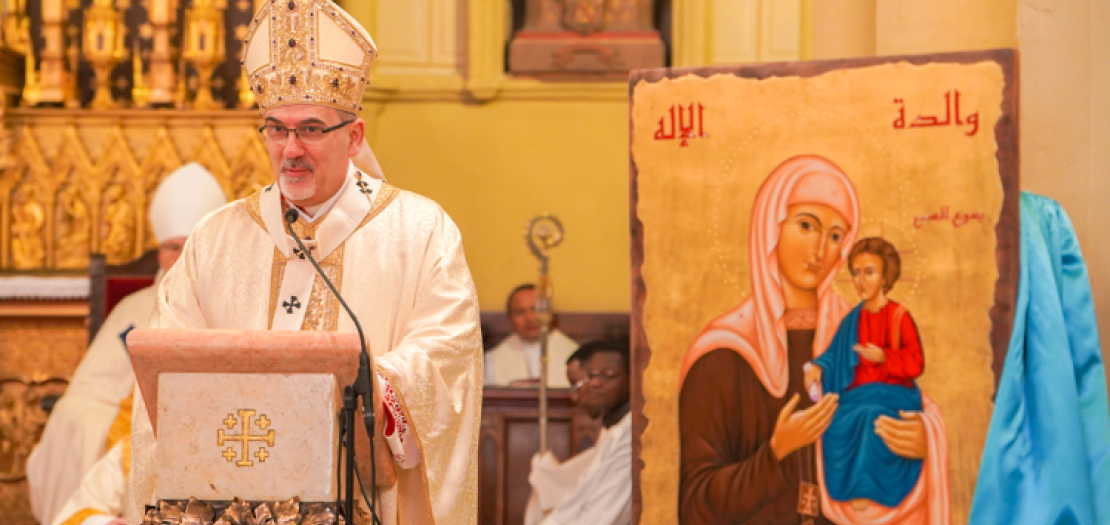
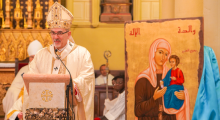
Following is the text Cardinal Pizzaballa's homily on the Solemnity of Mary, Mother of God, dated January 1, 2026:
Brothers and sisters,
Happy New Year!
On this first day of the year, while the world exchanges wishes for an uncertain future, the Church places us not under the sign of vague hope or mere human optimism, but under a double light that is a sure source of guidance: the solemnity of Mary, Mother of God, and the World Day of Peace. These two realities are not placed side by side by chance or for liturgical convenience. They are closely united, like root and fruit, like spring and river. Mary is the root of peace because She brought into the world its Prince, the One who is our peace. (Eph 2:14) To begin the year looking to her means not starting from our fragile strengths or strategies, but from the humble and powerful “yes” that changed history forever – the “yes” of the Mother of God. It is an invitation to found the coming time not on calculation, but on acceptance; not on fear, but on trust.
Saint Paul, in his letter to the Galatians, brings us with absolute precision to the heart of the mystery we celebrate today: “When the fullness of time had come, God sent his Son, born of a woman” (Gal 4:4). These are words full of concreteness. Paul does not say “appeared” like a ghost, nor “sent like a flash” from heaven. He says “born of a woman.” With this irrevocable choice, God forever bound the salvation of the world not to an impersonal force, but to the freedom of a person, to the fragile and beloved flesh of a young woman from Nazareth. He wanted to have a mother. That is why the title “Theotókos,” Mother of God, proclaimed by the Council of Ephesus, is not just a theological dogma for specialists. It is the revelation of a divine method, of God’s style: God works salvation, builds his history with humanity, through acceptance, humility, generation, and relationship. Peace, therefore, does not descend from above like a magical miracle that cancels contradictions; it sprouts slowly, like a seed, from the fertile ground of a heart that says “here I am,” that becomes space, that makes itself available. Mary, in this, is more than a model; she is the theological “place” where we understand how God wishes to act: starting from within, not from without; from smallness, not from power.
The Gospel further clarifies this style. Right after the overwhelming event of the birth, in the humble chaos of the stable, the shepherds arrive – the unexpected witnesses – with their story full of wonder. And Luke gives us the fundamental attitude of the Mother: “Mary, for her part, treasured all these things and pondered them in her heart” (Lk 2:19). A very powerful and also revolutionary image. Faced with the shocking novelty, the amazement of others, and the greatness of the event that concerns her so closely, Mary does not make speeches, does not rush to organize, does not try to immediately interpret everything. She does two things: she treasures and she ponders. It is the portrait of an interior peace, but active, not passive. To treasure (synetērei) means to protect, to keep safe, not to let the fragments of experience scatter. To ponder (symballousa) literally means “to put together,” to compare, to make events dialogue with the Word of God that already dwelled in her.
Dearest ones,
The Word of God today reveals the prophetic antidote to the subtle and widespread violence of our time. Violence often arises from the haste to judge, the immediate impulse to react, and the deafening noise that suffocates every true word and every patient listening. Peace is a work of treasuring: treasuring relationships, spoken words, the mystery of the other whom we do not immediately understand, and the fragile memory of God’s goodness in our history. It is a silent, artisanal work, done first in the heart before in the public square. Mary teaches us that there is no outward peace without this inner patience, without this spiritual “gestation” of events in the light of God.
It is precisely this light of God, treasured and made to shine in Mary’s heart, that reflects on us as true peace. The beautiful priestly blessing we hear today from the book of Numbers reveals the origin of this peace: “The Lord make his face shine upon you... and give you peace” (Nm 6:25-26). Peace, then, is not the absence of problems or conflicts – that would be a dangerous illusion – but the presence of a Face that shines in our darkness. It is the foundational certainty that we are not abandoned in the arena of history, that our life is not a random clash of atoms, but is watched over, loved, and accompanied. The mystery we celebrate today invites us to let the light of that Face – the Face of a God who in Jesus has a human face – in this difficult time, touch our wounds, our fears, the tensions of our families, our communities, and our society. Those wounds will not disappear by magic, but they can become places where hope is possible, where a gesture of reconciliation, a word of forgiveness, or a step toward the other can be born, small and fragile. That is why our vocation as Christians, baptized in Christ, is to be “reflections” of that Face. We are called to be, like Mary, “guardians” and “mediators” of God’s light for the world.
The Holy Father’s Message for this 59th World Day of Peace urges us with foresight to bring this light even into the newest, most complex, and sometimes insidious spaces of our common life: the digital world, artificial intelligence, and the media ecosystem. It reminds us of a crucial truth: technology is not neutral. It is always an extension of the human heart. It can be an instrument of manipulation, division, oppressive surveillance, and new loneliness, or it can become an instrument of encounter, sharing of good, access to knowledge, and building of an authentic common good. We have seen this clearly even in the context of the war of these years, a conflict that in one way or another involves us all. We are called to be artisans of peace not only in the family, at work, or in politics, but also through the use of our fingers on the keyboard, our words shared on social media, our – critical or compulsive – consumption of information, and our more or less insistent ethical questioning about how we want the future of humanity to be shaped by algorithms.
Even in this new digital continent, the method remains Marian: not dominating others with judgment or insult, but serving the truth with charity; not instrumentalizing people, but safeguarding the intangible dignity of every face, even that behind an anonymous profile. It means bringing into the digital noise the ability to “treasure and ponder,” to respect even one’s own time and interiority, threatened by the vortex of perpetual connection.
To treasure, to ponder, to welcome: These are the three words that today’s liturgy gives us as an antidote to violence and a method for building models of peace.
To treasure is more than to preserve: it is to grow the intelligence of the heart. It means not giving in to the haste of our time, and letting time reveal what has happened. To ponder, in turn, means knowing how to evaluate what has happened, always in the light of the Word of God, to see it in the light of the Kingdom of God that grows like a hidden seed. And so we can welcome life with the trust that God dwells in it, and not as a condemnation to live crushed by what happens to us.
Let us place this year under the maternal and powerful protection of Mary, Mother of God. May her “yes” teach us to open the doors of our existence, our cities, and our hearts to the Prince of Peace. And may the ancient and ever-new blessing we have heard be fulfilled for us, for our families, for this beloved Holy Land so wounded and so precious, and for our world hungry for hope and meaning:
“The Lord let his face shine upon you, and be gracious to you!
The Lord look upon you kindly and give you peace!” (Num. 6,25-26)
Happy New Year of peace to all! A peace that is born from the heart of God, passes through the heart of a Mother, and is entrusted to our hands and hearts as children.
†Pierbattista Card. Pizzaballa
Latin Patriarch of Jerusalem