Issued by the Catholic Center for Studies and Media - Jordan. Editor-in-chief Fr. Rif'at Bader - موقع أبونا abouna.org

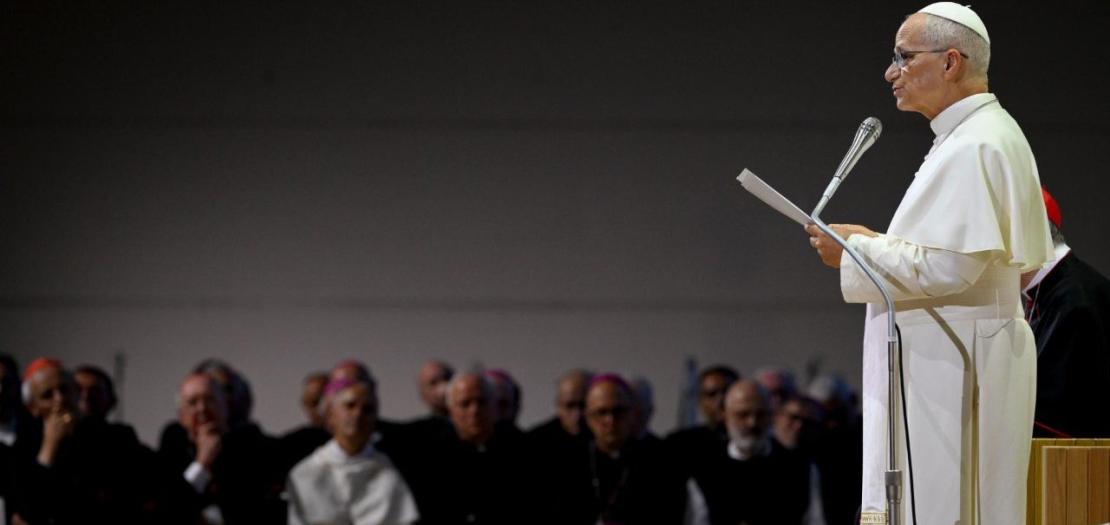
“Against the false realism that rearms minds, words, and nations, Catholic culture today must set the realism of mercy, in which there can be no enemies, and all people, even adversaries, are brothers and sisters to be looked in the eye and encountered in truth.”
These are the words Pope Leo XIV addressed to the participants at the Meeting in Rimini, and in particular to the thousands of young people who bring the great end-of-summer gathering to life, a gathering that grew out of the experience of Communion and Liberation. They were not words spoken merely for the occasion, but a precise invitation. First and foremost, an invitation to look at the reality in which we are living.
Already 44 years ago, Saint John Paul II, speaking at the Meeting, had emphasized the beauty of words such as “encounter” and “friendship among peoples” during what he himself called “dramatic moments in the history of the world.”
Today, the international situation is even more uncertain and precarious than it was then: a growing number of conflicts, ongoing massacres of civilians and children—one need only think of Gaza and Ukraine—and the many nations investing ever greater sums in rearming themselves. Faced with all this, the Pope recalls the vocation of the Meeting, which is not to be “a sort of enclave,” but a “crossroads” of encounters and dialogue.
This, Pope Leo said, is the hour of responsibility.
To follow Christ today, after the tragedies of the twentieth century, means fully recognizing that evil cannot be fought with evil. The only answer, the Christian answer, is love—“the method of redemption,” embodied by the crucified Messiah. And so, to those who today, in the name of a presumed realism—which the Pope did not hesitate to call “false”—would rearm minds, words and nations, Catholic culture responds with an authentic realism: the realism of mercy, “in which there can be no enemies, and all people, even adversaries, are brothers and sisters to be looked in the eye and encountered in truth.”
There is therefore a need for courageous pioneers who will commit themselves concretely to freeing human coexistence from suspicion, work from the idolatry of profit, and technology and finance from the business of death.
Pope Leo calls for the exposure of “unjust power relations” that lie “at the root of poverty and inequality, war and environmental disasters.” This is a strong and consequential appeal from the Successor of Peter, who from the very first day of his pontificate has spoken of “unarmed and disarming” peace, and it should be kept in mind as a criterion for judging the social and even political engagement of all Catholic laypeople.
It is also particularly significant that the Pope invites the people of the Meeting to take risks, to put themselves on the line, “broadening their bonds beyond every overly narrow sense of belonging.” For the Communion and Liberation Movement, groups and communities must become a springboard for diving into the whole of reality, resisting whatever would seek to distance them from brothers and sisters of different cultures, sensibilities and backgrounds, “especially the poorest.”
Finally, it is worth emphasizing the Pope’s reminder that there is never coercion, indoctrination or recruitment in love, because there is love only in freedom, in living encounter and in the generous gift of oneself.