Issued by the Catholic Center for Studies and Media - Jordan. Editor-in-chief Fr. Rif'at Bader - موقع أبونا abouna.org

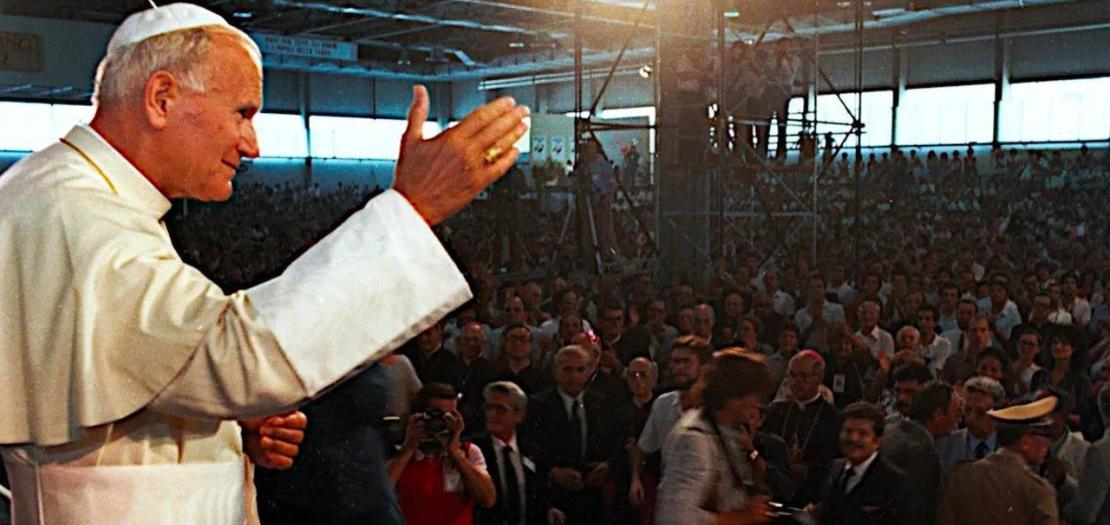
On October 15, the John Paul II Vatican Foundation celebrates its 45th anniversary. The Holy See’s non-profit organization was established on October 16, 1981, by the Polish Pontiff himself. This institution is not a faint reflection of the past because it represents a living testament to a legacy that the Church and the world still need today.
In his poem, The Jeweler’s Shop, Karol Wojtyła wrote these lines about wedding rings:
“They will always bring the past to mind,
as though it were a lesson to be remembered;
each day they will open the future wide before us,
binding it to the past.”
A legacy that offers a lesson for the present
These words aptly capture the work of the Foundation. As Monsignor Paweł Ptasznik, president of the Vatican institution, explains: “The Foundation seeks to look to the great legacy Saint John Paul II left us in such a way that every gesture, every word, and every papal document of his may become a lesson for our present, which so desperately needs people of faith like him.”
“When Wojtyła established the Foundation, he had already prophetically understood that the world would continue to need his words of hope and courage in the years to come.”
Monsignor Ptasznik highlights how in the world today, “we are living through a historical period that is undoubtedly exceptional in many respects: from the global conflicts we are inevitably confronted with to the deeper, existential struggles within ourselves, which ultimately reflect the social and historical landscape. These issues have been addressed and explored on several occasions by the current Pontiff, Pope Leo XIV.”
He stresses that Saint John Paul II's answer to this “has always been one and remains universal, as relevant today as ever: Christ and His message of Resurrection. It is the hope that evil will certainly not have the final word.”
The John Paul II Foundation is therefore called to be a “bearer of hope in the world,” following the example of its founder, who taught this lesson not only through his words but also through the example of his life.
“Those of us at the Foundation feel particularly called to embrace this message,” Monsignor Ptasznik concludes. “We must be the first to become apostles of Christ, following Wojtyła’s example.”
Hope and culture
Hope is also deeply connected to one of the themes particularly dear to Saint John Paul II: culture. But how did the Polish Pope define culture?
“Perhaps the most concise definition can be found in his address to UNESCO in 1980: ‘Culture is that through which man, as man, becomes more fully human.’ For Wojtyła, the human person is at the heart of culture, both its creator and its recipient. The human person is both its subject and its ultimate purpose. Therefore, everything—every human action that contributes to human development and helps people become more fully human—is culture,” the Foundation president explains.
“In the words of our founder, we also find the cultural mission that the Foundation seeks to carry forward through a variety of initiatives.”
There is also the longstanding relationship the Church has cultivated with artists, intellectuals, and the world of science.
Initiatives for the 45th anniversary
Following in Wojtyła’s footsteps, the Vatican Foundation continues along this path, including through a range of cultural projects. These are reflected in the program of events marking the 45th anniversary of its founding.
In Rome, from October 19 to 22, culminating on the feast day of Saint John Paul II, the program will include liturgical celebrations, concerts, a scientific conference, and the screening of a new film about the Polish Pontiff, entitled Maria, Madre del Papa (Mary, Mother of the Pope), directed by Jan Sobierajski.
The program will also feature a gathering at the Polish House at Via Cassia 1200, where, as in previous years, a commemorative plaque bearing the names of benefactors will be unveiled. It is thanks to their contributions that many young people—another key focus of the Foundation’s work—“have graduated from university and been able to earn doctoral degrees.”
“The Foundation also awards scholarships each year for the JPII Studies program organized by the Saint John Paul II Institute of Culture at Rome’s Angelicum University. It supports numerous cultural, scientific, film, and artistic projects, as well as co-organizing pontifical competitions and summer mountain camps for young people,” the Foundation president shares.
He also highlights the student residence in Lublin, “where we enable more than one hundred students from various countries to complete a five-year university program, providing for their education, spiritual formation, accommodation, and meals.”
Educating young people for the future
Culture thus becomes a form of “cultural pragmatism”: educating young people so that, in the years to come, they may form a political and intellectual leadership grounded in strong Christian values.
Reflecting on the role of culture in the history and future of societies, Saint John Paul II “emphasized Christianity’s contribution to its formation. He clearly affirmed that evangelization gave rise to Europe, laying the foundations for the civilization of its nations and their cultures,” Monsignor Ptasznik continues.
When we speak of young people, we inevitably think of the future. What, then, are the Foundation’s prospects for the years ahead?
“This very celebration of the 45th anniversary of our work was conceived as a bridge to tomorrow. The many events planned for the occasion already point the way toward the path we wish to pursue: keeping the memory of Saint John Paul II increasingly alive while, at the same time, making his legacy relevant to the world in which we live today and the world we will inhabit tomorrow.
Above all, the Foundation president stresses, “we want to continue nurturing that precious gift God has given us, and for which Saint John Paul II fought so tirelessly: Hope.”