Issued by the Catholic Center for Studies and Media - Jordan. Editor-in-chief Fr. Rif'at Bader - موقع أبونا abouna.org

Following is the text of the meditation by His Beatitude Cardinal Pierbattista Pizzaballa, Latin Patriarch of Jerusalem, on the second Sunday of Easter, dated April 12, 2026:
The Gospel passage we read today (John 20:19–31) takes us back to the evening of the first day of the week, when, early in the morning, Mary Magdalene went to the tomb to honor the Lord’s body. (John 20:1)
All the disciples, except Thomas, were gathered inside, locked in a room for fear of the Jews. (John 20:19 There the Risen One comes and stands in their midst.
First thing, Jesus comes and stands. To stand is a verb used by John the evangelist for the first time in reference to John the Baptist: “There stands one among you whom you do not recognize…” (Jn 1:26) It is the verb of stability.
The Messiah stands in our midst, bearing witness that the Lord is truly present among his people. He has come in our midst, but his coming is not a brief or temporary visit: his coming is a definitive act—of the one who chooses to come and remains, who never leaves again.
Throughout the history of salvation, God comes in the midst of his people: he saves them, frees them, and guides them. Yet this is not enough to allay the people’s mistrust, many times they ask themselves: “Is the Lord in our midst, or not?” (Ex 17:7) The history of salvation is diffused by this question, by this restlessness. It is the question asked by Thomas; it is the question each of us asks, especially in the most dramatic moments of our life and history.
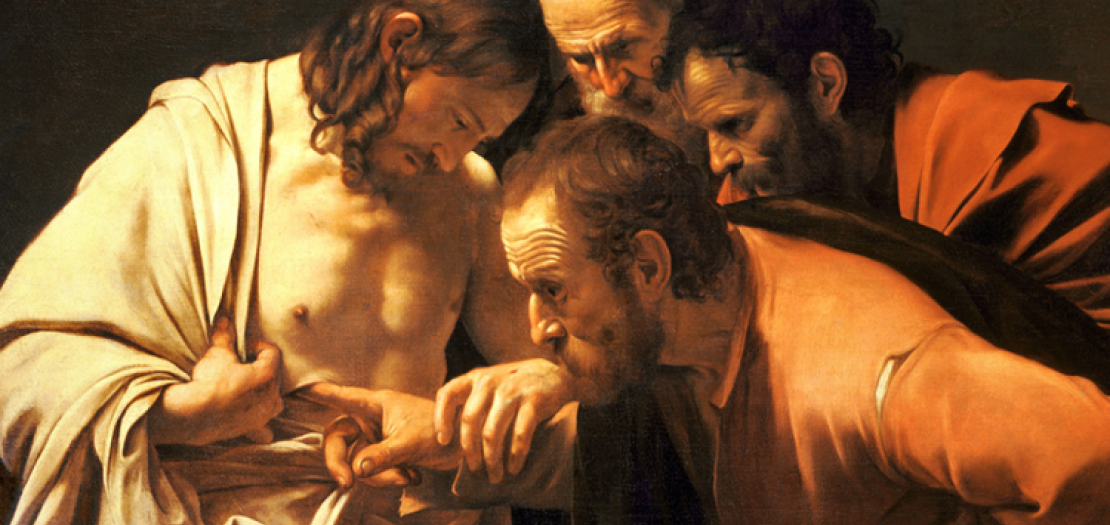
The Gospel of John tells us that the Risen Lord stands in the midst of his own in a very special way: by showing them his wounds, the marks of His Passion. Through these marks, the disciples can recognize that it is truly Him, and not another. Thomas himself confirms this: “Unless I see the mark of the nails in his hands, and put my finger into the nailmarks and put my hand into his side, I will not believe”. (Jn 20:25)
Hence, these wounds are not simply a detail, but the very place where Easter is revealed: when the Risen One appears, he does not reveal His face or His glory, but the wounds of His crucifixion.
These wounds do not close, they remain open forever, testifying to the faithfulness of God’s gift, that never fails, continuously given to us; that stand in the midst of His own people as an everlasting source of life and joy: “He showed them his hands and his side.
The disciples rejoiced when they saw the Lord.” (Jn 20:20) But why are these wounds so important that they are at the center of today’s Gospel, at the heart of the first encounter between the Risen One and His disciples?
They are important, not only because they are proof of the Lord’s identity and because they create a connection between his death and his resurrection, but also because they reveal the path for sharing in the new life of the Risen One: we must live in the memory of His Passion, remembering his love that exceeds our rejection, our betrayals, and even our fleeing away.
The wounds in His hands and feet, and the wound in His side, are the living memory of God’s history with us, a memory of the love he has for us. In those glorious wounds, our lives finds a resting place, just as they are.
In those wounds the Church is born, called to be among humanity a living memory of the logic by which the Father carries forward His history with mankind, which is the logic of meekness. Without these wounds, Easter would have been an act of power, the sign of a victory that eliminates limitation and vulnerability.
Through his wounds, the Risen One consecrates his Passover as the place of eternal offering, of eternal Passion.
With Easter, a new era begins, one in which the disciples too are called to rise with Christ.
But it is not an era without wounds. It is a time in which every wound finds a place and a meaning in the wounds of the Risen One, and in Him finds comfort and joy.
Those who know how to remember His wounds, His infinite love, rise with Christ.
+Pierbattista