Issued by the Catholic Center for Studies and Media - Jordan. Editor-in-chief Fr. Rif'at Bader - موقع أبونا abouna.org

At the time, it was a turning point in relations between Catholics and Jews and with believers of other faiths, as well as a beacon of hope in the aftermath of the Second World War.
Today, sixty years later, the conciliar Declaration Nostra aetate remains a point of reference for rekindling “that hope in our world, devastated by war and our degraded natural environment.”
It also continues to offer a paradigm for guiding the Church’s pastoral and theological choices at a time when divisions prevail over dialogue, religious freedom is constantly violated, and the name of God is betrayed and used to legitimise violence and terrorism.
Condemning discrimination and persecution
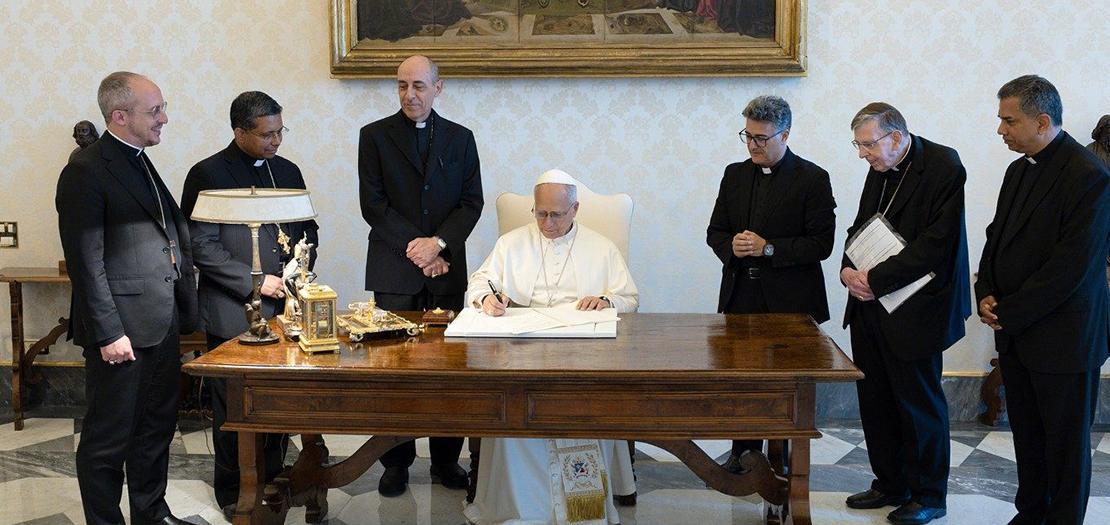
For this reason, on the 60th anniversary of this “brief yet bold” conciliar Declaration, the Dicastery for the Doctrine of the Faith, the Dicastery for Promoting Christian Unity, and the Dicastery for Interreligious Dialogue have published the Note “A Journey of Hope.”
The document retraces the essential stages of dialogue since Nostra aetate, assessing its challenges and achievements and outlining prospects for the future.
Its purpose is to renew a timeless message: “The Church reproves, as foreign to the mind of Christ, any discrimination against people or persecution of them on account of race, colour, social condition, or religion”.
“The Church reproves, as foreign to the mind of Christ, any discrimination against people or persecution of them on account of race, colour, social condition, or religion.”
Journey from the Second Vatican Council to the present day
The document’s reflection begins with a question of pressing relevance: “How can the call to universal fraternity be lived concretely in societies marked by increasing cultural and religious diversity, by war and violence, and by a growing trend toward secularization?”
The approximately twenty-page text is signed by the Prefects of the respective Dicasteries—Cardinals Víctor Manuel Fernández, Kurt Koch, and George Koovakad—and by their Secretaries, Fr. Armando Matteo, Archbishop Flavio Pace, and Fr. Indunil Janakaratne Kodithuwakku Kankanamalage, respectively.
The journey outlined by the document begins with the origins of Nostra aetate, which at the time was “a response to the tragic consequences of antisemitism, which culminated in the Shoah.”
Its publication on 28 October 1965 marked “a profound change,” because, for the first time, the Church explicitly declared that she “rejects nothing that is true and holy” in other religions and invited the faithful to regard their precepts and doctrines “with esteem and respect.”
The Note, recalling the Declaration Dignitatis humanae, affirms: “No respectful relationship with other religions can be sincere or feasible without a corresponding respect for the religious freedom of others.”
With the same “conviction,” the signatories call for “the same freedom for Christians in countries where they are a minority,” highlighting the “persecution” that Christians still suffer today “in various parts of the world at the hands of extremist religious groups.”
“Every persecution for religious reasons is always a violation of human dignity, to which a common response must urgently be found—one that, in the spirit of Nostra aetate, promotes respect, dialogue, and peaceful coexistence among all and towards all.”
Relations between Jews and Christians
The Vatican document devotes considerable attention to the distinctive relationship between Christians and Jews, beginning with their common roots in the Old Testament and extending to the Council’s recommendation of “mutual understanding and respect” and “fraternal” dialogue.
Along the same lines, “A Journey of Hope” reiterates that “God’s covenant with the Jewish people is irrevocable, and this continually challenges the Church.”
This does not mean that “the covenant with the Jewish people runs parallel to the Christian way of salvation”: for the Church, “Christ is the one and only Redeemer.”
Nevertheless, “this irrevocable covenant has theological significance”; consequently, “we cannot do without one another.”
Joint struggle against antisemitism
Solidarity with the Jewish people also includes “the shared struggle” against antisemitism.
Nostra aetate already deplored anti-Jewish hatred and persecution “at any time and by anyone,” including within the Church.
It also recalls the condemnations issued by the Popes, particularly those concerning the Holocaust.
The document notes that the conflicts that have erupted in the Middle East have “left their mark” on dialogue between Jews and Christians.
“Many channels of communication have been strained and continue to be tested by differing interpretations of the events that have unfolded, interpretations that are often not unanimous even within the respective religious communities,” the Dicasteries state.
They urge that the “mutual knowledge and esteem” that has remained firm throughout sixty years of “common effort” be maintained and developed further.
Clear fruits of dialogue
It is precisely this common work, the document emphasises, that has produced “evident” fruits in dialogue with Islam and other religions, including Hinduism, Buddhism, Jainism, Sikhism, Shintoism, Taoism, Confucianism, Zoroastrianism, and traditional African religions.
Lasting relationships of friendship have been established among religious leaders, joint educational and social projects have been launched, and common declarations have been published in response to humanitarian tragedies, wars, or environmental crises.
Theological dialogue among experts and interreligious monastic dialogue have been fundamental in this regard. So too has the lived experience, carried out quietly and discreetly, of priests, religious, and laypeople in multi-religious neighbourhoods, “where the simple fact of living in peace and being present for one another, as neighbours, is already a form of witness.”
All these achievements, “sometimes still embryonic, invisible yet fruitful,” embody the insight of Nostra aetate: “To live in the world as witnesses to the love of God, in dialogue with all.”
Condemnation of Islamophobia
The three Dicasteries strongly criticise manifestations of “Islamophobia” that “fail to distinguish adequately between, on the one hand, cases of fundamentalism and violence and, on the other, the peaceful lives of other Muslim believers who integrate into and contribute to the countries that welcome them.”
“We should thank the Christian communities that have grown in a spirit of welcome and as well as in greater knowledge and esteem for Muslim believers,” it states.
The poor as ‘the compass’
Retracing the teaching of the Popes from Paul VI to Leo XIV, the Vatican document then focuses on the importance of dialogue in this period of history.
The “welcome or rejection” of the poor is presented as a “universal criterion of discernment” for understanding whether the right direction is being followed.
Calling the poor a compass, the document says “concrete concern for the most vulnerable is the essential measure by which the integrity of every project—whether political, economic, social academic, religious, or cultural—must be judged.”
Difficulties of dialogue
The document then highlights “the difficulties surrounding dialogue” today. Some fear “doctrinal relativism or a dilution of religious identity,” while relations that “have historically been marked by conflict” or the memory of “past wounds” make mutual trust difficult.
The very foundations of dialogue are undermined by “the increase of fundamentalism, the persistence of prejudice, the political manipulation of religious affiliation, and violence committed in the name of God.”
In secularised societies, this is compounded by the marginalisation or instrumentalisation of religious discourse, which is “reduced to folklore or subjective opinion, or obscured entirely.”
Behaving as brothers and sisters
The journey, therefore, remains “demanding” and “requires humility, courage, and discernment.”
Dialogue, the document reiterates, is neither a “strategy” nor a renunciation of one’s identity, but an “authentic evangelical path.” Indeed, it presupposes “a clear awareness of one’s own religious and cultural identity, together with a genuine openness to otherness.”
“Respect” and “esteem” are “indispensable foundations” for overcoming “attitudes of exclusion, contempt, or indifference that had long prevailed.”
“We cannot call upon God as the Father of all if we refuse to behave in a fraternal manner toward certain people who have been created in the image of God,” it states, quoting Nostra aetate.
“We cannot call upon God as the Father of all if we refuse to behave in a fraternal manner toward certain people who have been created in the image of God.”
Abandoning defensiveness, hostility, conquest
In the face of those who today “foment divisions and stir up conflicts,” believers of different traditions are called to “seek, with clarity and hope, the conditions necessary for peaceful coexistence.”
To achieve this goal, it is necessary to abandon “the logic of defensiveness, hostility, or conquest in order to adopt an attitude that is open, benevolent, and courageous.”
The new document concludes with an appeal addressed to all people. May we become “builders of bridges, not walls,” “artisans of peace and fraternity,” capable of “welcoming others in their diversity” and “collaborating in building a more just and humane society.”