Issued by the Catholic Center for Studies and Media - Jordan. Editor-in-chief Fr. Rif'at Bader - موقع أبونا abouna.org

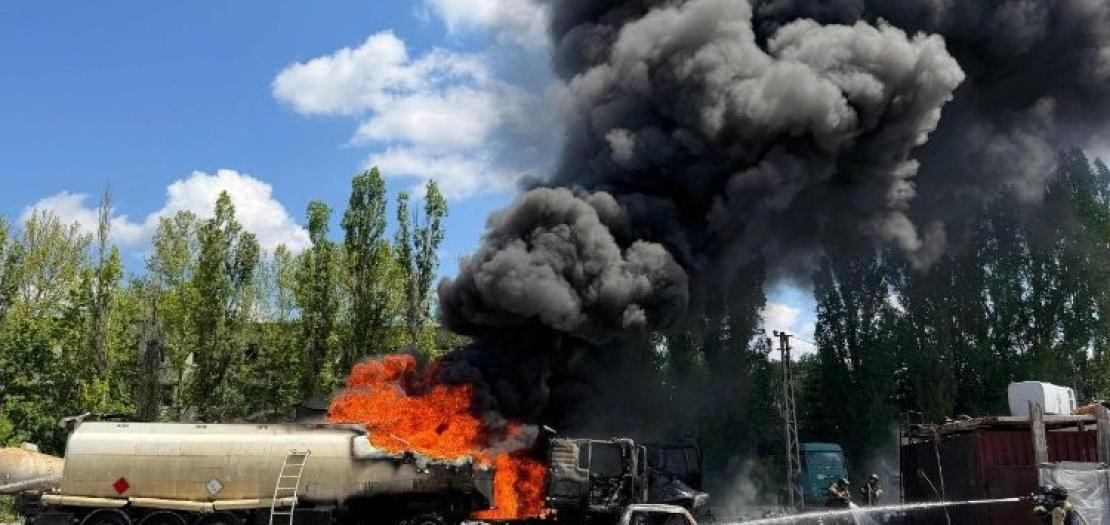
“The last few hours have again been very heavy for the entire country. Between May 13 and May 14, there were numerous bombings,” the Apostolic Nuncio to Ukraine, Archbishop Visvaldas Kulbokas, told Vatican News by phone on Thursday, May 14.
In the interview, the Nuncio reflected on what has been defined as the heaviest attack launched by Russia since the start of the war, with a tragic toll of at least 24 dead and 48 injured just in the capital, including children.
Archbishop Kulbokas explained that "Ukrainian authorities counted over 1,500 long-range drones that reached western cities such as Ivano-Frankivsk, Uzhhorod, and others, then during the night it was Kyiv’s turn, with drones and about sixty missiles, mostly ballistic.”
Attacks on humanitarian vehicles are worrying
The Nuncio also expressed great concern that even a United Nations vehicle, belonging to the Office for the Coordination of Humanitarian Affairs, was attacked in Kherson while distributing humanitarian aid, which he said, was a clearly marked vehicles that move only after informing both Ukrainian and Russian authorities in advance.
He said it is evident that these are deliberate attacks, "and it is not the first time."
The Apostolic Nuncio called it "very concerning when humanitarian workers with clear markings are deliberately targeted, so that the population does not receive aid.”
Some missile fragments fell in the Nunciature
The Archbishop also said that “some missile fragments fell in the Nunciature,” without causing significant damage to people or buildings. “But missiles come with small fragments," he said, noting, "we even found some of these fragments this morning.”
The Nuncio said he stays in contact with his network, and spoke with Father Rafail Stefurak, OSBM, parish priest of Saint Basil the Great Church at the Basilian Fathers’ monastery in Kyiv, about one and a half kilometers from the Nunciature, which has been under repair for months.
Archbishop Kulbokas explained that they recently repaired the church roof and found 57 holes caused by fragments from drones and missiles over the past months, and the roof needed repair because water was already leaking heavily.
Praying for peace
The Apostolic Nuncio to Ukraine suggested that the situation is significantly worse in the neighborhoods on the left bank of the Dnipro River, where there were “over 16 deaths in a single night, several hundred injured, with almost half of the city once again left without water.”
Faced with this scenario, the Archbishop noted that they discussed this situation with some diplomats who pointed out, "that if the bombings continue with such intensity, it is not a good sign. Rather, it indicates a will to continue the war.”
“All we can do,” the Apostolic Nuncio concluded, “is pray for peace.”