Issued by the Catholic Center for Studies and Media - Jordan. Editor-in-chief Fr. Rif'at Bader - موقع أبونا abouna.org

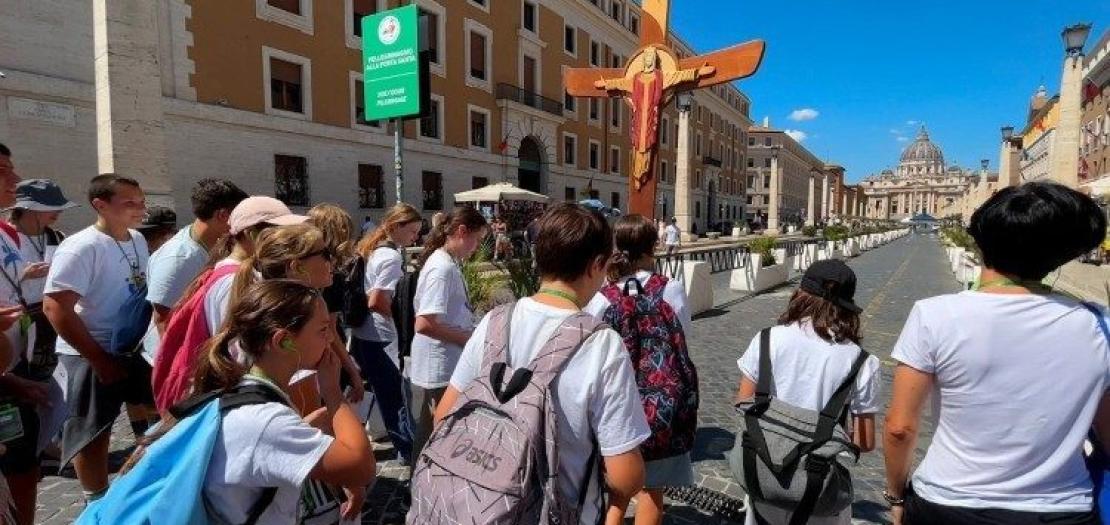
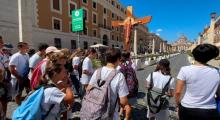
Almost 33.5 million pilgrims came to Rome during the Holy Year from 185 countries, said Archbishop Rino Fisichella, pro-prefect of the Dicastery for Evangelization and the Holy See’s official point man for the Jubilee on Monday, January 5.
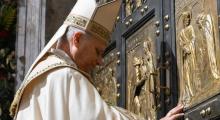
He shared the statistics during a press conference at the Vatican giving a round-up on the last year, as Pope Leo XIV will officially conclude the Jubilee with the closing of the Holy Door of St. Peter’s Basilica on January 6.
“The whole world came to Rome” during the Holy Year, said Archbishop Fisichella, highlighting how the initial projections estimated by the Roma Tre University - of around 31 million pilgrims - were exceeded.
Local civil authorities who collaborated closely with the Church – through what they unanimously referred to as the “Jubilee method” – in order to carry out all the events and implement the necessary infrastructure also attended the press conference.
The entire world came to Rome, but Europe especially: 62% of the pilgrims came from the European continent, with Italy ranking first in terms of number of participants. North America was the second continent most represented accounting for 17% of the pilgrims. In fact, after Italy most came from the United States, Spain, Brazil and Poland.
A Jubilee of spirituality that looks to the future
Neither the number of pilgrims nor the 35 'major events' fully captures the true significance of a year focused primarily on touching people's lives and renewing them on a deeper level. “The spiritual dimension at the base of the Jubilee made it possible to see a people on the move, with a great desire for prayer and conversion,” said Archbishop Fisichella.
“The Papal Basilicas and other centers of prayer—such as the Holy Stairs—recorded unprecedented attendance levels,” he continued. “Confessions increased, and the Jubilee celebration of complete forgiveness, the indulgence, has reached everyone.”
“The Jubilee comes to an end,” the Pro-Prefect explained, “but the many signs of hope that were offered remain, and the horizon widens to support a future filled with peace and serenity, as everyone desires. In a word, this Holy Year achieved the goal expressed in the Bull of Indiction of the Jubilee, Spes non confundit: to be for everyone an opportunity to rekindle hope.”
The generosity of 7,000 Volunteers
There are, however, some numbers that truly matter, because "in a time of easy individualism”, as Archbishop Fisichella noted, the tireless work of so many volunteers was very important.
He explained that 5,000 served throughout the Jubilee Year, and another 2,000 members of the Order of Malta provided first-aid services at the four Papal Basilicas.
Dialogue and collaboration: The “Jubilee Method”
Alfredo Mantovano, Secretary of the Council of Ministers of Italy, explained what the “Jubilee method” consisted of: “A state administration that must coordinate, not direct, other administrations. Coordination meetings that solve problems rather than create them. Each of the parties involved avoids taking ownership of results that are the fruit of everyone’s work. All this made it possible to change pace.” This meant an administrative system that was placed at the service of spirituality.
The Eternal City welcomed everyone
The Mayor of Rome and Extraordinary Government Commissioner for the Jubilee, Roberto Gualtieri, saw his city and its inhabitants patiently welcome the many faithful who came to the capital to obtain the plenary indulgence.
“The pilgrims did not take anything away from Rome’s ability to welcome tourists and provide services to its citizens. On the contrary, the Jubilee was a driving force,” the Mayor said.
“The joy, faith, and hope of the pilgrims touched the hearts of Romans, who in turn showed a welcoming attitude toward them, even when their numbers were extraordinary. Tor Vergata, for example, is an event that will forever be part of the history of our City and of the Church,” Gualtieri concluded, referencing the Jubilee of Young People in August.
The contribution of healthcare workers and security forces
“The Jubilee Method,” explained Francesco Rocca, President of the Lazio Region, “led the coordination group to work calmly rather than competitively—a sense of calm that was shared with all the workers. Emergency medical services carried out 580,000 interventions, 40,000 more than the previous year. Emergency room visits reached 1,600,000, which is 100,000 more than in 2024.”
Lastly, Rome’s Prefect Lamberto Giannini described the guiding principle of the capital’s security forces: “We needed security and serenity, so we sought to convey security not by militarizing, but by preventing problems. I was struck by the Jubilee of Youth, with confessionals set up at the Circus Maximus. It was something unique that will remain in everyone’s memory.”