Issued by the Catholic Center for Studies and Media - Jordan. Editor-in-chief Fr. Rif'at Bader - موقع أبونا abouna.org

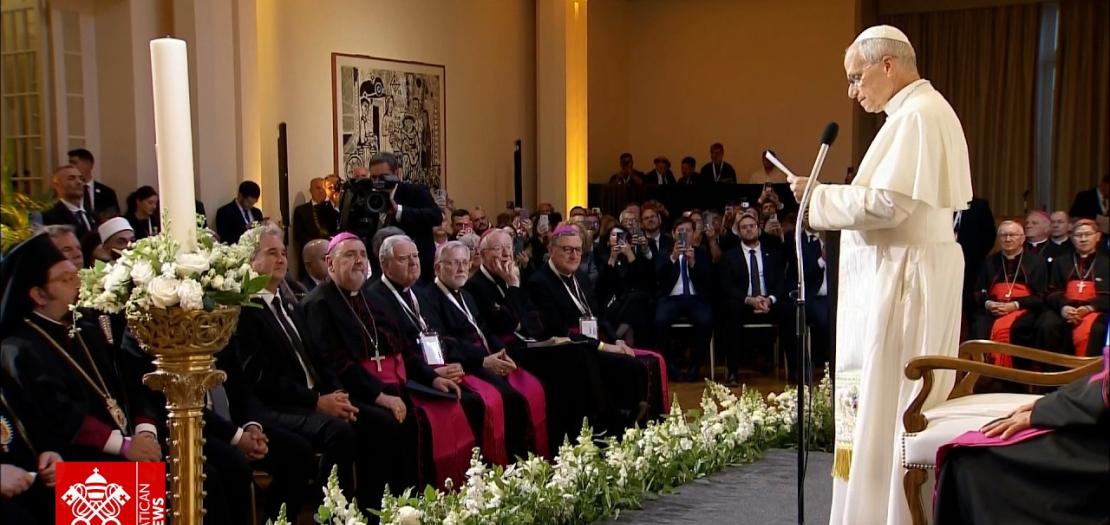
Pope Leo XIV has called on religious communities to work together to defend human dignity, promote freedom and nurture hope, noting that authentic prayer must translate into concrete gestures of fraternity, justice and peace.
“Whenever we pray, therefore, we must care for those who live alongside us, making the words we utter authentic through renewed fraternity,” he said.
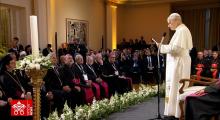
The Pope was speaking on Monday, November 9, at the Palacio San Martín in Buenos Aires, during a meeting with leaders of Christian communities and representatives of other religious traditions, on the second day of his visit to Argentina.
Argentina is the second country on his Apostolic Journey to Uruguay, Argentina and Peru, taking place from 6 to 17 November. It is also the homeland of his predecessor, Pope Francis, whose commitment to dialogue and encounter Pope Leo recalled at the beginning of his address.
Dialogue and friendship
The Pope described dialogue and friendship as fundamental elements of Pope Francis' life, expressing his desire to strengthen them by building “new bridges” and “new paths of cooperation” in society.
He reaffirmed the bonds uniting Christians through baptism, the Church's spiritual ties with the Jewish people and its respect for what is “holy and true” in other religious traditions, recalling the Second Vatican Council's declaration Nostra Aetate.
Reflecting on Argentina's history, Pope Leo noted that the country's identity had been shaped by native peoples and successive waves of immigration, bringing different cultures and religious traditions.
Despite their differences, these communities learned to work together and contribute to the common good.
“Religions were never a cause of division, but rather a meeting point and a source of commitment to society,” he said.
Prayer, dignity and freedom
Pope Leo then reflected on prayer as a form of listening, saying that it expresses who people are before God and can help them rediscover silence and attentiveness amid the distractions of the digital age.
He identified three dimensions of religious life: religions as guardians of human dignity, expressions of freedom, and places in which hope can be cultivated.
Religions, he said, remind humanity that people are more than matter and that every person has a fundamental desire for life, goodness, truth and justice.
“Whenever we pray, therefore, we must care for those who live alongside us,” he said, urging believers to defend life “from conception to its natural end.”
He called for the promotion of human dignity in family life, education, work and care for the environment, and warned against what he described as the idols of domination, vainglory and war.
“We are not the god of others,” he said, adding that possessions do not make people divine and that there is only one Lord and Judge of history.
Religions as places of hope
In the third part of his address, Pope Leo described hope as an essential dimension of religious faith.
“When human beings speak to God, they open themselves to the future,” he said, adding that religious traditions connect generations through memory, expectation and promise.
The Pope also recalled the Latin meaning of the word religare, to bind or connect, saying that religious faith should inspire solidarity with those experiencing poverty, those who have lost the meaning of life and those committed to renewing the world through justice.
“Becoming prayer and proclamation, our language is thus transformed into eloquent charity, which inspires every action,” he said.
A shared commitment to peace
Concluding his address, Pope Leo said that religious communities' shared service helps build a better future for all. He recalled Saint John Paul II's appeal for constructive dialogue among religions, highlighting that genuine prayer should not lead to opposition or contempt for others, but to mutual understanding and respect.
Such dialogue, he said, does not require relativism or the blending of religious beliefs, but should deepen each person's responsibility to bear witness to their faith.
“May the Almighty,” he concluded, “bless our enthusiasm for humanity and inspire our commitment to peace.”