Issued by the Catholic Center for Studies and Media - Jordan. Editor-in-chief Fr. Rif'at Bader - موقع أبونا abouna.org

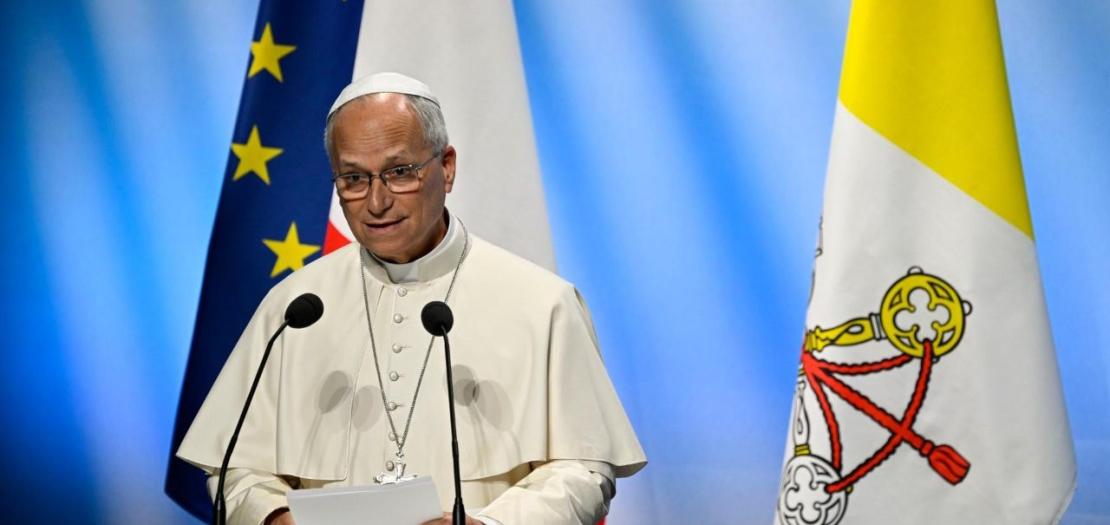
At the Robert Schuman Conference Centre in Metz, Pope Leo XIV highlights Europe's Christian roots as the basis for building greater peace and unity
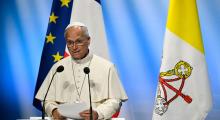
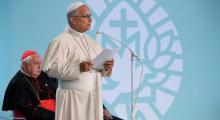
Pope Leo XIV described “an imaginary journey beginning from the roots of Europe” and looking to the present and the future in the quest for peace and unity.
European civilization built on tradition, encounter
Explaining that Europe must be understood more as a “cultural and historical reality” than a geographical one, the Pope noted that Europe “has flourished and progressed when it was able to draw on the best aspects of its past and reinvent them in new and creative ways through encounter with others,” including with other civilizations.
Among the deep roots of European civilization, Pope Leo highlighted a much earlier “founding father” of Europe, Saint Benedict, whose influence promoted care for the poor, the sick, and the elderly; the education of children and universities; hospitals and medicine; architecture and engineering; the development of the sciences; law and the organization of cities and States themselves.”
“Without this monastic influence,” Pope Leo asserted, “European civilization as we know it would not exist,” adding, “We cannot speak of Europe, then, without mentioning Christianity.”
Universal values promote peace and unity
The Holy Father went on to describe the influence of Robert Schuman and Alcide De Gasperi, who, along with many others, helped usher in the modern project of European unity and peace.
Schuman and De Gaspari drew from Europe’s Christian roots the values of equality, the dignity of work, the primacy of inner values, and fraternal charity; the value of the human person and their personal responsibility, respect for law, love of beauty, and a commitment to truth and justice.
These values do not stem solely from religious commitment, the Pope said; instead, recognizing Europe’s debt to Christianity helps us understand more clearly that openness to the transcendent is always a constitutive part of the human person and a living source of civilization.”
In his address Pope Leo highlighted the importance of respect for religious freedom and cooperation between church and state, while affirming that universal values – such as the rights and obligations of the human person, freedom, democracy, equality, and respect for the rule of law – offer a basis harmony in a multicultural society.
Welcome and integration of migrants
This is particularly important, he said, in view of the unprecedented migration into Europe, which requires society both to welcome immigrants and to integrate them into the community.
“The universal character of Europe’s founding values” he continued, “assures us that this dialogue is possible and can provide a solid foundation for our societies, enabling us to work more effectively for peace and a reconciled world.”
From Robert Schuman, Pope Leo said, we can learn a deep desire for peace, which is neither a “naïve pacifism” nor a surrender to the “illusion that rearmament is the answer.”
Harmony must be built on encounter, not conflict
He insisted that Europe must be based on respect for international law, and a commitment to keeping one’s word. “International law and multilateralism,” he said, “emphasize the genuine equality of States in their relations and constituted the best antidote to the desire for domination, which lies at the root of every conflict.”
Since the Second World War, Pope Leo said, Europe “has amply demonstrated that it is possible to articulate divergent opinions, claims, and interests through encounter rather than conflict.”
'Be builders of community'
And he concluded his address with an appeal to young people “are called upon to build the Europe of today and tomorrow.” He called them to be courageous in promoting peace, to not give into the logic of violence and oppression; to not be afraid of the future; to start families and to defend human dignity from conception to death; and to work for the common good, even through political engagement.”
“Be builders of community,” Pope Leo told the young, “and with you, Europe, firmly rooted in its heritage, will continue to flourish and to inspire the whole world.”