Issued by the Catholic Center for Studies and Media - Jordan. Editor-in-chief Fr. Rif'at Bader - موقع أبونا abouna.org

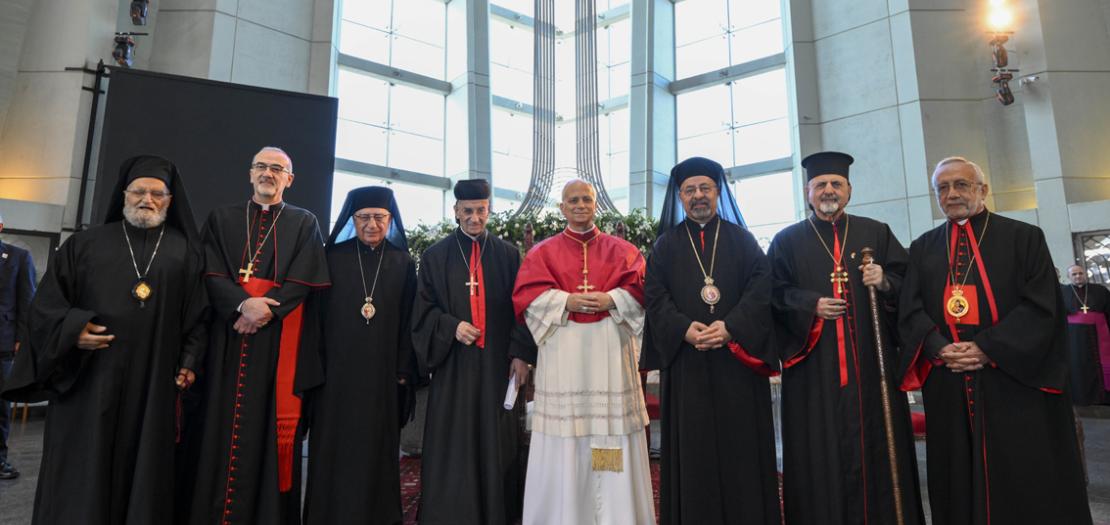
The first international trip of Pope Leo XIV, carried out between November 27 and December 2, 2025, brought the Pontiff to two countries fundamental to the history of Christianity and to the balance of the Middle East: Turkey and Lebanon. It was an itinerary filled with symbols, encounters, and gestures of fraternity, intended to reaffirm the Church’s role as a builder of bridges in an era marked by division and conflict.
A journey to the roots of Christianity
The choice of Turkey as the first stop was not accidental. The year 2025 marks the 1700th anniversary of the Council of Nicaea, the common root of all Christian denominations. Returning to where it all began, to the city that hosted the first great assembly of bishops, held great symbolic value. Pope Leo XIV undertook this pilgrimage not only as a tribute to history but as an invitation to look to the past to rediscover what unites.
Ankara and Istanbul welcomed him with official ceremonies and meetings with authorities, but it was in the spiritual and communal dimension that the visit revealed its most authentic face. In patriarchal churches, and in Orthodox, Armenian, and Catholic cathedrals, the Pope dialogued and prayed with representatives of different traditions, reminding all that unity is not uniformity but harmony.
The most striking moment was the pilgrimage to İznik, ancient Nicaea. Walking among the ruins of the place that hosted the Fathers of the first council, Leo XIV recalled that that historic moment laid the foundations for the Creed still professed today by billions of Christians. A powerful message, especially in a time when tensions and misunderstandings risk distancing communities.
Lebanon: a fragile beacon in the Mediterranean
After Turkey, the journey continued to Lebanon, a country beloved by many Popes and a symbol of coexistence among cultures and religions. Lebanon has been experiencing a complex situation for years: economic crisis, political instability, and growing emigration. In this context, the visit of Pope Leo XIV represented a breath of hope.
In Beirut, thousands of young people welcomed him in the square of the Patriarchate of Antioch of the Maronites. The atmosphere was festive yet deeply attentive: the Pope spoke to them in simple words, urging them not to let their courage for the future be stolen, to believe in the possibility of renewing their country from within.
A particularly moving moment was the silent prayer at the Beirut Waterfront, a symbolic place of rebirth after the wounds of the 2020 explosion. In that immense open-air assembly, the Pope delivered a powerful appeal for peace and reconciliation, recalling that the Christian presence in Lebanon is not only a legacy of the past but a gift for the entire Middle East.
Also meaningful was the visit to a hospital on the outskirts of the capital, where Leo XIV met doctors, nurses, and patients, thanking healthcare workers for their dedication in such difficult years. His embrace of an injured child and the child's mother was one of the gestures that moved local public opinion most deeply.
A message that transcends borders
At every stage of the trip, Pope Leo XIV insisted on four key words:Hope, unity, peace, and justice.
They were the guiding thread connecting speeches, celebrations, official meetings, and spontaneous gestures.
- Hope, aimed especially at young people, so they do not give in to the temptation to emigrate, leaving empty the places where their presence is most needed.
- Unity, recalled in the embrace with leaders of the Eastern Churches, in ecumenical prayer, and in the remembrance of the Council of Nicaea.
- Peace, invoked as a priority in a region torn by political tensions, wars, and instability.
- Justice, understood as dignity for all, attention to the poor, protection of minorities, and defense of human rights.
The trip revealed a Pope close to the people, able to speak to hearts more than to institutions, determined to build bridges where barriers too often rise.
A legacy that looks to the future
Christian communities in Turkey and Lebanon welcomed the visit with deep gratitude. Many religious leaders emphasized how important it was to receive the support of a Pontiff in such uncertain times.
The visit helped strengthen ecumenical dialogue, rekindle the hope of the faithful, and draw international attention to the vulnerability of many Middle Eastern communities.
The legacy of the trip goes beyond official speeches: it remains in the faces of the young people encountered in Beirut, in the rites celebrated among the ancient walls of Nicaea, in the handshakes exchanged with patriarchs and religious leaders, in the tears of those who saw in the Pope a father who listens.
The apostolic journey of Pope Leo XIV to Turkey and Lebanon was far more than a protocol itinerary: it was a spiritual and human path that united places, people, and diverse traditions.
It reminded the Church and the world that peace is not born from proclamations, but from the ability to meet, listen, and rebuild together.