Issued by the Catholic Center for Studies and Media - Jordan. Editor-in-chief Fr. Rif'at Bader - موقع أبونا abouna.org

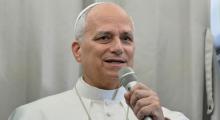
Pope Leo XIV on Sunday, April 19, renewed his appeal for a path of dialogue to be pursued in Ukraine, which is under increased Russian attacks, and in the Middle East, where he said, a ceasefire in Lebanon is "a sign of hope."
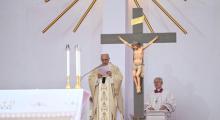
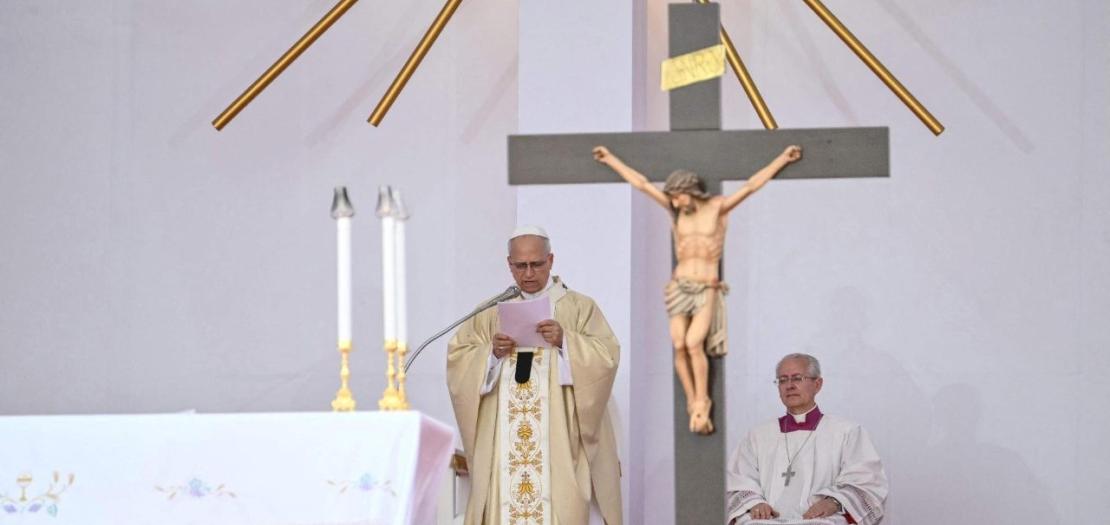
He was speaking during the Regina Coeli address after Holy Mass in the Kilamba district of Luanda in Angola on Sunday, on the second day of his visit to the southern African nation.
“I deeply regret the recent intensification of attacks against Ukraine, which continue to affect the civilian population,” the Pope said, and he expressed his closeness and prayers to all who are suffering.
“I renew my appeal for the weapons to fall silent,” he added, “and for the path of dialogue to be pursued.”
The past week has seen Russia launch the deadliest attacks in months on Ukraine, with more than 700 drones in multiple waves, killing at least 18 people in Odesa, Dnipro and Kyiv. The intensification of strikes came after a brief ceasefire took place during the Orthodox Easter last weekend, although both sides accused each other of hundreds of violations.
Pope Leo went on to say that “the announced truce in Lebanon is a sign of hope, offering relief to the Lebanese people and to the wider Levant.”
“I encourage those engaged in seeking a diplomatic solution to continue along the path of peace, so that the end of hostilities throughout the Middle East may become lasting,” he appealed.
A 10-day ceasefire came into effect on Thursday between Israel and Lebanon, announced earlier in the day by the U.S. President. Israeli attacks targeting Hezbollah in Lebanon have killed almost 2,000 people, injured thousands and displaced tens of thousands.
Pope Leo, who is in Angola on the third leg of his four-nation apostolic journey to the African Continent, concluded the celebration of Holy Mass in Luanda’s Kilamba esplanade, inviting the faithful to join him in prayer.
“With this joyful hymn, we do not wish to silence or drown out the cry of those who suffer,” he said, “Rather, we seek to embrace it and join it to our own voices in a new harmony, so that even in pain the light of faith may remain alive, and with it the hope for a better world.”
Noting that Christ conquered death, he said that “united with him and in him as one body”, we must “strive today and every day to foster around us the fruits of Easter: love, true justice, and peace, beyond every obstacle and difficulty."
“May the Mother of Jesus, Mother of the Heart, help us always to feel alive and strong within us, the presence of her risen Son close at hand.”
Pope at Mass in Kilamba: Jesus walks beside the Church in Angola
"Remain faithful to what the Church teaches, trust your Pastors, and keep your gaze fixed on Jesus, who reveals Himself in a particular way in the Word and in the Eucharist."
Pope Leo XIV insisted on this point during his Mass in Kilamba, Angola, on Sunday 19 April 2026, during his first full day in the country and in the midst of his four-nation journey to Africa.
In his homily, he said that with a heart full of gratitude, he celebrates the Eucharist in their midst, stressing he thanks God for this gift and for their joyful welcome.
On this Third Sunday of Easter, the Pope recalled the day's Gospel according to St. Luke, which recounted the passage of the disciples on the road to Emmaus. Two of the Lord’s disciples, with their hearts wounded and sorrowful, leave Jerusalem to return to their village of Emmaus, after having seen the death of that Jesus in whom they had placed their trust and whom they had followed. Initially they are despondent, but then all this changes when they recognize that Christ is in their midst, that the Lord Jesus is walking beside them.
Pope Leo told those before him that in this opening scene of the Gospel, he sees reflected the history of Angola, "this beautiful yet wounded country, which hungers and thirsts for hope, for peace, and for fraternity."
"The conversation along the road between the two disciples, who recall with discouragement what had happened to their Master," he continued, "brings to mind the suffering that has marked your country: a long civil war, with its aftermath of enmity and division, squandered resources, and poverty."
Faced with all of this, the Holy Father acknowledged that when one has long been immersed in a history so marked by suffering, one risks becoming like the disciples of Emmaus, losing hope and remaining paralyzed by discouragement. One is weary, not knowing how to begin again or whether it is even possible.
Yet the Lord, he reminded the faithful, draws near to the two discouraged disciples and by becoming their companion on the journey, "helps them piece together that story, to look beyond their pain, to discover that they are not alone on the path, and that a future—still inhabited by the God of love—awaits them."
"Dear friends, the Good News of the Lord, also for us today, is precisely this," Pope Leo underscored. "He is alive, He is risen, and He walks beside us as we journey along the road of suffering and bitterness. He opens our eyes to recognize His work and grants us the grace to set out again and to rebuild the future." Here, then, is the path set before us—and for you, dear brothers and sisters of Angola—to begin again: on the one hand, the certainty that the Lord accompanies us and has compassion for us; on the other, the commitment that He asks of us.
The Holy Father explained that above all we experience the Lord’s companionship in our relationship with Him.
He said we encounter God in prayer, in listening to His Word, which makes our hearts burn within us, as it did for the two disciples, and above all in the celebration of the Eucharist.
"For this reason," he cautioned, "we must always be attentive to those forms of traditional religiosity which, while certainly part of the roots of your culture, also risk confusing and mixing in magical and superstitious elements that do not help us on the spiritual journey."
"Remain faithful," he said, "to what the Church teaches, trust your Pastors, and keep your gaze fixed on Jesus, who reveals Himself in a particular way in the Word and in the Eucharist. In both, we experience that the Risen Lord walks beside us, and united with Him, we too overcome the deaths that besiege us and live as those who have been raised."
Knowing that we are not alone, the Holy Father said, this must drive us to heal wounds and rekindle hope.
"The history of your country, the still difficult consequences you endure, the social and economic challenges, and the various forms of poverty," Pope Leo underscored, "all call for the presence of a Church that walks alongside her people and is able to hear the cry of her children. A Church that, with the light of the Word and the nourishment of the Eucharist, can revive lost hope."
He said the Church needs people like you, who give themselves as Jesus breaks the bread for the two disciples of Emmaus.
Angola, he said, needs Bishops, priests, missionaries, men and women religious, and lay faithful who have in their hearts the desire to break their own lives and give them to one another.
By the grace of the Risen Christ, he noted, "we too can become this broken bread that transforms reality. And just as the Eucharist reminds us that we are one body and one spirit, united in the one Lord, so we too can—and we wish to—build a country where old divisions are definitively overcome, where hatred and violence disappear, and where the wound of corruption is healed by a new culture of justice and sharing."
"Only in this way," he insisted, "will a future of hope be possible, especially for the many young people who have lost it."
Pope Leo concluded his homily by encouraging the faithful of the country to look to the future with hope and to build the hope of the future. "Do not be afraid to do so! The Risen Jesus, who walks the road with you and breaks Himself as bread for you, encourages you to be witnesses of His Resurrection and protagonists of a new humanity and a new society."
He also reassured that on this journey, the nation's Catholics can count on the closeness and prayers of the Pope, and he said, as he entrusted them to the Blessed Mother, that he knows he can count on them too.