Issued by the Catholic Center for Studies and Media - Jordan. Editor-in-chief Fr. Rif'at Bader - موقع أبونا abouna.org

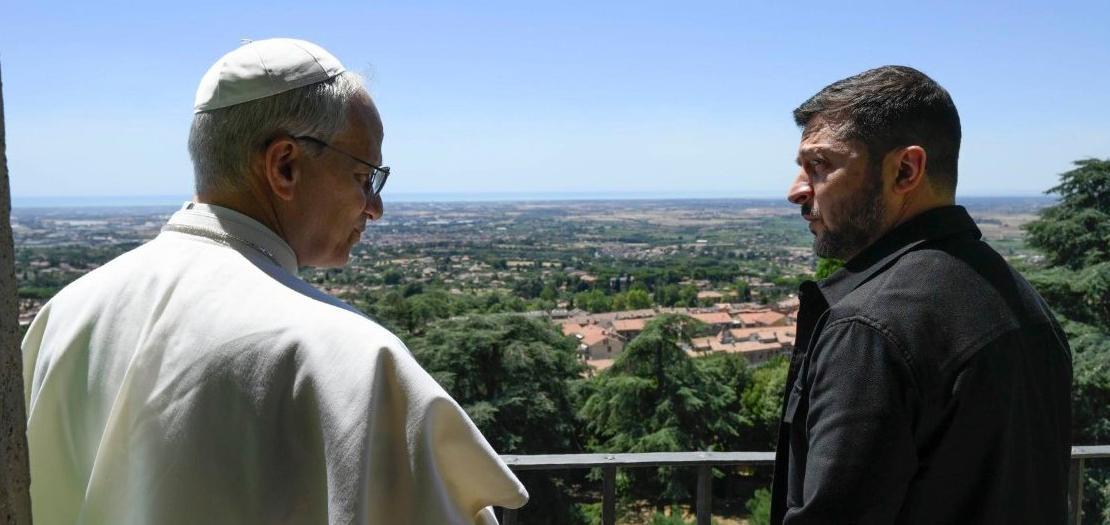
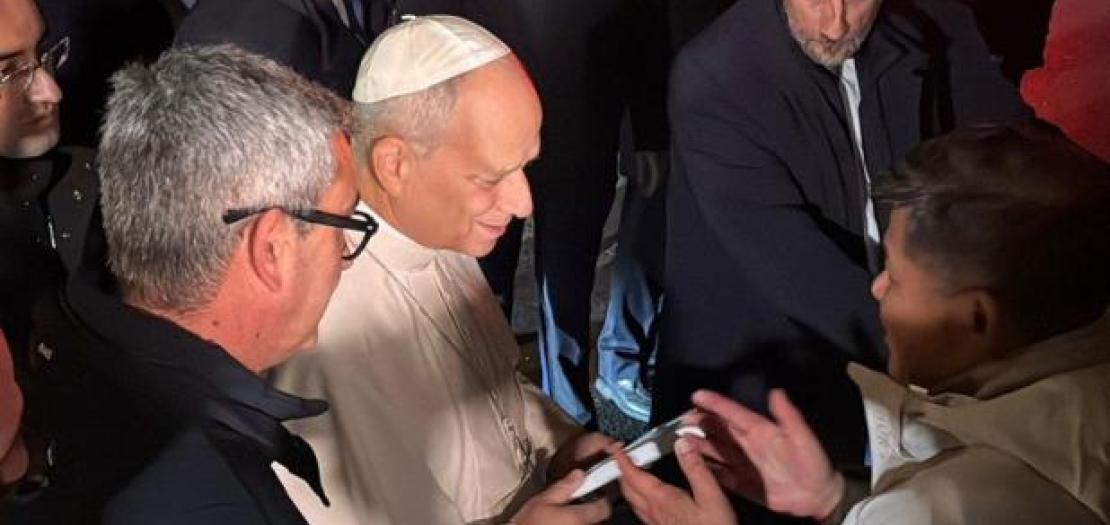
Pope Leo XIV welcomed Ukrainian President Volodymyr Zelenskyy at the papal residence in Castel Gandolfo on the morning of 9 December.
The Holy See Press Office issued a statement describing the cordial meeting, saying discussions centered mainly on the war in Ukraine.
During their talks, the Pope reiterated the importance of ongoing dialogue and once again stressed his “urgent hope that ongoing diplomatic efforts will lead to a just and lasting peace.”
The two heads of state also spoke about the issue of prisoners of war, calling for ensuring the safe return of Ukrainian children to their families.
Exactly five months ago, the President met with Pope Leo at the residence at Castel Gandolfo for a private audience—during which similar topics were discussed.
In the July meeting, Pope Leo—elected just two months prior to the papacy—expressed his sorrow for the victims of the war and assured the people of Ukraine of his ongoing prayers for them.
The Holy Father had also reiterated the Vatican’s willingness to host both Ukraine and Russia for potential negotiations.
Following the meeting, President Zelenskyy addressed journalists in English, expressing his gratitude for the audience and the Pope’s support especially regarding the return of Ukrainian children—calling it “a very important question.”
Pope: Historical U.S.-Europe alliance important today and in the future
Commenting on what he has seen of the U.S. President’s peace plan for Ukraine, Pope Leo said it appears that “unfortunately” what was for many years a "true" alliance between Europe and the United States could undergo a huge change.
Speaking to journalists in Castel Gandolfo, just outside Rome, on Tuesday evening, the Pope responded to questions on different issues, including the ongoing peace proposal for the Russia/Ukraine war put forward by U.S. mediators.
On the same day he met with Ukrainian President Vladimir Zelenskyy, whom he received at Villa Barberini in Castel Gandolfo during the morning, the Pope declined to comment on the peace plan proposed by the Trump administration. He did, however, say, “Unfortunately, I believe that some aspects of what I have seen would bring about a huge change in what has, for many, many years, been a true alliance between Europe and the United States.”
He noted that “remarks that are made about Europe, also in interviews recently, I think, are trying to break apart what I think needs to be a very important alliance today and in the future.”
Pointing out that the U.S. President and his advisers have the right to put together a proposal, he said he believes “it has a number of things in it that (…) perhaps many people in the United States would be in agreement, [while] I think many others would see things in a different way.”
Asked about the role of the Holy See in bringing back abducted children from Ukraine, the Pope confirmed he had discussed that issue with the Ukrainian leader.
“Most of the work that's going on, which is very slow, unfortunately, but is done, if you will, behind the scenes,” he said. And he affirmed that the Holy See continues to work on that: “to try and get those children back to their homes, to their families.”
In answers to Italian-speaking journalists, Pope Leo confirmed that “the Holy See is available to provide space and opportunities for talks and negotiations,” adding that “So far, the offer has not been accepted, but we remain willing to seek a solution and a peace that is both lasting and just.”
Regarding Ukrainian President Zelensky’s renewed invitation to visit Ukraine—described by the President today on X as “a strong signal of support for the population”, the Pope responded: “I hope so, though I don’t know when. One must also be realistic in these matters; perhaps it will be possible.”
On the role of Europe in the peace process, that has been put into doubt by President Trump, the Pope recalled that he had already addressed this issue on the return flight from Beirut to Rome during his recent apostolic journey.
“I believe Europe’s role is very important, and the unity of European countries is truly significant, especially in this case,” he said.
“Trying to reach a peace agreement without including Europe in the discussions is not realistic. The war is in Europe, and I believe that Europe must be part of the security guarantees sought today and in the future.”
“Unfortunately,” he added, “not everyone understands this, but I believe there is a great opportunity for the idea of Europe to come together and seek solutions collectively.”
Reflecting on his travels to Türkiye and Lebanon, Pope Leo described his visit to the Blue Mosque as experienced “in silence, in a spirit of recollection and listening, with deep respect for the place and the faith of those gathered there in prayer,” as reported by the Holy See Press Office at the time.
To the question about why he had not prayed as “visibly” as his predecessors had, he said: “Who said I didn’t pray? They said I didn’t, but I already explained on the plane—I mentioned a book (‘The Practice of the Presence of God’ by Brother Lawrence)—and perhaps I am praying even now,” he replied.
The Pope added that his preferred place of prayer was "in a Catholic Church in the presence of the Most Blessed Sacrament,” describing reports about that particular moment in the mosque as “curious.”
Finally, addressing a more personal question about moving to the Vatican Apostolic Palace, the Pope noted that he currently resides in his apartment at the Palace of the Holy Office. Asked when he will make the move to the papal apartment and with whom, he replied: “There is no date yet; I am comfortable where I am, in the Holy Office."