Issued by the Catholic Center for Studies and Media - Jordan. Editor-in-chief Fr. Rif'at Bader - موقع أبونا abouna.org

Today, the Fourth of July, marks the 250th anniversary of the signing of the Declaration of Independence.
Accordingly, this morning, the Vatican published Pope Leo's letter to the American people, in which he assured them of his prayers on the special occasion.
The Pope had spent the first half of Saturday making a pastoral visit to the southern Italian island of Lampedusa showing how closeness to migrants.
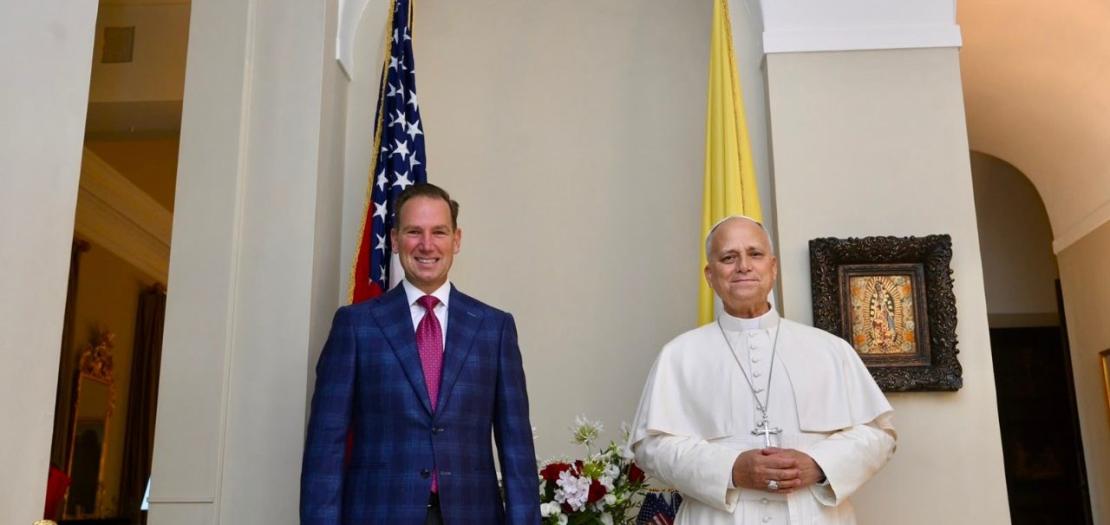
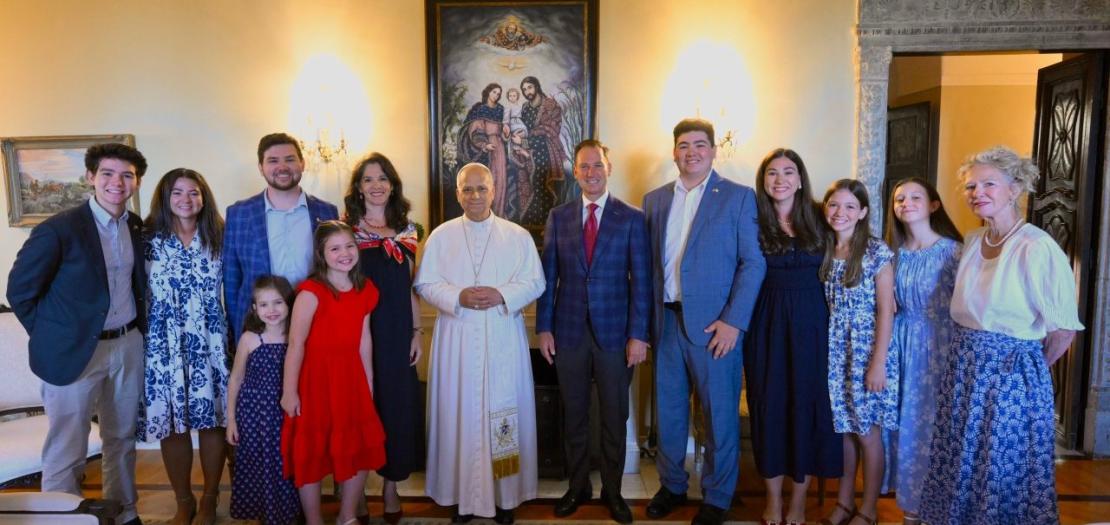
After the full day, the Holy See Press Office informed journalists that, "welcoming the invitation of the United States Ambassador to the Holy See, Brian Burch, the Holy Father visited the Ambassador's residence in Rome on Saturday evening, on the occasion of the national holiday."
On Friday evening, Rome time, on the eve of the anniversary, Pope Leo accepted the Liberty Medal from the U.S. National Constitution Center in recognition of his lifelong commitment to promoting religious liberty and freedom of conscience and expression around the world.
The Chicago-born Pope addressed those gathered in Philadelphia by video message from the Vatican. He prayed that the 250th anniversary of the founding of the United States would be an occasion for a renewed commitment to the fundamental ideals on which the nation was founded, especially life and freedom, concluding with the words, "May God bless America."
"As a son of this great country, founded by courageous men and women who dreamed of liberty and of a better life for themselves and for their children," Pope Leo said, "I join you in asking God's blessings upon America's future, that the lofty ideals enshrined at the beginning of the Declaration of Independence may continue to guide the flourishing of the nation in unity, justice and peace."
Pope Leo assures Americans of prayers on 250th anniversary of United States
"May the Spirit of 1776 continue to inspire hope and unity as the United States of America moves into the future."
Pope Leo XIV expressed this in a letter he sent to mark the 250th anniversary of the signing of the Declaration of Independence on July 4, 2026.
In the text, the US-born Holy Father reflected on the principles that have shaped the United States for two and a half centuries, especially religious freedom and human dignity.
Calling the semiquincentennial a defining milestone in the nation's history, Pope Leo noted that the Declaration of Independence gave enduring voice to the ideals of liberty, equality, the pursuit of happiness, justice and democratic self-government.
For 250 years, he observed, generations of Americans have sought to advance these principles through sacrifice, service, innovation and civic participation.
The anniversary, he suggested, offers not only an opportunity to celebrate the nation's remarkable journey, but also a moment to reflect on the responsibilities Americans bear toward one another and toward future generations.
"Among the most cherished of these principles," he underscored, "is religious freedom — the right of every person to worship according to conscience and to practice their faith openly, without coercion or fear."
This principle, he said, "has long been central to the American promise, protecting both individual dignity and the peaceful coexistence of a diverse people."
Pope Leo stressed that it has enabled the Catholic Church to flourish in the United States.
Reflecting on the role of Catholics in public life, Pope Leo emphasized that faith does not diminish civic responsibility but strengthens it.
"As faithful sons and daughters of the Church," he wrote, "Catholics are called to imbue every dimension of their existence with the charity of Christ, living out the Gospel in the circumstances of daily life."
He noted that this witness has inspired the Church's longstanding contributions to American society through education, healthcare, and serving the common good.
Recalling his predecessor Pope Leo XIII's encyclical Sapientiae Christianae, the Holy Father cited his predecessor's observation that "no better citizen is there... than the Christian who is mindful of his duty."
"Far from standing in opposition to the responsibilities of citizenship," Pope Leo said that faith "lends new vigor to the pursuit of justice, peace and the common good, bringing to perfection every natural gift bestowed by the Creator."
He also called to mind when Saint Paul himself encouraged the early Christians to pray for those in positions of authority in order to live a peaceful life in accord with the will of God.
Turning to the dignity of the human person, Pope Leo reaffirmed that every human life is endowed by God with an inherent and inviolable worth deserving of reverence, protection and care.
"In this spirit," he wrote, "a full understanding of this dignity leads to recognizing the importance of safeguarding human life from its beginning at conception until natural death, and of building a society in which the vulnerable, the suffering and the forgotten are always met with compassion, solidarity and love."
The Pope added that defending human life also means welcoming, protecting and accompanying migrants. He recalled how immigrants' sacrifices and contributions have shaped the nation's history.
"In every generation," he observed, "those who have arrived seeking freedom, opportunity and a place to belong have helped to shape the nation's character. To receive them with compassion and generosity is not only an act of charity, but also a recognition of the dignity that belongs to every human person."
Pope Leo also recalled the themes of his encyclical Magnifica humanitas, stressing that today's global challenges require shared responsibility and cooperation.
"Building a world in which everyone can flourish requires shared responsibility and courage. No one can single-handedly bear the weight of the challenges the world is facing."
The Pope encouraged Americans to allow the anniversary to renew their shared commitment to freedom, opportunity and democracy.
"May Americans," he prayed, "honor the courage and vision of those who came before them by strengthening their communities, respecting their differences and working together toward a more perfect union."
Pope Leo concluded by entrusting the American people to the intercession of the Immaculate Conception, Patroness of the United States, praying that she continue to watch over the nation and all who dwell within it.