Issued by the Catholic Center for Studies and Media - Jordan. Editor-in-chief Fr. Rif'at Bader - موقع أبونا abouna.org

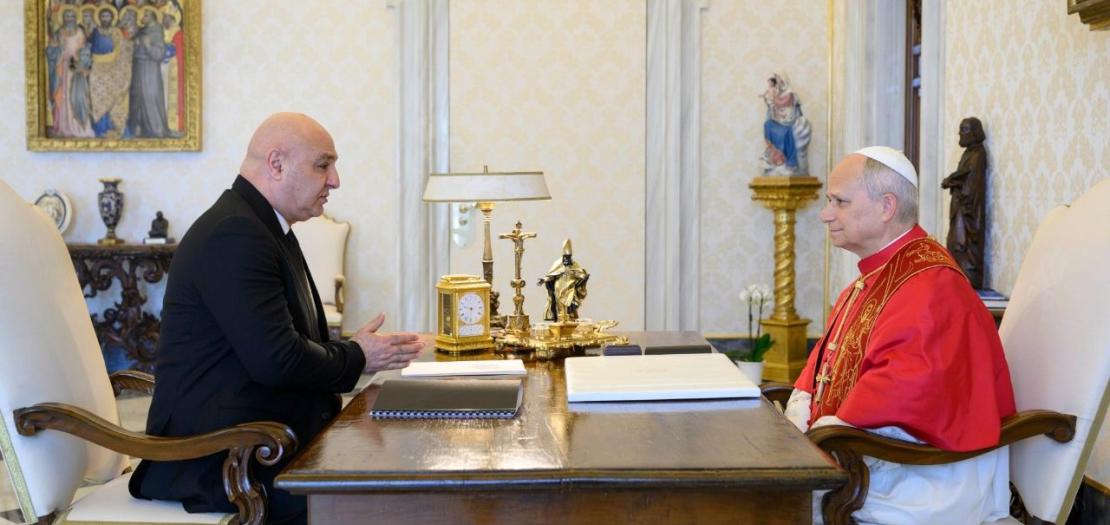
Pope Leo XIV received the President of the Republic of Lebanon, Mr. Joseph Aoun, in the Vatican on Thursday morning.
The President subsequently met with Holy See Secretary of State, Cardinal Pietro Parolin, accompanied by Holy See Secretary for Relations with States and International Organizations, Archbishop Paul Richard Gallagher.
According to a statement issued by the Holy See Press Office after the audience, the discussions at the Secretariat of State were "cordial" and "focused essentially on the Trilateral Framework Agreement, signed by the United States, Israel, and Lebanon and intended to stabilize the southern borders of the Republic of Lebanon and to achieve a just and lasting peace."
"The Holy See, while expressing its satisfaction at the signing of the document," the statement concluded, "voiced serious concerns about the difficulties being experienced in implementing it, and assured its support for efforts in this regard."
Gratitude to the Pope for his support
In a statement published on the website of the Lebanese Presidency, President Aoun reiterated his gratitude to Pope Leo XIV and the Holy See for all the efforts made in support of Lebanon. He specifically asked that they continue supporting Beirut’s demands, foremost among them the call for Israel to implement the terms of the framework agreement, signed under U.S. auspices on June 26.
Aoun called on Israel to halt the daily attacks that are particularly targeting civilians, infrastructure, and villages in southern Lebanon, and to withdraw from occupied territories, paving the way for the reconstruction of what has been destroyed and for the return of displaced people.
Aoun, the Lebanese Presidency statement continued, emphasized that these measures must be accompanied by the extension of the Lebanese state’s authority over all of its territory.
Tensions in southern Lebanon
The meetings at the Vatican come at a time of heightened tension, particularly in southern Lebanon, where attacks have continued despite the temporary ceasefire reached with Israel on April 17.
Israel maintains that it is targeting only Hezbollah infrastructure and personnel, while Beirut continues to denounce the ongoing Israeli military operations.
Against this backdrop, political deadlock persists over the future of southern Lebanon. No date has yet been set for the eighth round of U.S.-mediated talks, aimed at advancing the framework agreement between the two countries and establishing a roadmap toward peace.