Issued by the Catholic Center for Studies and Media - Jordan. Editor-in-chief Fr. Rif'at Bader - موقع أبونا abouna.org

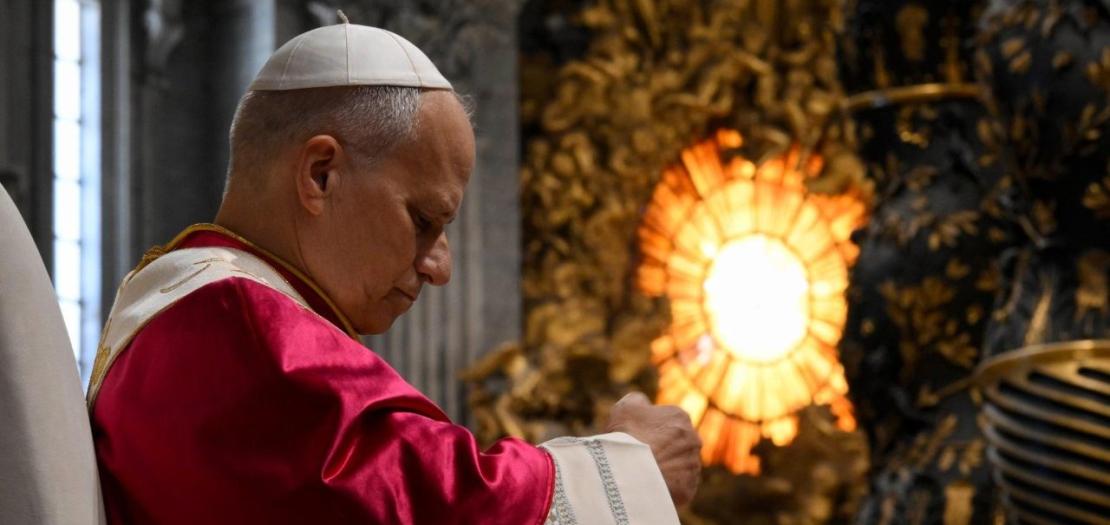
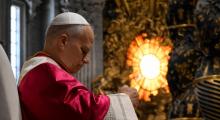
Pope Leo XIV during April 11 prayer vigil for peace in St. Peter's Basilica
As people return to speaking about a “just war,” it is worth recalling the teaching on peace of the Popes who have succeeded one another on the Chair of Peter over the past hundred years. This teaching has gradually been enriched and deepened, to the point of recognizing how increasingly difficult it is to claim that a “just war” exists. Reflections based on the theology of past centuries and possible justifications for war fail to take into account that when theologians of earlier times wrote about these issues, wars were fought with swords and clubs—not with deadly weapons and machine-guided drones, a reality that raises moral questions of dramatic intensity. There has been a growing awareness that war is not a path to be followed.
From the 1917 letter to the belligerent nations by Pope Benedict XV, which described the First World War as an “useless slaughter,” to the efforts of Pope Pius XII to prevent the outbreak of the Second World War; from the words of Pope John XXIII in Pacem in Terris (1963), who wrote that “it is almost impossible to think that in the atomic era war could be used as an instrument of justice,” to the cry of Pope Paul VI at the United Nations,“No more war!”—and the often unheard appeals of Pope John Paul II to prevent disastrous conflicts in the Middle East: the Successors of Peter have consistently raised their voices with both prophetic insight and realism, though sadly they have often gone unheard.
The primary reference text is the Catechism of the Catholic Church, which acknowledges the right to legitimate self-defense but places “strict conditions” even on defensive war:
"the damage inflicted by the aggressor on the nation or community of nations must be lasting, grave, and certain; all other means of putting an end to it must have been shown to be impractical or ineffective; there must be serious prospects of success; the use of arms must not produce evils and disorders graver than the evil to be eliminated. The power of moderm means of destruction weighs very heavily in evaluating this condition."
Who can deny that humanity today stands on the brink precisely because of escalating conflicts and the power of these “modern means of destruction”?
The “no” to war was repeated with increasing force during the pontificate of Pope Francis, who in the encyclical Fratelli tutti (2020) wrote: "War can easily be chosen by invoking all sorts of allegedly humanitarian, defensive or precautionary excuses, and even resorting to the manipulation of information. In recent decades, every single war has been ostensibly “justified”... at issue is whether the development of nuclear, chemical and biological weapons, and the enormous and growing possibilities offered by new technologies, have granted war an uncontrollable destructive power over great numbers of innocent civilians. The truth is that “never has humanity had such power over itself, yet nothing ensures that it will be used wisely”. We can no longer think of war as a solution, because its risks will probably always be greater than its supposed benefits... Never again war!"
His successor, Pope Leo XIV, has made peace one of the central themes of his pontificate. Faced with the madness of escalating conflict and disproportionate spending on rearmament, he continues along the path opened by his predecessors, calling for peace, dialogue, and negotiation with both realism and prophetic clarity. The massacres of civilians in recent years have shaken the consciences of billions around the world, who look to the Bishop of Rome. Like Jesus in Gethsemane, Pope Leo urges us to put the sword back into its sheath: "We are met by threats, rather than the invitation to listen and to come together," he said during the Prayer Vigil on April 11. He explained that “those who pray are aware of their own limitations; they do not kill or threaten with death. Instead, death enslaves those who have turned their backs on the living God, turning themselves and their own power into a mute, blind and deaf idol (cf. Ps 115:4–8), to which they sacrifice every value, demanding that the whole world bend its knee. Enough of the idolatry of self and money! Enough of the display of power! Enough of war! True strength is shown in serving life."