Issued by the Catholic Center for Studies and Media - Jordan. Editor-in-chief Fr. Rif'at Bader - موقع أبونا abouna.org

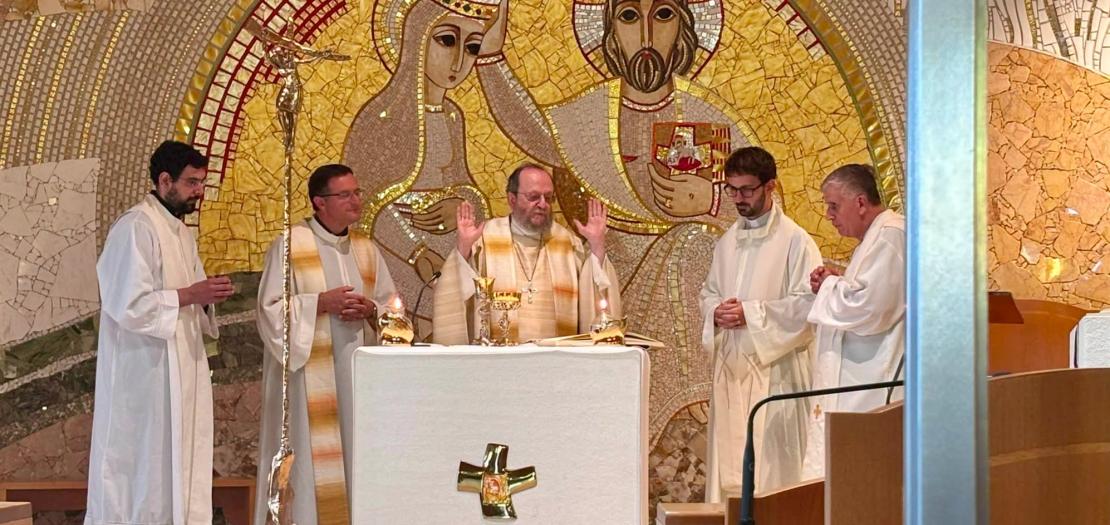
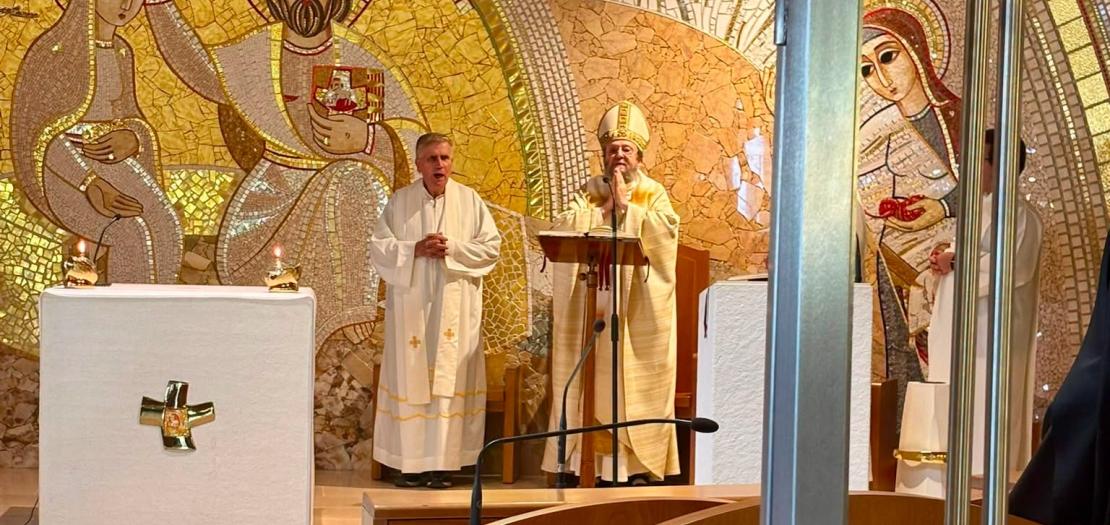
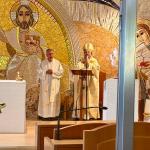
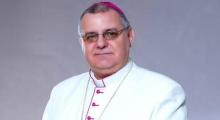
Bishop Paolo Martinelli has presided over the triduum and the solemnity of St. Clare of Assisi at the Monastery of the Poor Clare Sisters in Cademario (Switzerland), where he spent some days of rest and spiritual retreat.
The celebration is included in the context of the Franciscan Jubilee Year marking the 800th anniversary of the blessed passing of St. Francis.
The bishop also recalled with gratitude the hidden but precious presence of the sisters, who carry in their prayer the life of the Church, including the Middle East, the Gulf countries, and Yemen. “How beautiful it is to feel enshrined in the prayers of the sisters,” he said.
The celebrations offered Bishop Paolo the opportunity to reflect on the deep spiritual bond between St. Clare and St. Francis of Assisi, well represented by the image of the “little plant.” “Saint Clare always called herself a little plant of the blessed Father Francis, recognizing the profound, generative spiritual relationship between them,” the Bishop explained.
At the same time, the image expresses the originality of the founder of the Poor Sisters: “Saint Clare did not simply emulate Francis; he ignited in her a new evangelical perspective,” giving rise to “a new form of following Christ.”
The bond between Clare and Francis was personal, spiritual, and generative. Francis had transformed Clare’s life and opened before her a new evangelical horizon. Yet he did not bind her to himself. As Bishop Paolo recalled: “Francis had been her friend, brother, and father because he had brought her to Christ, not kept her for himself.”
Clare would live 27 years after the death of Francis, together with her sisters, carrying in her heart the memory of the encounter that had changed everything. In this sense, the passing of Clare and the passing of Francis, though distant in time, remain inseparable in their spiritual meaning.
Bishop Paolo compared the blessed passing of Clare with that of Francis. Francis welcomed death as a passage to eternal life; Clare faced the same mystery with serenity, blessing God for the gift of existence. Her witness, the Bishop said, speaks with particular strength to today’s world: “it is good to exist, it is good to be creatures.”
This spiritual relationship also bore fruit in the history of the Church. Bishop Paolo recalled the approval of the Rule of St. Clare by Pope Innocent IV on August 9, 1253, just two days before her death. It was “the first rule of religious life approved by the Holy See, written by a woman,” showing Clare’s originality in deep connection with Francis, who had inspired her. Francis and Clare never lived their charism outside the Church. As Bishop Paolo said, “they decided from the beginning to conceive of their ‘we’ within the greater ‘we’ of the people of God, the Church.”
In Bishop Paolo’s reflection, Clare appears above all as a woman of relationships. The liturgy presents her within “a constellation of relationships”: sister and wife, daughter and mother, friend. She is at the origin of the Order of the Poor Clares, but not as an isolated figure. She is a “generated origin,” a woman who received a gift and allowed it to become a new form of consecrated life in the Church.
At the heart of this vocation is Christ. Clare’s life is the story of a woman drawn by the love of Christ and progressively conformed to Him. Bishop Paolo reminded the faithful that the Christian faith is not moralism or fear, but attraction, joy, and the response to a love that calls. In Clare, this love becomes poverty, humility, prayer, and total belonging to Christ.
This belonging is never solitary. It becomes communion, fraternity, and sorority. For Bishop Paolo, this is one of the central teachings of Francis and Clare: Christian life bears fruit when it remains rooted in communion. “This is the secret of the fruitfulness of the saints: remaining in communion.”
In St. Clare, the Church contemplates a woman who received everything as a gift: life, vocation, friendship, charism, and communion. Her witness teaches us that holiness is not isolation, but a life generated by love and given back in love. In a time often tempted to escape fragility and limits, St. Clare teaches us to look at existence, fragility, relationships, and even the end of life in the light of a love that has wanted us and calls us by name. She reminds us that our creaturely existence is blessed by God, and that life becomes fruitful when it remains rooted in Christ, in the Church, and in communion.