Issued by the Catholic Center for Studies and Media - Jordan. Editor-in-chief Fr. Rif'at Bader - موقع أبونا abouna.org

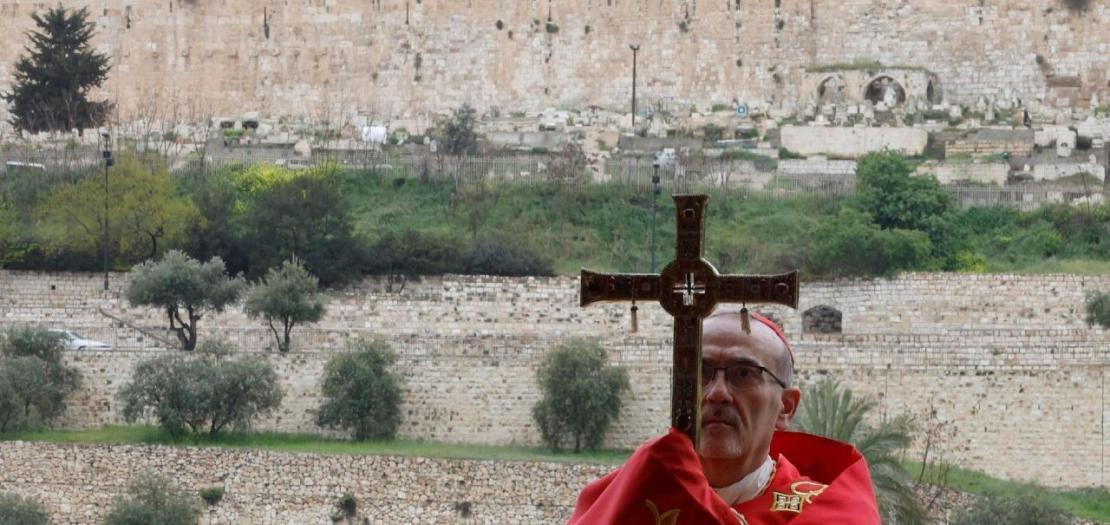
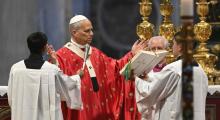
File photo of Cardinal Pizzaballa holding a prayer service to mark Palm Sunday, in Jerusalem
Cardinal Pierbattista Pizzaballa, Patriarch of Jerusalem, issued a pastoral letter on April 27, 2026, during this important time that marks a decade of his presence in the service of Jerusalem.
The depth of the letter and its grounding in the Holy City derive from Cardinal Pizzaballa’s own personal journey in Jerusalem, having first arrived 30 years ago. He served as an apostolic administrator before becoming the Latin Patriarch of Jerusalem, as well as being appointed as a cardinal of the Catholic Church.
Amidst crises, he continues a noble presence of supporting the poor and young people and of repeatedly visiting Gaza during and in the aftermath of the war.
The letter bears the title “They Returned to Jerusalem with Great Joy”, and is subtitled "A Proposal for Living the Vocation of the Church in the Holy Land.”
Addressed to the Latin Patriarchate of Jerusalem, Patriarch Pizzaballa's letter contains both a practical and a spiritual character while repositioning the Church's vocation in the Holy Land at the top of priorities. These priorities consist of staying, being present, healing, and openness.
The Latin Patriarchate of Jerusalem spans several geographic locations that include Jordan, Palestine, Israel, and Cyprus.
Patriarch Pizzaballa begins his letter with a sincere reading of the current situation in the Holy Land. The letter acknowledges the challenges of recurring wars, social fragmentation, waves of forcible displacement, poverty, and daily hardships imposed by the reality of occupation.
Reading the reality
In the letter’s first section titled "Reading the Reality," Patriarch Pizzaballa seeks to attain a deeper understanding rather than passing a quick judgment in response to these challenges. He emphasizes that what is happening is not a fleeting moment, but rather a reality that could become part of the culture of the Holy Land if left unaddressed. Thus, reading the reality is not to harbor pessimism, but to form the foundation for practical pastoral thinking.
The Latin Patriarch places "Jerusalem" as a reference model, as the heavenly city descended from Heaven. This, therefore, commits us to uphold a community rooted in a relationship with God, which embodies the dignity of humanity.
It is the continuous divine presence of the Holy City “coming down out of heaven from God " that makes the Church a space for encounter rather than a fortress of exclusion. To have its doors open and to “heal our collective memory” are starting points where reconciliation is valued over weapons designed for conflict.
In the Arabic version, the translator adds an important note, indicating that the word “Urashalim” in the letter has neither political connotations nor does it refer to the city as it exists today. But rather, it refers to the ancient Biblical name of Jerusalem as it appears in the Holy Bible, particularly in the Book of Revelation. When referring to the city in its present sense, the translator notes that it is referred to as "Al-Quds."
The letter identifies worship with daily life. Liturgy and prayer are not a means to attain another end. Instead, they are the heart of the ecclesial life and the source of renewal that enables the Church to touch reality with the lightness of love.
Practical directives
From this premise, clear practical directives emerge, such as fostering public and private prayers, nurturing families as "domestic churches," supporting schools that cultivate openness, and preserving the character of healthcare and social welfare institutions as sites of dialogue and healing.
The Latin Patriarch borrows the language of the Book of Revelation. He sees "the leaves of the tree that are for the healing of the nations” in the services rendered by hospitals, clinics, Caritas, and care homes. They represent a genuine embodiment of Jerusalem's vocation in communal healing without religious or ethnic discrimination. This quiet service, according to Patriarch Pizzaballa, is what creates common ground for encounter among peoples and religions.
The letter is devoted to the major ethical themes: the rejection of violence as a non-negotiable value, the re-reading of historical memory as a necessary spiritual work (liberating memory from its poisons), and the value of interfaith dialogue not as a luxury but as an existential necessity in a land of numerous identities.
The letter calls for courage and patience. Patriarch Pizzaballa encourages us to form a "dialogue of life" rather than "a dialogue of elites" and to commit ourselves to daily practices that teach encounter and openness in lieu of isolation and seclusion.
Resisting the logic of war
His positions dare to resist the logic of war. In the Holy City, the Latin Patriarch experienced being banned from celebrating Palm Sunday at the Church of the Holy Sepulchre. The reflection of the symbolism of his office and the experience of service amidst violence lends the letter both authenticity and urgency.
As we read Patriarch Pizzaballa's pastoral letter, we must also recall an earlier and influential pastoral letter written by emeritus Latin Patriarch of Jerusalem Michel Sabbah in 1997, on "Reading the Bible Today in the Land of the Bible."
Sabbah's letter was a reminder that the sacred text is understood differently when living in the context of one’s own land. Today, Pizzaballa completes that with a pastoral step. From textual reading, we now need to apply the vision of a living Gospel that keeps the Church present across the Earth, where we transform Biblical heritage into a program of life, care, and accompaniment.
A pastoral roadmap
The significance of this pastoral letter and its call for action lies in Cardinal Pizzaballa's merging of personal reflection and evangelical spirituality. It offers a concrete pastoral roadmap of protecting the Christian presence in the Holy Land, caring for the poor and the marginalized, educating new generations to accept openness, and creating a culture of healing and dialogue.
It is an invitation to return to Jerusalem, not merely a geographical return but a re-creation of the city’s heart, memory, and Christian commitment. A city whose gates are open, illuminated by the light of Easter, and where its people sow seeds of peace that heal nations.