Issued by the Catholic Center for Studies and Media - Jordan. Editor-in-chief Fr. Rif'at Bader - موقع أبونا abouna.org

Al-Wahadneh: One hundred years of faith and common living
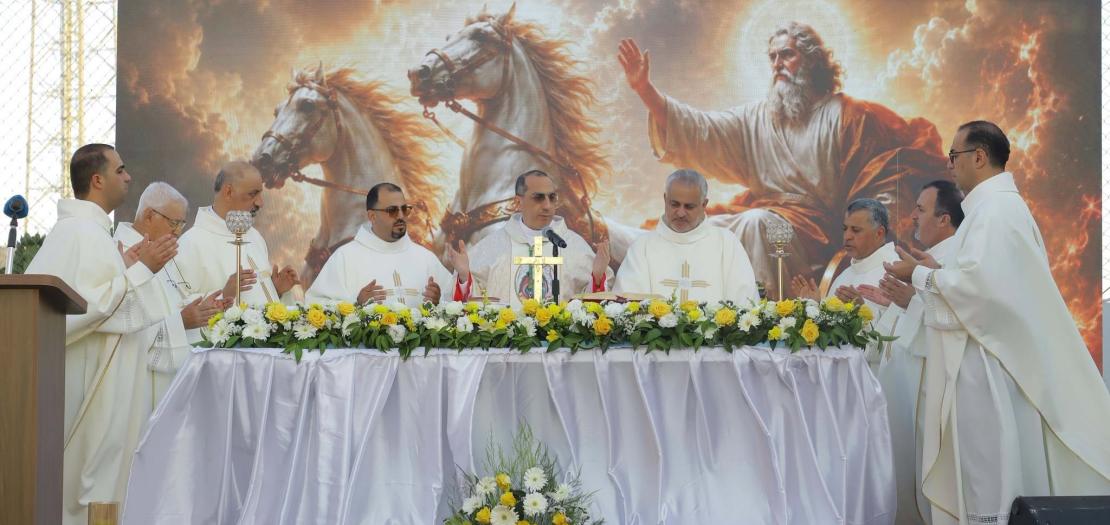
This year, the Latin Parish and the Church of St. Elijah in Al-Wahadneh, northern Jordan, celebrates the centenary of its founding (1926–2026), marking a full century of faith, benevolence, and service in a homeland that has always been a model of common living between Muslims and Christians.
Al-Wahadneh is situated on the slopes of Ajloun Mountains, overlooking the Jordan Valley and northern Palestine, in a region associated with Prophet Elijah, the patron saint of the parish whereby according to tradition, the neighboring village of Listib is identified with Tishbe in Gilead, Elijah's birthplace, while the nearby Wadi Al-Yabis is believed to be the place where he sought refuge during the drought. The Latin Patriarchate's interest in Al-Wahadneh dates back to the late 19th century, when Fr. Theobald Navone visited the village in 1889 prior to the official establishment of the parish in 1926 at a time when roads were rugged and journeys could only be made on foot or horseback. Despite these challenges, the Latin Patriarchate of Jerusalem strived to bring the Church's mission to people wherever they lived. Thus, it sent priests and accompanied the community with parental until 1945 when Fr. Ya’coub Sa’adeh became the first resident parish priest, and consequently ushering in a new era of stability and growth.
The parish was served by devoted priests who proclaimed the message of the Gospel with humility and dedication, as every one of them contributed not only to the construction of buildings but rather gave priority to serving humans. Furthermore, significant milestones in the parish's history included the construction of the priest's monastery between 1947 and 1948 by Fr. Ya’coub Sa’adeh, then building the parish school in 1961, and the building of the present church by Fr. Khalil Bdewi. The church was dedicated by Patriarch Alberto Gori on August 5, 1964, becoming both a house of prayer and a visible sign of the Church's presence in the region.
Since the Church's mission is inseparable from education, the Latin School, and later the kindergarten, became among the parish's greatest achievements as educated generations of young people from Al-Wahadneh served Jordan in several fields. In 1992, the Rosary Sisters came to the village, marking another bright chapter in the parish's history, as they conveyed a message of education and social outreach with love and unwavering dedication.
One of the most remarkable characteristics of St. Elijah Parish is that it has never been merely a community that is confined to pastoral care, but rather became a parish that generates vocations. Although relatively small in number, it has produced one of the highest numbers of priestly and religious vocations within the Latin Patriarchate. Many priests from this parish have served the Church in Jordan, the Holy Land, and the world at large, while numerous women have dedicated themselves to the service of both the Church and humanity.
The centenary celebration was not merely an occasion to remember the past, but rather a proclamation that this parish remains vibrant with faith and benevolence. The people of Al-Wahadneh, together with friends and guests from various parts of the Kingdom marked this anniversary in a solemn ceremony presided over by Latin Patriarchal Vicar for Jordan Bishop Iyad Twal, and organized by parish priest Fr. Salam Haddad. On that evening, renowned Lebanese singer Christiane Najjar, accompanied by the distinguished Jordanian musician Harran Hijazin, performed an evening of hymns.
The following day, His Beatitude Cardinal Pierbattista Pizzaballa, Latin Patriarch of Jerusalem, celebrated the solemn Mass marking the Feast of St. Elijah, patron of both the parish and the region at the renowned archaeological site of St. Elijah, where the Byzantine church, was dedicated in A.D. 622.
Consequently, the centennial of the St. Elias Parish in Al-Wahadneh was not merely a celebration marking the passage of time, but rather a celebration of the continuity of its mission—the mission of the Church to serve people through faith and education, as well as the mission of Jordan in offering the world a unique model of national unity. In Al-Wahadneh, common living is not confined to slogans as it is embodied in everyday life, where St. Elias Church stands alongside the historic Lustib Mosque, a scene that reflects a long history of fraternity and mutual respect between Muslims and Christians. It is an authentic Jordanian message, one that deserves to be conveyed to future generations and be presented to the world as a genuine model of a nation that forges its unity from its diversity and draws its strength from its people.