Issued by the Catholic Center for Studies and Media - Jordan. Editor-in-chief Fr. Rif'at Bader - موقع أبونا abouna.org

“When two periods of fasting coincide”
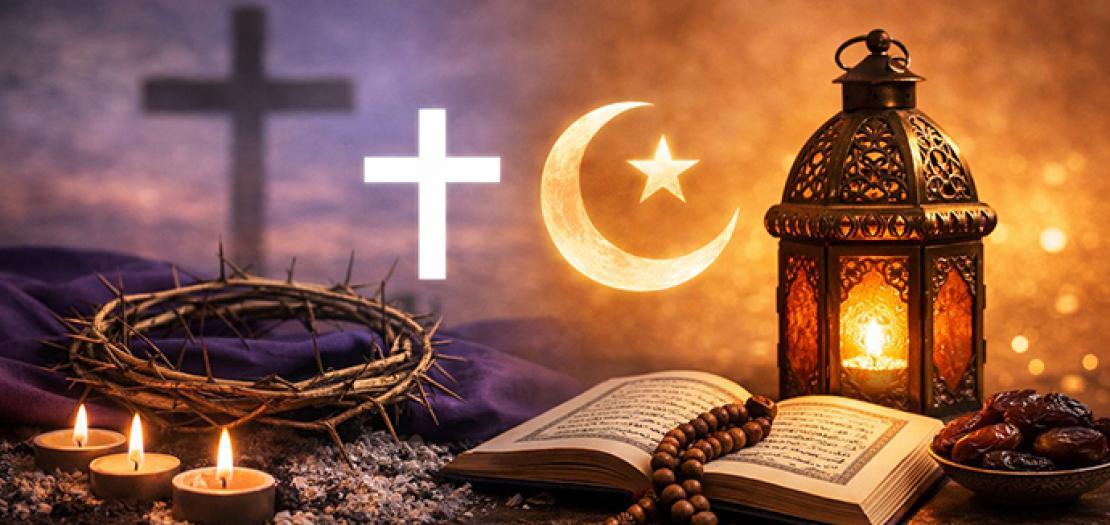
This year, the blessed month of Ramadan for Muslims coincides with the Lenten Season for Christians marking a rare spiritual moment filled with a profound significance. The overlap of these two great fasts in Islam and Christianity is not limited to abstaining from food and drink; it rather opens a horizon to reflect on the deeper meaning of fasting in its capacity as a shared moral school that refines a person’s speech, vision, and attitude towards others, as well as strengthens the conviction that human fraternity is a treasure we must care for and pass on to future generations.
In this context, in his first Lenten message, Pope Leo XIV highlights what might be called “the fasting with tongues and ears.” In the Christian understanding, true fasting is not fulfilled through physical abstinence alone; it is rather fulfilled through discipline in speech by refraining from gossip, condemnation, and spreading of rumors. A tongue that fasts from expressing harsh words, and an ear that fasts from entertaining gossip help build a more humane and peaceful environment. Words can cause wounds more deeply than a sword does, and rumors can destroy trust built over years. Fasting thus becomes a training. His Holiness says: “Dear friends, let us ask for the grace of a Lent that leads us to greater attentiveness to God and to the least among us. Let us ask for the strength that comes from the type of fasting that also extends to our use of language, so that hurtful words may diminish and give way to a greater space for the voice of others.”
This significance finds a clear echo in Islam, where the Prophetic tradition teaches: “Whoever does not give up false speech and acts upon it, God has no need for him to give up his food and drink.” At its core, fasting is a cultivation of conscience, a purification of the soul, and a disciplining of one’s actions. From this premise, the two fasts meet in a shared vision, namely abstaining from food is a means, but the goal is a person who is more truthful, more compassionate, and more sincere.
From another perspective, one can consider the recent remarks made by Her Majesty Queen Rania Al Abdullah in New Delhi on humility in its capacity as an extension of this spiritual significance of fasting. Fasting is not only about restraining physical desires; it is also a liberation from pride and self-importance. Humility is not weakness but a moral strength that recognizes the dignity of others and rejects condescension or hatred. In a world increasingly shaped by polarization and inflated egos, “fasting from arrogance” becomes a spiritual and social necessity. As Her Majesty said: "To understand humility, consider its inverse: Overconfidence, arrogance, an inflated sense of one’s abilities, as well as the failure to reflect, regroup, and accept shortcomings.”
In Christian tradition, humility stands at the heart of the Gospel life, as it is embodied in the image of Christ being gentle and humble of heart. In Islam, the Koran warns against arrogance and calls on people not to walk upon the earth with pride. Both traditions link closeness to God with humility before others. In this regard, fasting emerges as an inner procession that reorders a person’s relationship with oneself and others, this teaches us to see in our neighbor a brother or sister rather than an adversary, a partner in humanity rather than an object of judgment and condemnation.
This significance also takes on a dialogical dimension in light of the annual message that Vatican addressed to Muslims marking the advent of Ramadan, usually issued on the first Friday of the month. That message goes beyond offering greetings. It rather emphasizes shared values, namely prayer, fasting, charity, serving the poor, and working for peace. It reflects a firm conviction that religions, when they restored to their ethical core, they become bridges rather than walls.
The coincidence of these two fasting periods this year is a precious opportunity to transform fasting from a seasonal practice into a lasting moral commitment, namely a fasting from hurtful words, from ears enjoying gossip, and from hearts swollen with pride. Only then fasting truly becomes a path toward a humbler person, a more compassionate society, and a more peaceful world.
Have a blessed Ramadan and a blessed Lenten season.