Issued by the Catholic Center for Studies and Media - Jordan. Editor-in-chief Fr. Rif'at Bader - موقع أبونا abouna.org

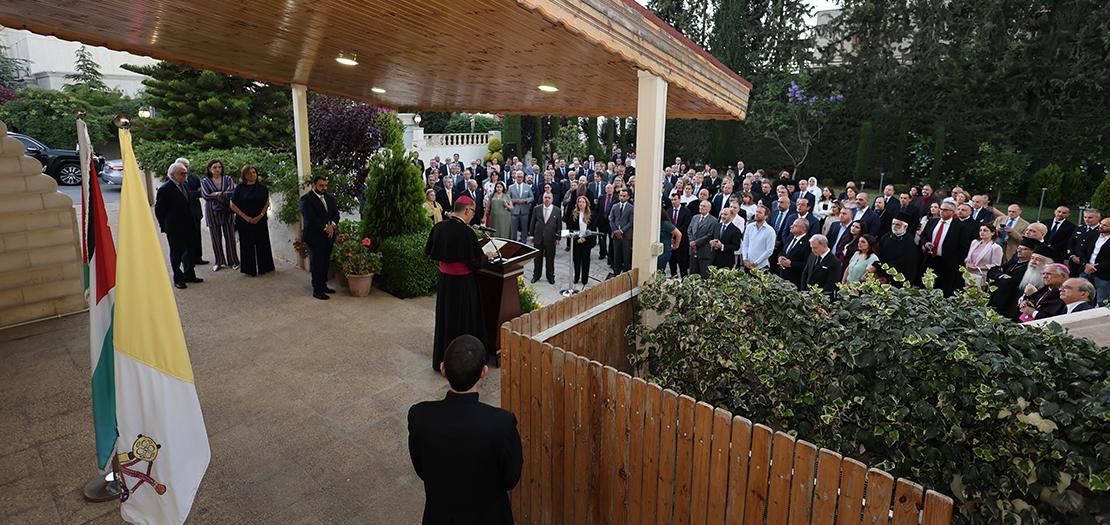
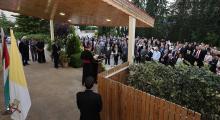
The Apostolic Nunciature in Amman has celebrated the national day of the Holy See, which coincides with the Feast of Saints Peter and Paul, during a reception held at the Apostolic Nunciature and attended by official, diplomatic, and religious figures.
In an address delivered during the celebration, Apostolic Nuncio to Jordan Archbishop Giovanni Dal Toso welcomed the attendees, noting that by appointing him as its first resident nuncio to Jordan, the Holy See wished to emphasize the growing importance it attaches to the Kingdom of Jordan, “with which we share a common vision regarding common living among individuals and peoples.”
He added that Jordan, for its part, has demonstrated its appreciation for the Holy See, and recalled His Majesty King Abdullah II’s visit to Pope Leo XIV last October, as well as the meeting that brought together His Royal Highness Prince El Hassan Ibn Talal and the Royal Institute for Inter-Faith Studies with the Vatican’s Dicastery for Interreligious Dialogue.
Apostolic Nuncio Dal Toso stressed that the fundamental message shared by Jordan and the Holy See is the “defence and enhancement of human dignity.” He referred to Pope Leo XIV’s recent encyclical, “Magnifica Humanitas”, the first major document of his pontificate, which addresses the issue of artificial intelligence with respect to human dignity.
He pointed out that the Pontiff emphasized that human beings “must not become victims of autonomous automated systems or systems controlled by a limited number of people,” affirming that artificial intelligence should remain a tool at the service of humanity and for the enhancement of human dignity, since the human person “remains the true agent of every activity worthy of being called human.”
He also noted that during his recent apostolic visit to Spain, the Pope recalled the contribution of the School of Salamanca in the 16th century, particularly the Dominican Fathers, to the development of the concept of the Law of Nations in its capacity as a shared legal foundation for human dignity, which is a concept rooted in Christian revelation.
Addressing the developments in the region, Archbishop Dal Toso said that the Holy See continues to raise its voice in defence of human dignity amidst the ongoing crises, while calling for peace and respect for international law as well as humanitarian law. He added: “The Holy See may not possess military, economic, or political power in the conventional sense, but we recognize that common living among peoples and nations is not sustainable without a moral foundation based on shared values.
He stressed that the Holy See works tirelessly in order to entrench this common foundation, stressing that the shared problems require shared approaches. Consequently, the importance of multilateralism and international cooperation, as well as the role religions should play in promoting common living rather than fueling hatred and division, in pursuit of peace through justice.
In this context, Archbishop Dal Toso expressed his appreciation for the humanitarian efforts exerted by the Hashemite Kingdom of Jordan in the region, with particular reference to the Gaza Strip. He also noted that the Holy See’s commitment to defending human dignity has made it intervene repeatedly on behalf of Gaza and other war-affected areas.
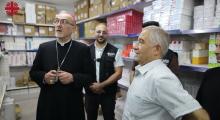
He said, “I would like to express my gratitude to Jordan for its relief efforts in the region,” and recalled the visits paid two days ago to Gaza by Cardinal Pierbattista Pizzaballa, Latin Patriarch of Jerusalem with the Greek Orthodox Patriarch of Jerusalem to Gaza, as well as the assistance extended by Catholic institutions operating from Amman. He also called for continued prayer for peace.
The Apostolic Nuncio also highlighted the role played by the Catholic Church in Jordan, referring to its contributions through its schools, hospitals, educational and charitable institutions, in addition to its care for holy sites and the historical heritage of Christians in the Kingdom. He continued that “Christians are an integral part of the Jordanian society,” and expressed concern over their declining numbers in the region, and underlined the importance of preserving their presence and role.
Furthermore, he referred to the ongoing preparations to mark the celebration of the second millennium of the Baptism of Lord Jesus Christ in the Jordan River in 2030. He asserted that this occasion enjoys the interest of His Majesty King Abdullah II, who seeks to highlight its significance in its capacity as a confirmation of the deep-rooted Christian presence in the Kingdom. Adding that “the Catholic Church will also contribute to commemorating this important anniversary,” he expressed his appreciation for King Abdullah II and praised his continued support for this initiative.
Concluding his address, Archbishop Dal Toso thanked the attendees for their participation and cooperation, as well as expressed gratitude to the staff of the Apostolic Nunciature for their ongoing support and wished everyone a blessed feast and a pleasant evening.