Issued by the Catholic Center for Studies and Media - Jordan. Editor-in-chief Fr. Rif'at Bader - موقع أبونا abouna.org

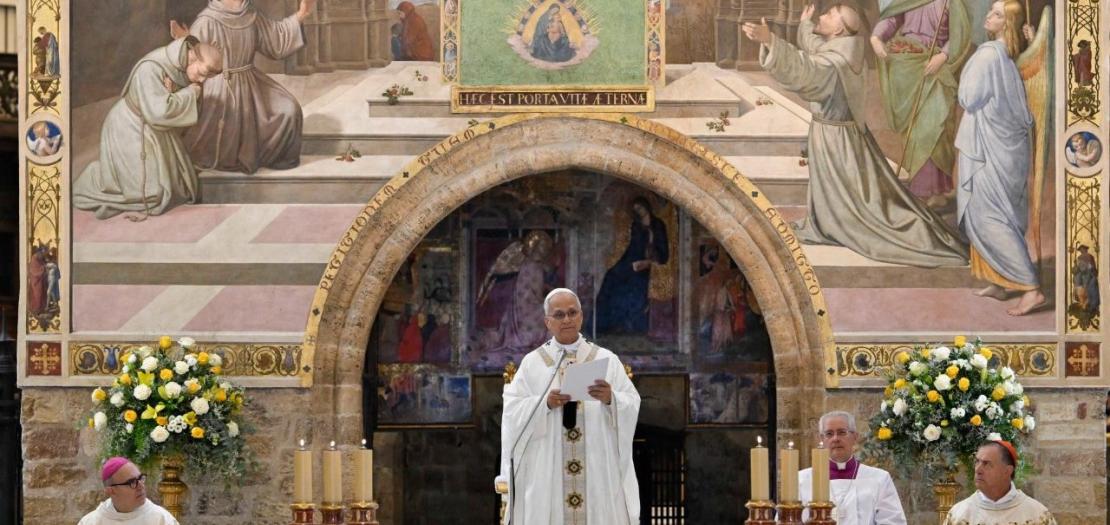
Pope Leo celebrated Mass on Thursday, August 6, for the thousands of young people from across Europe gathered in Assisi for Go!,the 2026 Franciscan Youth Meeting.
At Mass in the Basilica of Saint Mary of the Angels, the Pope encouraged his young listeners to go “to the margins” of society, “where the injustice and arrogance of a few deny the dignity and dreams of many”.
“We are called to read the Scriptures with the Master,” Pope Leo said, “to interpret our times, and to make decisions as we walk in His footsteps. We are here to overcome resignation and fear, to untangle the doubts that hold us back just as they held back the apostles. Jesus calls us into a dialogue with His story so that we may write new pages of history.”
Assisi is a place where “everything whispers that our lives can be transformed, unleash light, and repair the world,” the Pope said, reminding his listeners that it was here in Assisi that “the transfiguration of Francis, of Clare, and then of thousands of other young people” first began.
Pope Leo began his homily by considering the Feast of the Transfiguration of the Lord, which the Church marks today.
Jesus, the Pope said, was “transfigured precisely in conversation with the Father, with those who preceded him — Moses and Elijah — and with his contemporaries, the disciples.”
The Church exists, Pope Leo said, “to draw us into this dynamic of listening and deciding, helping us understand for whom to live and how to live.”
The Church is “the community where we learn to distinguish the voice of God”, the Pope stressed, “and to dare that obedience to the Holy Spirit that made bold and creative all those who agreed to follow Jesus.”
While St Francis’ choice to turn away from the world was revolutionary, St Clare’s was “even more striking”, Pope Leo said. Like Francis, Clare “wanted to live … in true freedom”, and this, the Pope explained, is the "energy" of Christianity - “that of beginnings and many fresh starts”.
“And so, dear young people, today Europe and the whole world are looking to you for new saints: dare to believe in the word of the Gospel, become fully human with the freedom of Jesus Christ, and embrace Sister Poverty! The title of your gathering—Go!—is a mission, a sending out onto roads for which we have no maps, because they open up as we listen to the heart, obey the Spirit, and follow the Risen Lord where He has chosen to go before us.”
All of this must be done without keeping our distance “from the wounds of the Lord,” as Pope Francis warned, Leo continued, quoting Evangelii gaudium, in which his predecessor stresses that “Jesus wants us to touch human misery, to touch the suffering flesh of others. He expects us to stop looking for those personal or communal niches that allow us to keep our distance from the heart of human suffering.”
Even if his listeners "might not be understood, even by those in your own home—just as happened to Saint Francis,” the Pope stressed that “stepping away from the culture of power and tearing down the walls that divide human beings is never a betrayal of family, city, or tradition.”
Rather, he said, it serves to free us "from their ghosts, from enemies invented out of fear and ignorance, and from the violence that seeks to impose its own neat little order on a reality that vastly exceeds us on every side.”
“To trust in God is to discover, like Francis and Clare, a world of brothers and sisters to be appreciated and served, not exploited and dominated,” the Pope said. “Not a world to be defended, but one to be embraced.”
Gratitude for papal visit to Assisi: 'Today we feel we are the Church'
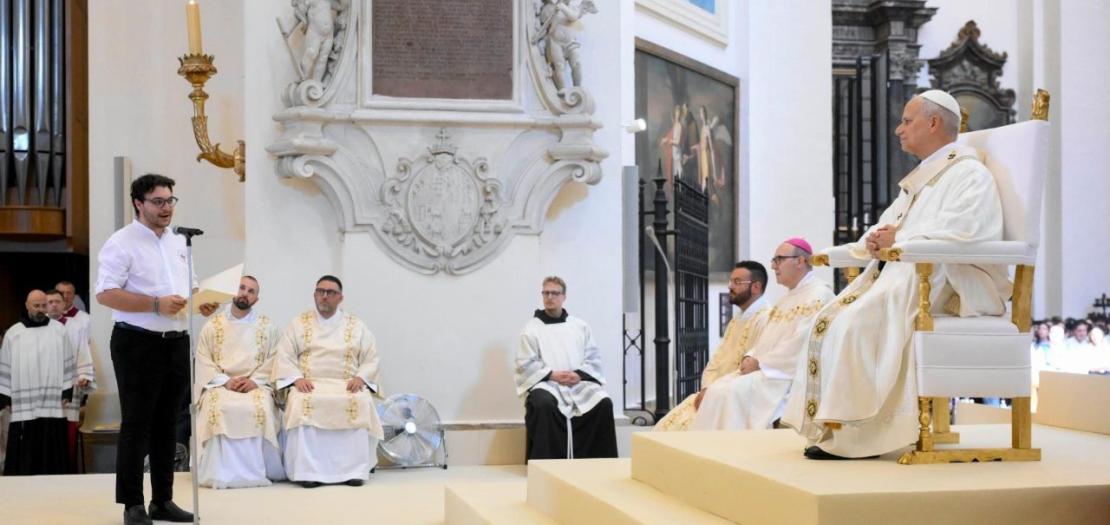
Pope Leo XIV's visit to Assisi was "an embrace," "a sign that the Successor of Peter walks alongside the People of God, sharing in their hopes and struggles." With these words, at the conclusion of the Mass presided over by the Pope in the Basilica of Santa Maria degli Angeli, and before the final blessing, one of the young people, Francesco Varone, addressed the Pope to thank him for his visit to Assisi.
His presence, Varone said, encourages young people not to be afraid "to choose what is good and to believe that the Gospel can still change the human heart."
Varone gave voice to "the pain of fragmentation and the fear of loneliness" experienced by so many young men and women. Precisely for this reason, he said, the experience in Assisi had been deeply formative. In the city of the Poor Man of Assisi, young people had been able "to experience firsthand that Jesus keeps us united, that we are not alone"—just as Pope Leo's episcopal motto proclaims: In Illo uno ("In the One, we are one"). In Christ, "no one is a stranger, no one is excluded"; rather, all are "true brothers and sisters, not by chance, but because we are children of the same Father."
Finally, Varone asked the Pope for one particular gift, one "that children ask of their father"—that he "not forget to pray for us."
"Pray that we may never lack the courage to choose Christ," Varone said, "that we may know how to recognize His voice amid the noise of the world, and that our youth may become a life given in service."
"Thank you, Holy Father, because today you make us feel that we are the Church," the young man concluded.