Issued by the Catholic Center for Studies and Media - Jordan. Editor-in-chief Fr. Rif'at Bader - موقع أبونا abouna.org

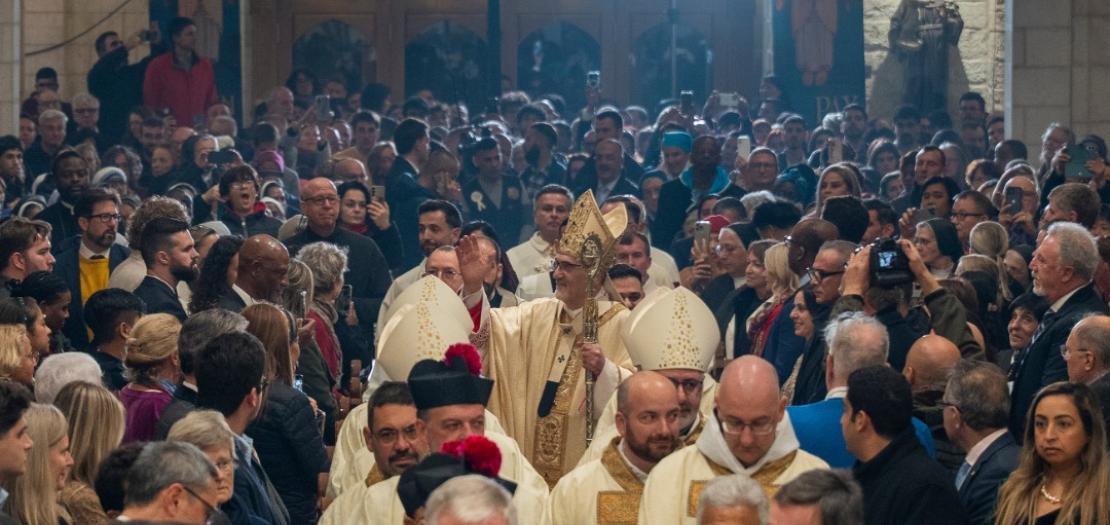
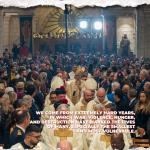
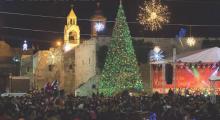
After two years of extreme difficulty, Bethlehem returned today to experience Christmas in a joyful, festive and widely shared celebration. The 2025 celebrations marked a slow but meaningful rebirth for the city: first, with the solemn entrance of the Custos of the Holy Land, Fr. Francesco Ielpo, who officially opened the path of Advent, then, on 6 December, with the traditional lighting of the tree in Manger Square, a moment that restored symbolic light to the heart of the city and gathered families and visitors in an atmosphere of expectation and hope. Finally, today, on Christmas Eve, the faithful, pilgrims and tourists present in the city warmly welcomed the Latin Patriarch of Jerusalem, Cardinal Pierbattista Pizzaballa, transforming the streets into one great collective embrace.
The parade and the reception of those present
After the parish welcome near the separation wall of Bethlehem, which divides the city and separates it from the Tomb (and Synagogue) of Rachel, the Patriarch reached the beginning of the famous "Star Street", the street of the star.
Here, an immense and festive crowd awaited him: families, religious, scouts, young and old, united in a welcome made of smiles, handshakes, applause, songs and flags. The Scout groups of Bethlehem, gathered near the Catholic Action centre, began the parade once the Patriarch stepped out of the official car to begin the traditional walk on foot. From that moment, the procession took on the rhythm of a vibrant popular celebration, accompanying the Cardinal all the way to Manger Square.
Arriving in the square, Pizzaballa addressed words of hope, gratitude and affection to those present, recalling the recent meeting with the community of Gaza and spiritually linking the wounds of the Holy Land to a universal need for peace. He strongly reaffirmed that, despite the difficulties, he sees a light that does not surrender to darkness. That light, he explained, is the very people present there, those who choose life, dignity, hope, fraternity, and who do not give up rebuilding, believing and walking forward. The message was received in profound silence, followed by a long applause that crossed the entire square.
The entrance into the Nativity
On the churchyard of the Basilica, the Patriarch was greeted by the friars of the Custody of the Holy Land, guardians of the Holy Site. This moment carried a deep symbolic value, highlighting the continuity of the Franciscan presence in the Nativity and their daily service to the Christian community.
The first to greet him was the Nativity Guardian, Fr. Marcelo Cicchinelli, who welcomed the Patriarch before he entered St. Catherine's Church, adjacent to the Basilica of the Nativity. Here, Cardinal Pizzaballa recited the first Vespers, officially beginning the night prayer, while the entire city awaited the Midnight Mass.
The solemn and composed Vespers liturgy served as a bridge between the festive streets and the mystery of the silent Basilica, reminding all that Christmas in Bethlehem is not only popular tradition, but above all the memory of a God who enters history and transforms it from within.
Christmas Mass
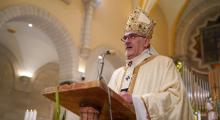
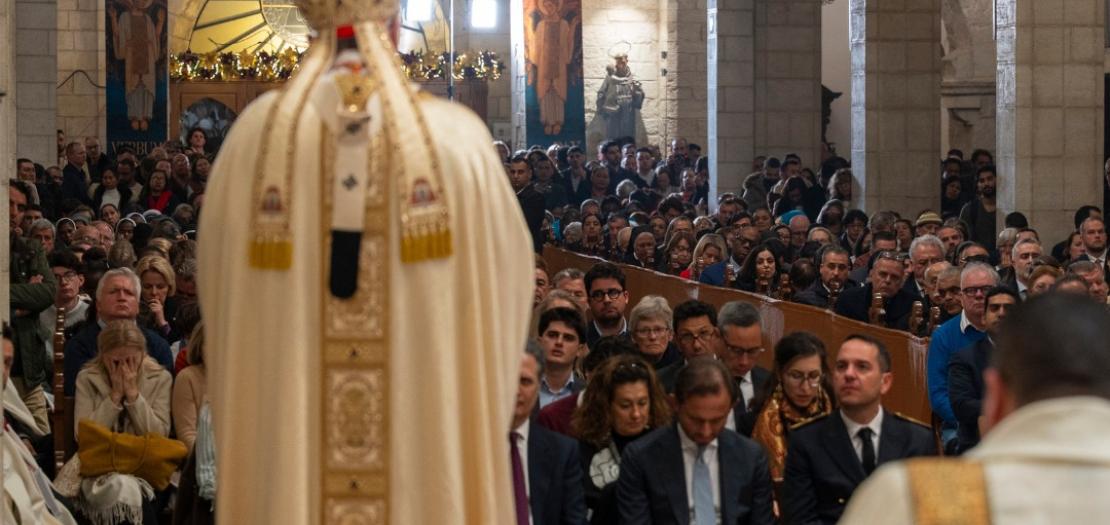
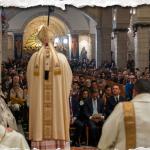
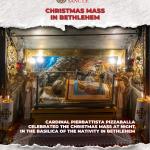
The Basilica of the Nativity in Bethlehem once again became the spiritual centre of Christmas. During the night, Cardinal Pizzaballa presided over the solemn Christmas Mass, a rite of universal value celebrated in the exact place where Christian tradition locates the birth of Jesus.
The Patriarch’s homily opened with a powerful historical and theological reflection. He underlined how the Gospel does not escape reality but dwells within it: "Luke places the birth of Jesus inside the great history of the world. God is not afraid of human history, not even when it is confused, marked by injustice, violence and domination." He reminded all that Christmas was born not in a peaceful era, but within reality, even when wounded. From the biblical readings, a clear message emerged: the light does not erase the night, but crosses it.
One of the most quoted passages was the reference to the decree of Caesar Augustus, read as a symbol for all ages:
"The decree of Caesar seems to dominate the scene. And yet, without knowing it, that decree becomes the instrument of a greater design." And again: "God does not wait for history to improve before entering it. He enters while history is what it is."
The hardships of the Holy Land were not ignored: "The choices of the powerful have concrete consequences for the lives of millions. The Holy Land is witness to this." Words that strongly resonated among local believers.
The Patriarch then turned his reflection to the Gospel passage on the shepherds:
"The Gospel shifts its gaze from the powerful to the shepherds in the fields, simple men, often invisible, who represent ordinary life and daily toil." And he added: "God does not reveal Himself to the privileged, but to the seekers, not to those who own, but to those who watch." The Patriarch reminded all that Christmas is not a refuge from the present but a school of responsibility:
"Christmas is not a spiritual refuge that removes us from the burdens of the present, but a school of responsibility."
Every act of peace, every reconciled word, every gesture that does not fuel hatred becomes a concrete incarnation of God's peace in history. The focus then shifted to Gaza, visited by the Patriarch in the previous days:
"I was struck by the strength of the people, by the desire to begin again. They are living a special Christmas, of new birth."
The homily reached its climax in the theme of light:
"The light of Bethlehem does not blind, it illuminates the path. It passes from heart to heart, through daily choices of peace." And in the great proclamation of the angels, cited as the compass of the celebration: "Glory to God in the highest, and on earth peace to men whom He loves" (Lc 2:14). A peace given, but not imposed, entrusted to human freedom.
At the end of the celebration, the Patriarch entrusted the Holy Land to the blessing of the Child: "May the Child born in Bethlehem bless this land and all its peoples. Bless every family that suffers, every wounded child, every man and woman weary under the burden of the present. The light shines in the darkness, and the darkness has not overcome it."
The procession in the Grotto
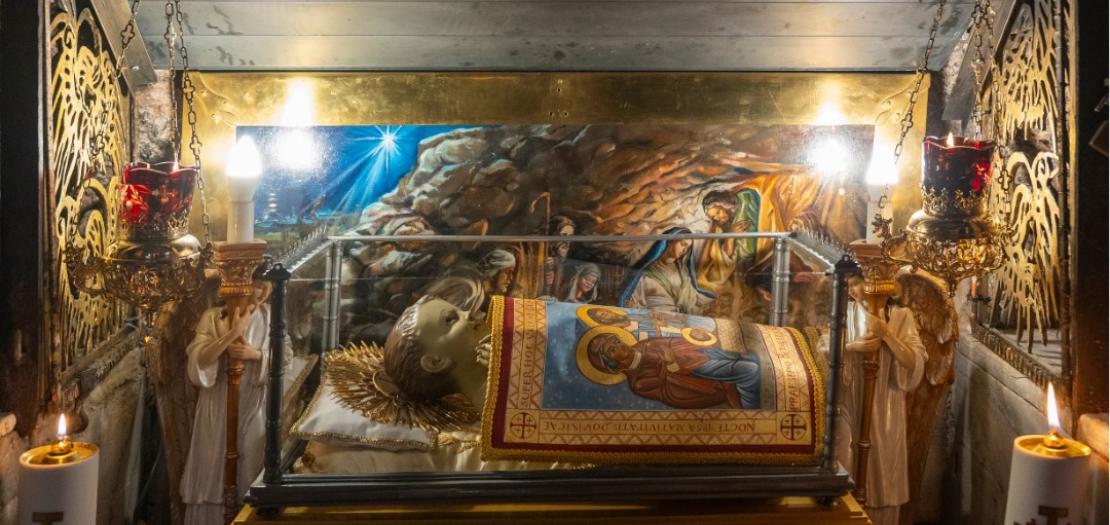
At the end of the celebration, the Patriarch descended into the Grotto of the Nativity together with the priests who concelebrated the Mass. There, he placed the statue of the Child Jesus upon the silver star marking the birthplace. After the reading of the Gospel, he placed the statue in the "Manger", offering incense and concluding the celebration with the blessing once he returned to St. Catherine’s Church.